

Maddy summaryHR 3498, the Henrietta Lacks Congressional Gold Medal Act, authorizes a commemorative gold medal to honor Henrietta Lacks for her contribution to science through her immortal HeLa cells. The bill directs the Treasury Secretary to strike the medal, which will be presented posthumously by Congress and displayed at the Smithsonian Institution. It also permits the sale of bronze duplicates to cover costs, with proceeds going to the U.S. Mint fund. This is a ceremonial recognition of Lacks' legacy, not a policy change affecting any group or requiring new regulations.
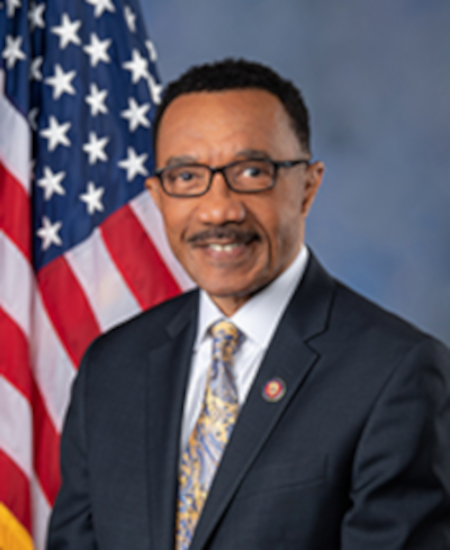
Rep. Kweisi Mfume
Sponsored bills
Stronger Communities through Better Transit Act This bill requires the Department of Transportation (DOT) to establish a grant program to support operating projects for public transportation and related service improvements, particularly in underserved communities and areas of persistent poverty. Specifically, the bill requires DOT to allocate funding under the program for urbanized areas, states, and Indian tribes that are recipients of funds under either the Federal Transit Administration's (FTA's) Urbanized Area Formula Funding program or Formula Grants for Rural Areas program. Eligible recipients may use funding for operating costs associated with projects that improve public transportation service for transit-dependent populations and support increased transit ridership (e.g., service expansion, information technology enhancements, and workforce development). DOT must apportion the funding so that recipients receive funds that are proportional to their share of operating costs. The bill also provides for an increased federal cost share for operating assistance for projects or programs carried out in areas of persistent poverty or underserved communities. DOT must set up a multimodal access measurement interface for public agencies to aid transit agencies in determining and reporting on access to jobs and essential services. A grant recipient must (1) report specific information to the FTA for inclusion in the National Transit Database, and (2) survey transit riders and non-riding residents regarding transit service improvements. Further, the bill expands the purposes of the public transportation programs to include supporting public transportation's role in combating climate change through growing/retaining transit ridership.
Maddy summaryHR 3376 creates the Water Affordability, Transparency, Equity, and Reliability Trust Fund, funded by increasing the corporate tax rate from 21% to 24.5% starting in 2025, with annual funding capped at $35 billion or 1/20th of 20-year infrastructure needs. The bill allocates funds to clean water programs (42%), safe drinking water programs (42.5%), household water well systems (1%), colonias assistance (0.5%), and Indian health services (3%), requiring specific prioritization of low-income and minority communities for many programs. It mandates an EPA study on water affordability, discriminatory practices, and civil rights violations in water service, including data collection on service disconnections affecting vulnerable populations. The bill also includes provisions for lead service line replacement, PFAS contamination response, and job training grants for water system operators with specific requirements to prioritize low-income communities.
Maddy summaryHRES 403 is a non-binding resolution expressing the House of Representatives' support for public servants. It commends federal, state, local, and uniformed service employees for their contributions during Public Service Recognition Week (May 4-10, 2025) and throughout the year. The resolution highlights their roles in areas like national defense, emergency response, Social Security, public health, and infrastructure. It urges the House to salute their dedication, honor those who lost their lives in service, and encourage promoting public service careers. This resolution does not create new policies or funding - it is a symbolic gesture of recognition.
Maddy summaryHR 3277, the Ensuring Lasting Smiles Act, requires group health plans and health insurance issuers to cover medically necessary outpatient and inpatient treatments for congenital anomalies or birth defects primarily affecting the eyes, ears, teeth, mouth, or jaw. This includes reconstructive procedures, dental/orthodontic support during treatment, and follow-up care, but excludes purely cosmetic surgery not tied to a medical diagnosis. Cost-sharing (like copays) for these services must not be stricter than for other medical benefits. The law takes effect for plan years beginning January 1, 2026, and mandates insurers to provide notice about this coverage to beneficiaries.
Maddy summaryThe MIL FMLA Act expands the Family and Medical Leave Act to provide military families with additional leave options. It allows eligible employees to take up to 26 workweeks of leave during a 12-month period to care for a covered servicemember (active duty member or veteran), regardless of the employee's family relationship to the servicemember. The bill adds new definitions to include domestic partners, grandparents, siblings, and other extended family members as eligible caregivers, and creates a new "veteran leave" provision for employees who are covered servicemembers needing leave due to service-related serious injury or illness. These changes aim to better support military families by providing more comprehensive leave options for caregiving needs related to military service.
Maddy summaryHR 3306, the Truth in Tariffs Act, requires retailers selling goods to U.S. consumers to clearly display the portion of a product's price caused by applicable tariffs (called a "tariff surcharge"). This applies to most retailers but exempts small businesses as defined by the Small Business Act. The Federal Trade Commission (FTC) will enforce this rule, treating violations as unfair or deceptive practices under existing law, with penalties similar to those for other FTC violations. The law takes effect 30 days after enactment, covering tariffs imposed by the President after January 20, 2025.
Maddy summaryHR 3243, the Therapeutic Fraud Prevention Act of 2025, bans the provision of paid conversion therapy aimed at changing a person's sexual orientation or gender identity, and prohibits advertising such therapy as effective, safe, or without risk. It directly affects LGBTQ+ individuals and their families who might be targeted by these practices, as professionals have determined conversion therapy is ineffective and harmful. The law treats violations as deceptive acts under consumer protection laws, empowering the Federal Trade Commission and state attorneys general to enforce it through civil actions. It explicitly excludes legitimate gender transition support and non-discriminatory counseling from the ban.
Maddy summaryThis bill expands OSHA safety protections to cover public employees, including teachers, police, and sanitation workers, who were previously excluded from federal workplace safety regulations. It directly affects state and local government workers by amending the Occupational Safety and Health Act to explicitly include "the United States, a State, or a political subdivision of a State" under OSHA coverage. The key mechanism is a technical amendment to the law’s definition of covered employees, ensuring public service workers fall under the same safety standards as private-sector employees. The bill takes effect 90 days after enactment for most workplaces, with a 36-month delay for state/local governments without existing OSHA plans.
Maddy summaryThis resolution requests the President to provide unredacted documents within 14 days about government use of electronic communication platforms like Signal, WhatsApp, and Slack for official communications. It specifically seeks information on how the administration preserves national security communications sent via these platforms and ensures compliance with federal recordkeeping laws. The resolution targets communications containing highly sensitive national security information, whether sent on government or personal devices. It does not change policy but seeks transparency regarding current practices.