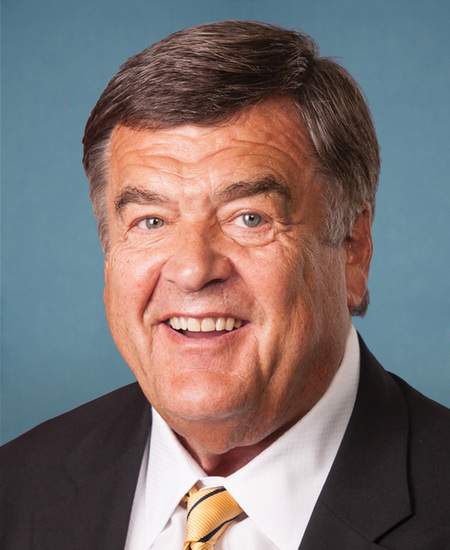
Photo of C. A. Dutch Ruppersberger
D United States House · District 2 · Maryland

Rep. C. A. Dutch Ruppersberger

Compare
Total votes
2,168
all sessions
Attendance
96%
86 missed
Lower than 86% of chamber peers
With party
98%
of cast votes
Higher than 92% of chamber peers
Bipartisan score
1%
crosses aisle rarely
Lower than 93% of chamber peers
Sponsored
731
bills & resolutions
Near the chamber average
Committees
0
assignments
731 bills and resolutions

Sponsored bills

Total
731
Primary
7
Co-sponsor
724
This page
731
matching current filters
Co-sponsor HRES 404
In committee May 18, 2021 1 co-sponsor
Co-sponsor HR 3305
In committee · United States House · Co-sponsor
End the Threat of Default Act

End the Threat of Default Act This bill repeals the public debt limit, which applies to most debt held by the federal government.

In committee May 18, 2021 1 co-sponsor
Co-sponsor HR 3321
In committee · United States House · Co-sponsor
Credit for Caring Act of 2021

Credit for Caring Act of 2021 This bill allows an eligible caregiver a tax credit of up to $5,000 for 30% of the cost of long-term care expenses that exceed $2,000 in a taxable year. The bill defines eligible caregiver as an individual who has earned income for the taxable year in excess of $7,500 and pays or incurs expenses for providing care to a spouse or other dependent relative with long-term care needs.

In committee May 18, 2021 1 co-sponsor
Co-sponsor HR 3294
In committee · United States House · Co-sponsor
IGNITE HBCU Excellence Act

Institutional Grants for New Infrastructure, Technology, and Education for HBCU Excellence Act or the IGNITE HBCU Excellence Act This bill establishes a grant program to support long-term improvements of historically Black colleges and universities (HBCUs) and graduate programs at HBCUs. Specifically, the bill requires the Department of Education (ED) to award grants to HBCUs to improve campus facilities. A recipient must use grant funds for certain activities, such as constructing or renovating facilities, carrying out major repairs, and strengthening the safety and security of a campus. Any new construction, modernization, or renovation projects must meet building code and energy and water conservation requirements. Further, HBCUs must seek to procure contracts from certain small businesses, including those owned and controlled by veterans and service-disabled veterans. The bill prohibits the use of grant funds for specified activities, including for the payment of routine and predictable maintenance costs, minor repairs, and utility bills. The Government Accountability Office must study the implementation of the grant program. The bill also requires ED to repay the outstanding balance of principal, interest, fees, and costs and any related reimbursements for certain capital financing loans.


In committee May 18, 2021 1 co-sponsor
Co-sponsor HR 1834
In committee · United States House · Co-sponsor
Hate Crimes Commission Act of 2021

Hate Crimes Commission Act of 2021 This bill establishes the United States Commission on Hate Crimes. The commission must investigate and report on whether hate crimes have increased; factors that contributed to an increase in hate crimes, if one is determined to exist; policies or actions by law enforcement agencies to reduce the commission of hate crimes; the impact of underreporting on hate crimes statistics and prevention; and successful community bias prevention responses.

In committee May 18, 2021 1 co-sponsor
Co-sponsor HR 1843
In committee · United States House · Co-sponsor
COVID–19 Hate Crimes Act

COVID - 19 Hate Crimes Act This bill requires a designated officer or employee of the Department of Justice (DOJ) to facilitate the expedited review of COVID-19 (i.e., coronavirus disease 2019) hate crimes and reports of COVID-19 hate crimes. It defines COVID-19 hate crime as a violent crime that is motivated by two things: (1) the actual or perceived characteristic (e.g., race or ethnicity) of any person, and (2) the actual or perceived relationship to the spread of COVID-19 of any person because of that characteristic. The bill requires DOJ to issue guidance for state and local law enforcement agencies on (1) the establishment of online hate crime reporting processes and the availability of online reporting in multiple languages, and (2) the expansion of culturally competent education campaigns. Additionally, DOJ and the Department of Health and Human Services must issue guidance on best practices for mitigating racially discriminatory language in describing the COVID-19 pandemic.

In committee May 18, 2021 1 co-sponsor
Co-sponsor HR 1752
In committee · United States House · Co-sponsor
COOL OFF Act

Choosing Our Own Lives Over Fast Firearms Act or the COOL OFF Act This bill establishes a three-day waiting period for certain handgun transfers. Specifically, the bill makes it unlawful for a licensed importer, manufacturer, or dealer to sell or transfer a handgun to an unlicensed individual unless three business days have elapsed since the licensee initiated a background check. A violator is subject to criminal penalties—a fine, up to one year in prison, or both. Additionally, the bill makes it unlawful for an unlicensed individual to receive a handgun from another unlicensed individual unless at least three business days have elapsed since the recipient most recently offered to take possession of the handgun. A violator is subject to criminal penalties—a fine, up to five years in prison, or both. The three-day waiting period does not apply to certain handgun transfers, such as for a loan between spouses for a lawful purpose.

In committee May 18, 2021 1 co-sponsor
Co-sponsor HR 1065
Passed · United States House · Co-sponsor
Pregnant Workers Fairness Act

Pregnant Workers Fairness Act This bill prohibits employment practices that discriminate against making reasonable accommodations for qualified employees affected by pregnancy, childbirth, or related medical conditions. A qualified employee is an employee or applicant who, with or without reasonable accommodation, can perform the essential functions of the position, with specified exceptions. Specifically, the bill declares that it is an unlawful employment practice to fail to make reasonable accommodations to known limitations of such employees unless the accommodation would impose an undue hardship on an entity's business operation; require a qualified employee affected by such condition to accept an accommodation other than any reasonable accommodation arrived at through an interactive process; deny employment opportunities based on the need of the entity to make such reasonable accommodations to a qualified employee; require such employees to take paid or unpaid leave if another reasonable accommodation can be provided; or take adverse action in terms, conditions, or privileges of employment against a qualified employee requesting or using such reasonable accommodations. The bill sets forth enforcement procedures and remedies that cover different types of employees in relation to such unlawful employment practices. The Equal Employment Opportunity Commission must provide examples of reasonable accommodations that shall be provided to affected employees unless the employer can demonstrate that doing so would impose an undue hardship. The bill prohibits state immunity under the Eleventh Amendment to the Constitution from an action for a violation of this bill.

Passed May 17, 2021 1 co-sponsor
Co-sponsor HR 3244
In committee · United States House · Co-sponsor
Teacher, Principal, and Leader Residency Access Act

Teacher, Principal, and Leader Residency Access Act This bill expands the federal work-study programs at institutions of higher education (IHEs) to include work-study programs that compensate students serving in a residency program at the IHE. R esidency program refers to a school-based educator preparation program in which a prospective teacher, principal, or school leader (1) works for one academic year with a mentor teacher, principal, or other school leader; (2) receives concurrent instruction from the IHE; (3) acquires effective teaching or school leader skills; and (4) attains certification or licensure prior to completion of the program.

In committee May 14, 2021 1 co-sponsor
Co-sponsor HR 3203
In committee · United States House · Co-sponsor
To enable certain hospitals that were participating in or applied for the drug discount program under section 340B of the Public Health Service Act prior to the COVID-19 public health emergency to temporarily maintain eligibility for such program, and for other purposes.

This bill waives certain eligibility requirements for hospitals participating in the 340B drug discount program (i.e., a program that allows entities to receive covered outpatient drugs at reduced prices from manufacturers) during the COVID-19 (i.e., coronavirus disease 2019) public health emergency. Specifically, the bill waives the required minimum proportion of low-income patients served for hospitals that began participating in the program during or prior to the COVID-19 emergency.

In committee May 14, 2021 1 co-sponsor
Showing 591 to 600 of 731 bills
Previous 1 … 59 60 61 … 74 Next