

Green Postal Service Fleet Act of 2022 This bill prohibits the U.S. Postal Service from carrying out the contract with Oshkosh Defense for the procurement of postal delivery vehicles unless each purchase is at least 75% electric or zero-emission vehicles.
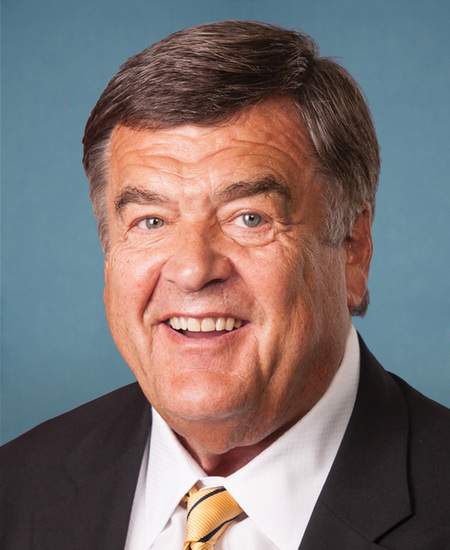
Rep. C. A. Dutch Ruppersberger
Sponsored bills
Baltimore National Heritage Area Reauthorization Act This bill extends the authority of the Department of the Interior to provide any assistance for the Baltimore National Heritage Area in Maryland through March 30, 2036. It also revises the map and modifies the boundaries of the heritage area.
This resolution condemns the terrorist attack on Congregation Beth Israel in Colleyville, Texas, on January 15, 2022. It also expresses support for the affected community, commends the actions of law enforcement and emergency responders, and reaffirms a commitment to combat hate, bigotry, anti-Semitism, and violence against Jewish Americans.
This bill provides for the award of a posthumous Congressional Gold Medal in commemoration of Doris Miller in recognition of his acts of valor while a member of the U.S. Navy during World War II.
Financing Lead Out of Water Act of 2022 This bill allows the issuance of tax-exempt private activity bonds to finance the replacement of any privately-owned portion of a lead service line in a public water system. Specifically, the bill provides that the use of proceeds from such bonds for replacement of a lead service line does not constitute private business use.
Maddy summaryHRES 952 is a resolution expressing the U.S. House of Representatives' support for designating February 28, 2022, as "Rare Disease Day." It recognizes that rare diseases affect fewer than 200,000 people in the U.S. and that over 7,000 such conditions impact approximately 1 in 10 Americans. The resolution calls for improved awareness, earlier diagnosis, and support for developing treatments, diagnostics, and cures for rare diseases. As a symbolic gesture, it does not create new laws, funding, or direct policy changes but aims to highlight challenges faced by individuals with rare diseases and their families.
Women's Health Protection Act of 2021 This bill prohibits governmental restrictions on the provision of, and access to, abortion services. Specifically, governments may not limit a provider's ability to prescribe certain drugs, offer abortion services via telemedicine, or immediately provide abortion services when the provider determines a delay risks the patient's health. Furthermore, governments may not require a provider to perform unnecessary medical procedures, provide medically inaccurate information, comply with credentialing or other conditions that do not apply to providers whose services are medically comparable to abortions, or carry out all services connected to an abortion. In addition, governments may not (1) require patients to make medically unnecessary in-person visits before receiving abortion services or disclose their reasons for obtaining such services, or (2) prohibit abortion services before fetal viability or after fetal viability when a provider determines the pregnancy risks the patient's life or health. The bill also prohibits other governmental measures that are similar to the bill's specified restrictions or that otherwise single out and impede access to abortion services, unless a government demonstrates that the measure significantly advances the safety of abortion services or health of patients and cannot be achieved through less restrictive means. The Department of Justice, individuals, or providers may bring a lawsuit to enforce this bill, and states are not immune from suits for violations. The bill applies to restrictions imposed both prior and subsequent to the bill's enactment.
Original Black History Month Resolution of 2022 This resolution recognizes the importance of commemorating Black History Month to acknowledge the achievements of Black Americans throughout history.
This concurrent resolution directs the Joint Committee on the Library to modify the statue, known as the Portrait Monument, commemorating women's suffrage and located in the rotunda of the U.S. Capitol by placing an inscription on it that is based on its original inscription from when it was delivered to the U.S. Capitol on February 10, 1921. The concurrent resolution also authorizes the use of the rotunda of the U.S. Capitol for a ceremony to unveil the revised Portrait Monument.
This resolution extends collective bargaining rights prescribed in the Congressional Accountability Act of 1995 to employees of the House of Representatives.