

National World War II Memorial Commemorative Coin Act This bill directs the Department of the Treasury to mint and issue up to 50,000 $5 coins, 400,000 $1 silver coins, and 750,000 half-dollar clad coins in commemoration of the National World War II Memorial in the District of Columbia. The design of the coins shall be emblematic of the memorial and the service and sacrifice of American soldiers and civilians during World War II. All surcharges received from the sale of such coins shall be paid to the Friends of the National World War II Memorial to support the National Park Service in maintaining and repairing the memorial, and for educational and commemorative programs.
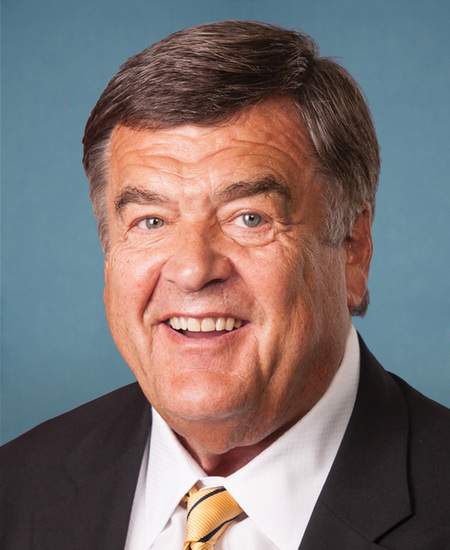
Rep. C. A. Dutch Ruppersberger
Sponsored bills
Assault Weapons Ban of 2022 This bill makes it a crime to knowingly import, sell, manufacture, transfer, or possess a semiautomatic assault weapon (SAW) or large capacity ammunition feeding device (LCAFD). The prohibition does not apply to a firearm that is (1) manually operated by bolt, pump, lever, or slide action, except for certain shotguns; (2) permanently inoperable; (3) an antique; (4) only capable of firing rimfire ammunition; or (5) a rifle or shotgun specifically identified by make and model. The bill also exempts from the prohibition the following, with respect to a SAW or LCAFD: importation, sale, manufacture, transfer, or possession related to certain law enforcement efforts, or authorized tests or experiments; importation, sale, transfer, or possession related to securing nuclear materials; and possession by a retired law enforcement officer. The bill permits continued possession, sale, or transfer of a grandfathered SAW, which must be securely stored. A licensed gun dealer must conduct a background check prior to the sale or transfer of a grandfathered SAW between private parties. The bill permits continued possession of, but prohibits sale or transfer of, a grandfathered LCAFD. Newly manufactured LCAFDs must display serial number identification. Newly manufactured SAWs and LCAFDs must display the date of manufacture. The bill also allows a state or local government to use Edward Byrne Memorial Justice Assistance Grant Program funds to compensate individuals who surrender a SAW or LCAFD under a buy-back program.
Preserving Access to Home Health Act of 2022 This bill restricts the Centers for Medicare & Medicaid Services (CMS) from decreasing payments for Medicare home health services based on certain adjustments until 2026. Current law requires the CMS to make certain permanent and temporary payment adjustments under the Medicare prospective payment system for home health services based on behavioral assumptions for 2020 through 2026. The bill restricts the CMS from making adjustments that decrease payments until 2026; the CMS must also ensure that any such necessary decreases are made before 2032.
Ensuring the FDA Fully Examines Clinical Trial Impact and Vitalness before Endorsement Act or the EFFECTIVE Act This bill specifies that the Food and Drug Administration may deny an application for a new opioid analgesic drug upon a determination that the drug does not provide a significant advantage or clinical superiority compared to other drugs.
Original Slavery Remembrance Day Resolution of 2021 This resolution supports the designation of a Slavery Remembrance Day and condemns slavery and its progenies.
Shirley Chisholm Congressional Gold Medal Act This bill provides for the posthumous presentation of a Congressional Gold Medal in commemoration of Shirley Chisholm, in recognition of her activism, independence, and groundbreaking achievements in politics, election as the first African American woman in Congress, and campaign to be the first African American to gain the nomination of a major political party for President of the United States. Following its award, the gold medal shall be given to the Smithsonian Institution where it shall be available for display and research.
No Shame at School Act of 20 22 This bill establishes requirements for the treatment of a child who is participating in the National School Lunch Program or the School Breakfast Program and owes unpaid school meal fees. It also requires local educational agencies to certify certain children (e.g., homeless children) as categorically eligible for free lunches or breakfasts without an application.
This resolution expresses support for the designation of Journeyman Lineworkers Recognition Day. (A journeyman lineworker is a person who builds and maintains electrical power systems.)
Break Free From Plastic Pollution Act of 2021 This bill sets forth requirements and incentives to reduce the production of a variety of products and materials, including plastics, and increase efforts to collect, recycle, or compost products and materials. The bill makes certain producers of products (e.g., packaging, paper, single-use products, beverage containers, or food service products) fiscally responsible for collecting, managing, and recycling or composting the products after consumer use. In addition, the bill establishes (1) minimum percentages of products that must be reused, recycled, or composted; and (2) an increasing percentage of recycled content that must be contained in beverage containers. Beginning on January 1, 2023, the bill phases out a variety of single-use products, such as plastic utensils. The bill also sets forth provisions to encourage the reduction of single-use products, including by establishing programs to refund consumers for returning beverage containers and by establishing a tax on carryout bags. The bill creates a temporary moratorium on new or expanded permits for certain facilities that manufacture plastics until regulations are updated to address pollution from the facilities. The Environmental Protection Agency (EPA) must publish guidelines for a national standardized labeling system for recycling and composting receptacles. Producers must include labels on their products that are easy to read and indicate whether the products are recyclable, compostable, or reusable. The EPA must also ensure that certain clothes washers have filtration units as required by this bill. Finally, the bill establishes limitations on the export of plastic waste to other countries.
Health Equity and Accountability Act of 2022 This bill directs the Department of Health and Human Services (HHS) and others to undertake efforts to reduce health disparities. For example, the bill (1) requires more detailed reporting of demographic and health disparities data, including related to public health emergencies; (2) directs certain components of HHS to support health workforce diversity; and (3) increases access to culturally and linguistically appropriate health care. The bill also modifies eligibility and other requirements for Medicare, Medicaid, private health insurance, nutrition assistance, and other programs to reduce health disparities among vulnerable populations. The bill includes specific provisions with respect to noncitizens; maternal, infant, and child health; mental and behavioral health; specified conditions that disproportionately affect racial and ethnic minority groups, such as certain cancers, HIV/AIDS, kidney disease, and diabetes; investments in communities facing health and other inequities; and nondiscrimination in the provision of services in federally supported health programs. Additionally, the bill (1) revises health information technology programs to address health disparities, and (2) supports health impact assessments and other efforts pertaining to environmental justice and social determinants of health (i.e., nonmedical factors that influence health outcomes, such as income and educational attainment). The bill also requires various studies and reports on issues related to health care and health disparities, including a report by the Government Accountability Office on health workforce diversity.