

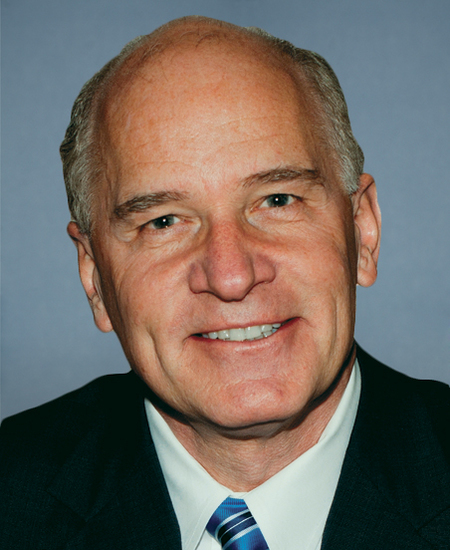
Photo of William R. Keating
D United States House · District 9 · Massachusetts On the 2026 ballot

Rep. William R. Keating

Compare
Total votes
2,837
all sessions
Attendance
97%
83 missed
Lower than 78% of chamber peers
With party
98%
of cast votes
Near the chamber average
Bipartisan score
1%
crosses aisle rarely
Near the chamber average
Sponsored
1,252
bills & resolutions
Near the chamber average
Committees
6
assignments
1,252 bills and resolutions

Sponsored bills

Total
1,252
Primary
77
Co-sponsor
1,175
This page
1,252
matching current filters
Co-sponsor HR 777
In committee · United States House · Co-sponsor
Closing the College Hunger Gap Act

Maddy summaryThis bill requires the U.S. Department of Education to proactively notify eligible college students about potential access to SNAP (food stamp) benefits. It targets students with a negative or zero student aid index (SAI) who file the Free Application for Federal Student Aid (FAFSA). The Department must send annual written and electronic notices explaining SNAP eligibility and providing state contact information for applying. The bill also mandates consultation between the Education and Agriculture Departments to design these notifications. This is a policy change focused on improving access to nutrition assistance for low-income students already enrolled in college.

In committee Jan 28, 2025 1 co-sponsor
Co-sponsor HRES 68
In committee · United States House · Co-sponsor
Expressing strong disapproval of the President's announcement to withdraw the United States from the Paris Agreement.

Maddy summaryHRES 68 is a non-binding House resolution expressing strong disapproval of the President’s announcement to withdraw the U.S. from the Paris Agreement. It commends states, businesses, and citizens supporting the Agreement, urges the President to reverse the withdrawal decision, and calls for Congress to prioritize U.S. climate leadership. The resolution does not create new laws or affect specific groups but formally states the House’s position against withdrawing from the international climate accord. It was introduced by 115 co-sponsors and reflects broad congressional concern about reversing U.S. climate commitments.

In committee Jan 24, 2025 1 co-sponsor
Co-sponsor HR 646
In committee · United States House · Co-sponsor
Build Housing with Care Act of 2025

Maddy summaryHR 646, the Build Housing with Care Act of 2025, establishes a HUD grant program to fund the co-location of affordable housing developments with child care facilities. It directly affects housing developers, child care providers, and residents of affordable housing by requiring grants to support projects in "child care deserts" (areas with severe child care shortages), prioritizing low-income, rural, or Head Start-serving providers. Key provisions mandate that projects must not evict residents, include resident engagement plans, and ensure child care providers serve low-income families or dual-language learners. The bill authorizes $100 million annually (2025-2030) and requires annual reports tracking child care slots created, resident usage, and demographic data.

In committee Jan 23, 2025 1 co-sponsor
Co-sponsor HR 612
In committee · United States House · Co-sponsor
Health Care Providers Safety Act of 2025

Maddy summaryHR 612, the Health Care Providers Safety Act of 2025, provides federal funding to help health care facilities improve safety. It authorizes the Secretary to award grants to hospitals, clinics, and other health care providers to cover costs for physical security (like structural improvements) and cyber security (such as data privacy tools and video surveillance systems). These grants directly help health care providers protect their facilities, staff, and patients from security threats. The bill creates a new funding mechanism under the Public Health Service Act, making specific security upgrades eligible for federal support.

In committee Jan 22, 2025 1 co-sponsor
Co-sponsor HR 637
In committee · United States House · Co-sponsor
911 SAVES Act

Supporting Accurate Views of Emergency Services Act of 2025 or the 911 SAVES Act This bill requires the Office of Management and Budget to categorize public safety telecommunicators as a protective service occupation under the Standard Occupational Classification system no later than 30 days after the enactment of this bill. (The Standard Occupational Classification system is a federal statistical standard used by federal agencies to classify workers into occupational categories for the purpose of collecting, calculating, or disseminating data.)

In committee Jan 22, 2025 1 co-sponsor
Co-sponsor HR 476
In committee · United States House · Co-sponsor
No Russian Tunnel to Crimea Act

Maddy summaryHR 476, the "No Russian Tunnel to Crimea Act," requires the U.S. President to impose sanctions on foreign individuals or entities that knowingly help build, maintain, or repair any tunnel or bridge connecting Russia to Crimea. The bill directly affects foreign businesses or officials involved in such infrastructure projects, which the bill states would support Russia’s occupation of Crimea - internationally recognized as Ukrainian territory. Key mechanisms include blocking U.S. assets of sanctioned parties and barring them from entering the U.S. via visa restrictions, with exceptions for humanitarian aid and certain national security activities. The legislation targets potential infrastructure projects discussed between Russian and Chinese officials in late 2023, aiming to disrupt Russia’s military use of Crimea during its invasion of Ukraine.

In committee Jan 16, 2025 1 co-sponsor
Co-sponsor HR 475
In committee · United States House · Co-sponsor
Sanction Russian Nuclear Safety Violators Act of 2025

Maddy summaryHR 475 would impose U.S. sanctions on Russian individuals or entities that have endangered the safety or operational control of Ukraine’s Zaporizhzhia Nuclear Power Plant since Russia’s 2022 invasion. Key provisions include freezing assets of targeted persons and banning their entry into the U.S. via visa restrictions. The bill includes critical exceptions for humanitarian aid (food, medicine, medical supplies) and efforts to restore Ukrainian control of the plant. These sanctions aim to address nuclear safety risks highlighted by the IAEA, without affecting legitimate humanitarian operations.

In committee Jan 16, 2025 1 co-sponsor
Co-sponsor HR 485
In committee · United States House · Co-sponsor
Muhammad Ali Congressional Gold Medal Act

Maddy summaryHR 485, the Muhammad Ali Congressional Gold Medal Act, authorizes Congress to award a gold medal in recognition of Muhammad Ali's lifetime contributions to sports, civil rights, and humanitarian causes. The bill directs the Treasury Secretary to strike the medal and present it to Ali's widow, Lonnie Ali, following his death in 2016. It also permits the sale of bronze duplicates to cover costs, with proceeds going to the U.S. Mint. This is a commemorative measure with no policy impact, solely honoring Ali's legacy through a symbolic medal.

In committee Jan 16, 2025 1 co-sponsor
Co-sponsor HR 507
In committee · United States House · Co-sponsor
Veterans Member Business Loan Act

Maddy summaryHR 507, the Veterans Member Business Loan Act, amends the Federal Credit Union Act to explicitly include loans made to veterans as qualifying "member business loans" under credit unions. This change directly affects veterans seeking business financing through federal credit unions, allowing them to access these loans under the same framework as other small business borrowers. The key mechanism is adding a new definition category ("made to a veteran") to the existing eligibility criteria for business loans, using the standard military definition of "veteran" from Title 38, U.S. Code. The bill does not create new funding or programs but expands existing credit union lending options to include veterans. This definition change takes effect six months after the bill's enactment.

In committee Jan 16, 2025 1 co-sponsor
Co-sponsor HR 486
In committee · United States House · Co-sponsor
Young Americans Financial Literacy Act

Maddy summaryHR 486, the Young Americans Financial Literacy Act, authorizes $27.5 million to $55 million annually through 2029 to fund competitive grants for centers of excellence focused on financial literacy education for individuals aged 8-24. These centers, established by eligible institutions like schools, nonprofits, or financial organizations, must develop research-based programs covering budgeting, debt management, student loan guidance, and avoiding pitfalls like predatory lending. The bill specifically requires programs to address at-risk populations, include evidence-based teaching methods, and serve groups such as high school graduates, college students, young families, and military personnel. It mandates annual reporting to Congress on grant recipients and the populations they serve, with funding ending in 2029.

In committee Jan 16, 2025 1 co-sponsor
Showing 341 to 350 of 1,252 bills
Previous 1 … 34 35 36 … 126 Next