This bill designates the facility of the United States Postal Service located at 3900 Crown Road Southwest in Atlanta, Georgia, as the John R. Lewis Post Office Building.
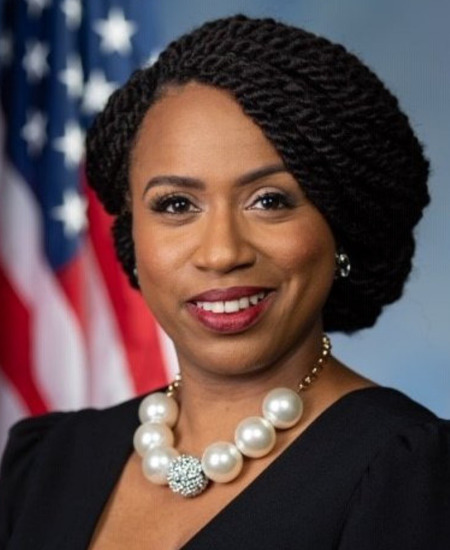
Rep. Ayanna Pressley
Sponsored bills
Reproductive Health Care Accessibility Act This bill establishes various grants and related programs that address sexual and reproductive health care for individuals with disabilities. Specifically, the Health Resources and Services Administration must support training for health care providers who offer sexual and reproductive health care to individuals with disabilities, and educating individuals with disabilities about sexual and reproductive health care. The Administration for Community Living must establish a national center to provide recommendations, technical assistance, and other resources related to the provision of sexual and reproductive health care for individuals with disabilities. The bill also authorizes support for medical schools, nursing schools, and other educational institutions that offer obstetrics and gynecology training programs to expand the number of individuals with disabilities entering the reproductive health care workforce. Additionally, the Department of Health and Human Services must study the effectiveness and other aspects of reproductive health care services and programs for individuals with disabilities.
Post-Disaster Mental Health Response Act This bill authorizes the provision of professional counseling services to victims of declared emergencies (current law limits such authorization to victims of major disasters).
Maximizing Outcomes through Better Investments in Lifesaving Equipment for (MOBILE) Health Care Act This bill allows a health center that currently receives funding through a Health Resources & Services Administration Health Center Program grant to use a New Access Point grant to set up a mobile unit regardless of whether the health center also establishes a permanent health care delivery site. New Access Point grants help health centers establish new delivery sites to provide comprehensive primary care to medically underserved populations. Under current law, health centers may only use the grants to set up a mobile unit if they also establish a permanent site.
Break the Cycle of Violence Act This bill establishes federal grant programs and related entities to support violence intervention initiatives. Specifically, the bill directs the Department of Health and Human Services (HHS) to award grants for coordinated community violence intervention initiatives in communities disproportionately impacted by homicides and community violence. HHS must also establish several related entities, including an Office of Community Violence Intervention to administer programs and activities related to violence intervention; the Community Violence Intervention Advisory Committee to advise and assist the office and HHS; and the National Community Violence Response Center to provide training and technical assistance, coordinate research, and develop data collection policies. Additionally, the bill directs the Department of Labor to award grants for job training and workforce programs in communities disproportionately affected by gun violence to connect youth ages 16 to 24 to in-demand occupations.
Payments Modernization Act of 2022 This bill requires the Federal Reserve Board to create a real-time payment system that allows funds to be available to any end user immediately at any time, including funds deposited at a depository institution.
National Council on African American History and Culture Act of 2022 This bill establishes a National Council on African American History and Culture in the National Endowment for the Humanities (NEH). The duties of the council shall include gathering timely and authoritative information concerning historical developments and cultural trends in African-American history and culture; evaluating the various programs and activities of the NEH to determine the extent to which such programs and activities are contributing, or not contributing, to the successful preservation and celebration of African-American history and culture; and developing and recommending to the NEH national policies to foster and promote the understanding of African-American history, the preservation of African-American culture, and the celebration of African Americans as contributors to the country's economic, cultural, and political success.

Veterans Infertility Treatment Act of 2021 This bill requires the Department of Veterans Affairs (VA) to furnish infertility treatments, standard fertility preservation services, or both to a covered veteran or partner of a covered veteran if the individuals jointly apply for such treatments or services. A covered veteran is a veteran who has infertility and is enrolled in the VA health care system. Under the bill, in vitro fertilization treatment may only be furnished for up to three completed cycles resulting in live birth or six attempted cycles, whichever occurs first. The VA may furnish in vitro fertilization treatment using donated gametes or embryos. During the interim period before infertility treatment regulations are in effect, the VA must ensure that (1) fertility counseling and treatment for veterans may also be furnished to the partner of a veteran regardless of whether the veteran and the partner are married, and (2) such counseling and treatment may be furnished using donated gametes or embryos.
Social Security Fairness Act of 2021 This bill repeals provisions that reduce Social Security benefits for individuals who receive other benefits, such as a pension from a state or local government. The bill eliminates the government pension offset , which in various instances reduces Social Security benefits for spouses, widows, and widowers who also receive government pensions of their own. The bill also eliminates the windfall elimination provision , which in some instances reduces Social Security benefits for individuals who also receive a pension or disability benefit from an employer that did not withhold Social Security taxes. These changes are effective for benefits payable after December 2021.
Maddy summaryHRES 1364 is a resolution recognizing access to water, sanitation, electricity, heating, cooling, broadband, and public transportation as basic human rights that must be accessible, safe, affordable, and climate-resilient for everyone. It specifically calls for banning utility shutoffs (including for nonpayment), ending predatory debt collection practices, and ensuring services are affordable based on income. The resolution also urges public control of utilities, prioritizes environmental justice communities for infrastructure investments, and requires utilities to report disconnection data by demographics and income. It directly affects all residents, with emphasis on low-income households and communities disproportionately impacted by unaffordable or unreliable services.