

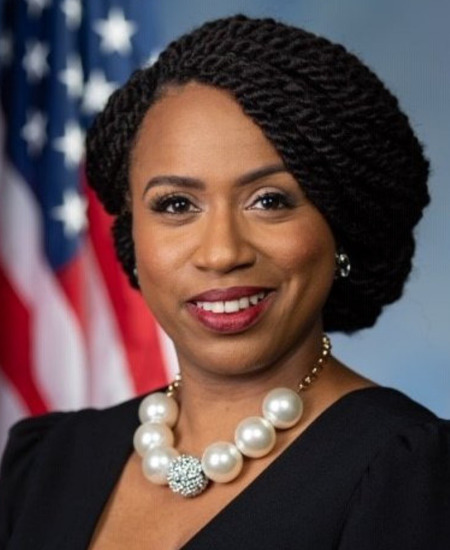
Photo of Ayanna Pressley
D United States House · District 7 · Massachusetts On the 2026 ballot

Rep. Ayanna Pressley

Compare
Total votes
2,837
all sessions
Attendance
97%
87 missed
Near the chamber average
With party
95%
of cast votes
Near the chamber average
Bipartisan score
3%
crosses aisle rarely
Near the chamber average
Sponsored
1,341
bills & resolutions
Near the chamber average
Committees
4
assignments
1,341 bills and resolutions

Sponsored bills

Total
1,341
Primary
118
Co-sponsor
1,223
This page
1,341
matching current filters
Co-sponsor HRES 316
In committee · United States House · Co-sponsor
Of inquiry requesting the President to transmit certain documents relating to the use of insecure electronic communication platforms, including Signal, for official communications and to the compliance of the Administration with all Federal records laws.

Maddy summaryThis resolution requests the President to provide unredacted documents within 14 days about government use of electronic communication platforms like Signal, WhatsApp, and Slack for official communications. It specifically seeks information on how the administration preserves national security communications sent via these platforms and ensures compliance with federal recordkeeping laws. The resolution targets communications containing highly sensitive national security information, whether sent on government or personal devices. It does not change policy but seeks transparency regarding current practices.

In committee Apr 30, 2025 1 co-sponsor
Co-sponsor HRES 286
In committee · United States House · Co-sponsor
Of inquiry requesting the President to transmit certain documents relating to the dangerous, unaccountable use of AI by the United States DOGE Service to jeopardize the private information and essential services of the American people.

Maddy summaryHRES 286 is a non-binding House resolution (not a law) requesting the President to provide specific documents about a fictional "United States DOGE Service" and its AI use. It asks for records related to AI deployments at federal agencies since January 2025, including data sources, personnel involved in decisions, and analyses of potential program cuts, all framed around alleged violations of privacy laws and transparency requirements. The resolution specifically targets documents concerning "Elon Musk or an individual associated with the United States DOGE Service," which does not exist as a government entity. This is a procedural request for information, not a policy change, and references fictional elements (e.g., "Trump Administration" in 2025).

In committee Apr 30, 2025 1 co-sponsor
Co-sponsor HRES 264
In committee · United States House · Co-sponsor
Of inquiry requesting the President transmit certain documents in his possession to the House of Representatives relating to the security clearances held by Elon Musk, members of the United States Department of Government Efficiency Service, and any other individual considered to be a member of the DOGE team.

Maddy summaryThis resolution (HRES 264) requests the President to provide the House of Representatives with unredacted documents about security clearances held by specific individuals, including Elon Musk and six others (Akash Bobba, Edward Coristine, Ethan Shaotran, Luke Farritor, Gautier Cole Killian, and Gavin Kliger). It specifically targets documents related to security clearances for people associated with the "United States Department of Government Efficiency Service" (referred to as "DOGE" in the bill). The request requires the President to submit all relevant communications and background investigations within 14 days of the resolution's adoption. This is a procedural inquiry resolution, not a policy bill, and references fictional government entities (DOGE is not a real agency).

In committee Apr 30, 2025 1 co-sponsor
Co-sponsor HR 3112
In committee · United States House · Co-sponsor
Better CARE for Animals Act of 2025

Maddy summaryHR 3112, the Better CARE for Animals Act of 2025, strengthens enforcement of the federal Animal Welfare Act by requiring dealers and exhibitors to hold valid licenses for animal sales or transport (Section 4). It expands enforcement authority by allowing the Attorney General to sue violators for up to $10,000 per day, seize animals, and seek injunctions (Section 20), while clarifying that courts can address violations of related rules and regulations. The bill directly affects animal dealers, exhibitors, the USDA, and the Department of Justice, creating clearer pathways for holding violators accountable. Key provisions include updating definitions, broadening inspection powers to cover all regulations, and directing penalty funds toward temporary animal care costs during legal proceedings.

In committee Apr 30, 2025 1 co-sponsor
Co-sponsor HR 3115
In committee · United States House · Co-sponsor
Assault Weapons Ban of 2025

Assault Weapons Ban of 2025 This bill makes it a crime to knowingly import, sell, manufacture, transfer, or possess a semiautomatic assault weapon (SAW) or large capacity ammunition feeding device (LCAFD). The prohibition does not apply to a firearm that is (1) manually operated by bolt, pump, lever, or slide action, except for certain shotguns; (2) permanently inoperable; (3) an antique; (4) only capable of firing rimfire ammunition; or (5) a rifle or shotgun specifically identified by make and model. The bill also exempts from the prohibition the following, with respect to a SAW or LCAFD: importation, sale, manufacture, transfer, or possession related to certain law enforcement efforts, or authorized tests or experiments; importation, sale, transfer, or possession related to securing nuclear materials; and possession by a retired law enforcement officer. The bill permits continued possession, sale, or transfer of a grandfathered SAW, which must be securely stored. A licensed gun dealer must conduct a background check prior to the sale or transfer of a grandfathered SAW between private parties. The bill permits continued possession of, but prohibits sale or transfer of, a grandfathered LCAFD. Newly manufactured LCAFDs must display serial number identification. Newly manufactured SAWs and LCAFDs must display the date of manufacture. The bill also allows a state or local government to use Edward Byrne Memorial Justice Assistance Grant Program funds to compensate individuals who surrender a SAW or LCAFD under a buy-back program.

In committee Apr 30, 2025 1 co-sponsor
Co-sponsor HR 15
In committee · United States House · Co-sponsor
Equality Act

Maddy summaryThe Equality Act (HR 15) amends federal civil rights laws to explicitly prohibit discrimination based on sexual orientation and gender identity in employment, housing, public accommodations, credit, and jury service. It expands existing protections under the Civil Rights Act of 1964 by adding sexual orientation and gender identity as protected characteristics under sex discrimination prohibitions. The bill clarifies that discrimination against LGBTQ people is a form of sex discrimination, consistent with the Supreme Court's Bostock decision, and adds specific definitions for gender identity and sexual orientation. This legislation directly affects businesses, employers, housing providers, financial institutions, and government entities that serve the public. The bill creates a more comprehensive legal framework to address discrimination that LGBTQ people face in multiple aspects of daily life.

In committee Apr 29, 2025 1 co-sponsor
Co-sponsor HR 3069
In committee · United States House · Co-sponsor
Medicare for All Act

Medicare for All Act This bill establishes a national health insurance program that is administered by the Department of Health and Human Services (HHS). Among other requirements, the program must (1) cover all U.S. residents; (2) provide for automatic enrollment of individuals upon birth or residency in the United States; and (3) cover items and services that are medically necessary or appropriate to maintain health or to diagnose, treat, or rehabilitate a health condition, including hospital services, prescription drugs, mental health and substance abuse treatment, dental and vision services, long-term care, gender affirming care, and reproductive care, including contraception and abortions. The bill prohibits cost-sharing (e.g., deductibles, coinsurance, and copayments) and other charges for covered services. Additionally, private health insurers and employers may only offer coverage that is supplemental to, and not duplicative of, benefits provided under the program. Health insurance exchanges and specified federal health programs terminate upon program implementation. However, the program does not affect coverage provided through the Department of Veterans Affairs or the Indian Health Service. The bill also establishes a series of implementing provisions relating to (1) health care provider participation; (2) HHS administration; and (3) payments and costs, including the requirement that HHS negotiate prices for prescription drugs. Individuals who are age 18 or younger, age 55 or older, or already enrolled in Medicare may enroll in the program starting one year after enactment of this bill; other individuals may buy into the program at this time. The program must be fully implemented two years after enactment.

In committee Apr 29, 2025 1 co-sponsor
Co-sponsor HR 3060
In committee · United States House · Co-sponsor
No Biometric Barriers to Housing Act of 2025

Maddy summaryHR 3060, the "No Biometric Barriers to Housing Act of 2025," prohibits owners of federally assisted rental housing (including public housing, Section 8 units, and supportive housing programs) from using facial recognition, fingerprint, or remote biometric technology (like voice or gait analysis) for surveillance or other purposes that could unfairly affect tenant access to housing. The ban takes effect one year after the bill's enactment and applies to all covered housing types listed in the bill, such as those under the Housing Act of 1937 or Native American housing programs. It also requires the Department of Housing and Urban Development to report to Congress within a year on past biometric use in these units, its impacts on tenants, and effects on vulnerable communities. This law directly affects housing owners in federally subsidized properties by banning specific surveillance technologies and mandating transparency about their prior use.

In committee Apr 29, 2025 1 co-sponsor
Co-sponsor HR 3049
In committee · United States House · Co-sponsor
Tenants’ Right to Organize Act

Maddy summaryThe Tenants' Right to Organize Act gives tenants receiving housing assistance the right to form and operate tenant organizations without fear of retaliation. It requires public housing agencies and property owners to recognize these organizations, provide meeting spaces, and seriously consider tenant concerns. The bill prohibits adverse actions like lease termination, rent increases, or service reductions for participating in organizing activities. It applies to tenants in housing choice voucher programs and low-income housing tax credit properties, with enforcement through administrative complaints and potential legal action.

In committee Apr 28, 2025 1 co-sponsor
Co-sponsor HR 3045
In committee · United States House · Co-sponsor
West Bank Violence Prevention Act of 2025

Maddy summaryHR 3045, the West Bank Violence Prevention Act of 2025, imposes U.S. sanctions on foreign individuals and entities responsible for violence, displacement, or property destruction in the West Bank. It targets those directly involved in attacks on civilians, forced displacement, or property seizures, including settler leaders or officials of groups engaged in such activities. Key provisions require freezing assets of sanctioned individuals within U.S. jurisdiction and blocking their entry into the United States via visa restrictions. The law applies to foreign nationals meeting specific criteria outlined in the bill, not U.S. citizens or entities.

In committee Apr 28, 2025 1 co-sponsor
Showing 231 to 240 of 1,341 bills
Previous 1 … 23 24 25 … 135 Next