

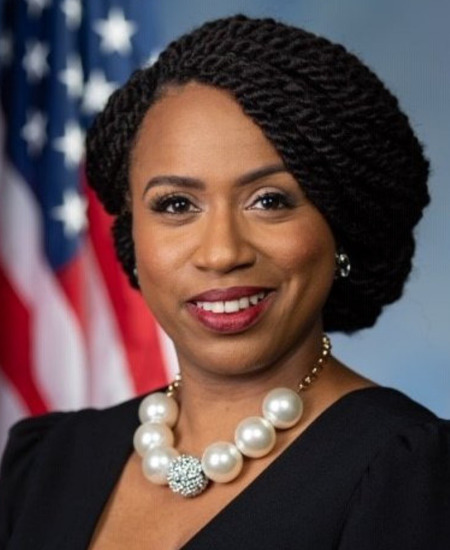
Photo of Ayanna Pressley
D United States House · District 7 · Massachusetts On the 2026 ballot

Rep. Ayanna Pressley

Compare
Total votes
2,837
all sessions
Attendance
97%
87 missed
Near the chamber average
With party
95%
of cast votes
Near the chamber average
Bipartisan score
3%
crosses aisle rarely
Near the chamber average
Sponsored
1,341
bills & resolutions
Near the chamber average
Committees
4
assignments
1,341 bills and resolutions

Sponsored bills

Total
1,341
Primary
118
Co-sponsor
1,223
This page
1,341
matching current filters
Co-sponsor HR 2181
In committee · United States House · Co-sponsor
Protect Our Watchdogs Act of 2025

Maddy summaryHR 2181, the Protect Our Watchdogs Act of 2025, strengthens protections for federal Inspectors General (IGs) by requiring the President to have specific, documented reasons to remove them. The bill amends federal law to specify nine grounds for removal, including documented felony convictions, gross mismanagement, waste of funds, abuse of authority, or neglect of duty - each requiring written justification. This directly affects IGs who oversee federal agency accountability and investigations, as it prevents arbitrary removals and mandates transparency in the process. The law applies to all federal Inspectors General across agencies, ensuring their independence is maintained through clear, enforceable standards.

In committee Sep 8, 2025 1 co-sponsor
Primary HRES 660
In committee · United States House · Lead sponsor
Recognizing that the United States has a moral obligation to meet its foundational promise of guaranteed justice for all.

Maddy summaryThis House Resolution (HRES 660) expresses the House of Representatives' position that the United States has a moral obligation to address the country's mass incarceration crisis. It identifies systemic issues including racial disparities in incarceration (Black people are incarcerated at 5 times the rate of White people), the disproportionate impact on women and LGBTQ+ individuals, and the economic burden of the justice system. The resolution calls for a "large-scale decarceration effort" that includes ending racial disparities, reducing prison populations through sentencing reform, ending cash bail, and investing in community-based safety solutions instead of punitive systems. While not legislation with binding effect, it serves as a statement of principles and framework for potential future policy changes to create a more just and humane justice system.

In committee Aug 19, 2025 0 co-sponsors
Co-sponsor HJRES 115
In committee · United States House · Co-sponsor
Terminating the emergency determined by the President on August 11, 2025, in the Executive Order titled "Declaring a crime emergency in the District of Columbia".

Maddy summaryThis bill (HJRES 115) terminates a presidential emergency declaration made on August 11, 2025, which claimed a "crime emergency" in Washington, D.C. It directly affects the District of Columbia by ending federal restrictions that prevented D.C. from using $1 billion in locally-raised funds for public safety, law enforcement, fire services, and schools. The resolution cites that the emergency declaration was legally flawed - section 740 of the DC Home Rule Act does not permit federalizing the Metropolitan Police Department - and notes that D.C. violent crime has reached a 30-year low. The bill formally ends the emergency under the DC Home Rule Act, restoring D.C.'s authority over its own budget and public safety resources.

In committee Aug 15, 2025 1 co-sponsor
Co-sponsor HR 4966
In committee · United States House · Co-sponsor
Stop Price Gouging in Grocery Stores Act of 2025

Maddy summaryHR 4966 prohibits grocery stores from selling items at "grossly excessive prices," defined as 120% or more above the average market price over the previous six months (with exceptions for unavoidable cost increases like supply chain issues). It bans using facial recognition or personal data to set different prices for individual customers (e.g., adjusting prices based on shopping history) and requires clear signage if facial recognition is used. Stores over 10,000 square feet must replace electronic shelf labels with physical price tags. The Federal Trade Commission enforces these rules, allowing consumers to seek $3,000 per violation or actual damages, with penalties for willful violations.

In committee Aug 12, 2025 1 co-sponsor
Co-sponsor HR 4917
In committee · United States House · Co-sponsor
Expanding the VOTE Act

Maddy summaryHR 4917, the Expanding the VOTE Act, amends the Voting Rights Act to increase language access for voters. It expands the definition of "voting materials" to include digital formats and requires states to provide language assistance (both written and oral) for minority language groups, with special provisions for American Indian and Alaska Native languages when written translations aren't feasible. The bill creates grants to help jurisdictions provide voting materials in languages that don't currently trigger Section 203 coverage, and mandates a study on lowering population thresholds for language assistance requirements. This directly affects states, local election jurisdictions, and voters who speak minority languages, including those in communities not currently covered by existing language access rules.

In committee Aug 5, 2025 1 co-sponsor
Co-sponsor HR 4916
In committee · United States House · Co-sponsor
Youth Voting Rights Act

Youth Voting Rights Act This bill expands voting access for youth. Specifically, the bill establishes a private right of action to enforce the Twenty-Sixth Amendment, which prohibits denying or abridging the right to vote based on age. Further, the bill authorizes the Department of Justice to enforce the Twenty-Sixth Amendment against age-based restrictions for voting by mail. Additionally, the bill directs each state to designate as voter registration agencies all offices within public institutions of higher education (IHEs) that provide assistance to students, implement a preregistration process to allow minors who are 16 years or older to register to vote in federal elections that take place when or after the preregistered individual turns age 18, and ensure the availability of polling places on campuses of IHEs (with the availability of waivers). The bill prohibits durational residency requirements for voting in all federal elections. Currently, this prohibition applies only to voting for the offices of President and Vice President. States and local jurisdictions with voter identification requirements must treat IHE-issued student identification cards as voter identification. The Election Assistance Commission (EAC) must make grants to states to increase the involvement of individuals under age 18 in public election activities. The Government Accountability Office must report to Congress on trends related to voter registration, absentee voting, and provisional voting. The EAC must also collect and make publicly available certain data from states.

In committee Aug 5, 2025 1 co-sponsor
Co-sponsor HR 4915
In committee · United States House · Co-sponsor
Election Mail Act

Maddy summaryThe Election Mail Act (HR 4915) establishes new standards for handling voting-by-mail materials in Federal elections. It requires the Postal Service to process absentee ballots the same day received, add postmarks showing mailing dates, and treat election mail as first-class with free postage for completed ballots. States must provide ballot return envelopes with tracking barcodes and accept mailed ballots postmarked on election day if received within 7 days. These provisions apply to Federal elections starting in 2026, with some requirements taking effect sooner.

In committee Aug 5, 2025 1 co-sponsor
Co-sponsor HR 4908
In committee · United States House · Co-sponsor
Time Off to Vote Act

Maddy summaryThe Time Off to Vote Act requires employers with 25 or more employees to provide two hours of paid leave for federal elections. Employees can use this leave to vote in person, return mail-in ballots, or perform other voting activities during open polling hours. Employers may set the specific two-hour window (excluding lunch breaks) but cannot deny the leave, retaliate against employees who take it, or cause loss of accrued benefits. Violations could result in civil penalties up to $10,000 per violation, enforced by the Department of Labor.

In committee Aug 5, 2025 1 co-sponsor
Co-sponsor HR 4914
In committee · United States House · Co-sponsor
Unhoused Voter Opportunity Through Elections Act

Unhoused Voter Opportunity Through Elections Act or the Unhoused VOTE Act This bill expands voter registration and voting access for unhoused individuals.  The bill specifies that no state or political subdivision may deny or abridge the right of any U.S. citizen to vote because the citizen resides at or in a nontraditional abode.  Additionally, the bill requires jurisdictions that allow for ballot drop boxes to ensure that these drop boxes are available for in-person use and are accessible and clearly labeled. If a state requires individuals to show proof of residence in order to vote in a federal election, then the state must accept the individual’s written attestation of residence. A state may not prohibit an individual who is residing in a homeless shelter from using the shelter as the individual’s residence for purposes of voting in a federal election. The bill requires chief state election officials to conduct outreach to unhoused individuals. The bill directs the Election Assistance Commission to (1) develop best practices for election officials regarding voter registration and voting access for unhoused individuals, and (2) make grants to eligible states and local governments for programs and activities to support access to voting for unhoused individuals.  The bill also revises the National Voter Registration Act of 1993, including by (1) treating emergency shelters as voter registration agencies, and (2) allowing an unhoused individual to use an unsheltered street location as the individual's place of residence for purposes of a voter registration application.

In committee Aug 5, 2025 1 co-sponsor
Co-sponsor HRES 629
In committee · United States House · Co-sponsor
Honoring the life of Dr. Paul Farmer by recognizing the duty of the Federal Government to adopt a 21st-century global health solidarity strategy and take actions to address past and ongoing harms that undermine the health and well-being of people around the world.

Maddy summaryHRES 629 is a non-binding House resolution honoring Dr. Paul Farmer and calling for U.S. policy changes to address global health inequities. It directly affects low- and middle-income countries by urging the federal government to adopt a "21st-century global health solidarity strategy," including increasing U.S. global health funding to $125 billion annually (to meet the UN 0.7% GNI target) and supporting national health systems through Dr. Farmer’s "Five S’s" framework (staff, space, stuff, systems, social support). The resolution also mandates addressing systemic economic harms like debt, tax evasion, and colonial legacies through debt cancellation, tax reform, and reparations for historical injustices. It emphasizes concrete policy shifts rather than funding alone, requiring coordinated multilateral action to close health financing gaps and reform global governance institutions.

In committee Aug 1, 2025 1 co-sponsor
Showing 161 to 170 of 1,341 bills
Previous 1 … 16 17 18 … 135 Next