

Medicaid Reentry Act of 2021 This bill allows Medicaid payment for medical services furnished to an incarcerated individual during the 30-day period preceding the individual's release. The Medicaid and Children's Health Insurance Program (CHIP) Payment and Access Commission must report on specified information relating to the accessibility and quality of health care for incarcerated individuals, including the impact of the bill's changes.
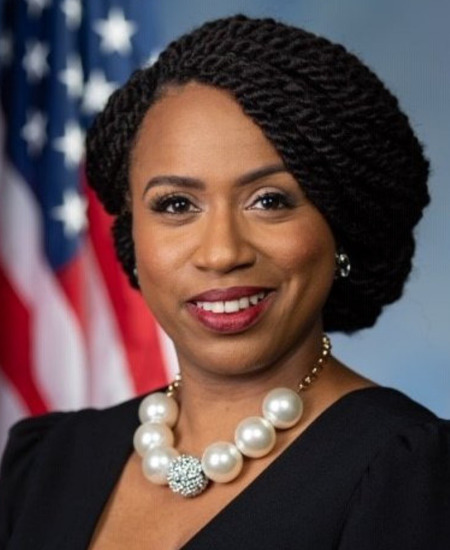
Rep. Ayanna Pressley
Sponsored bills
Innovative Maternal Payment And Coverage To Save Moms Act or the IMPACT to Save Moms Act This bill requires the Centers for Medicare & Medicaid Services to establish the Perinatal Care Alternative Payment Model Demonstration Project to allow states to test payment models for maternity care, including postpartum care, under Medicaid and the Children's Health Insurance Program (CHIP). Additionally, the Medicaid and CHIP Payment and Access Commission must report on specified information relating to the continuity of coverage for pregnant and postpartum women under Medicaid and CHIP.
Essential Worker Pandemic Compensation Act of 2021 This bill compensates specified essential workers who die or are hospitalized as a result of COVID-19 (i.e., coronavirus disease 2019) or related complications. Specifically, the bill provides death benefits to survivors of essential workers equal to the amount available under the public safety officer benefits program. Essential workers include those identified in the Cybersecurity and Infrastructure Security Agency guidance or by a Special Master appointed by the Department of Health and Human Services. Such death benefits include additional payments to a surviving spouse or child enrolled in qualified postsecondary education. Further, essential workers who are hospitalized as a result of COVID-19 receive one half of the base death benefit amount.
COVID-19 Diaper Assistance Act This bill provides additional funding for FY2021 for the Social Services Block Grant to provide diapers, wipes, and other diapering supplies to families in need. This grant is a flexible funding stream used by states and territories to support a wide range of social services.
Future Advancement of Academic Nursing Act or the FAAN Act This bill authorizes the Health Resources and Services Administration (HRSA) to award grants to nursing schools to increase capacity to respond to public health emergencies and pandemics and otherwise enhance nursing education programs. In awarding these grants, HRSA shall prioritize historically Black colleges and universities and other minority-serving institutions, schools that are located in medically underserved communities, and schools in areas with shortages of health professionals.
National Climate Emergency Act of 2021 or the Climate Emergency Act of 2021 This bill directs the President to declare a national emergency with respect to climate change. The President, in responding to the emergency, must ensure that the government invests in large scale mitigation and resiliency projects; makes investments that enable a racially and socially just transition to a clean energy economy by ensuring that at least 40% of investments flow to historically disadvantaged communities; avoids solutions that increase inequality or violate human rights; creates jobs that conform to labor standards that provide family sustaining wages and benefits and ensure safe workplaces; prioritizes local and equitable hiring and contracting that creates opportunities for marginalized communities; combats environmental injustice; and reinvests in existing public sector institutions and creates new public sector institutions to strategically mobilize and channel investments at the scale and pace required by the national emergency. The President shall report annually on actions taken in response to the national emergency.
This resolution calls on the President to take executive action to cancel up to $50,000 in federal student loan debt for borrowers. Further, it encourages the President to (1) ensure that borrowers have no tax liability from the debt cancellation, (2) ensure that the debt cancellation helps close racial wealth gaps, and (3) pause student loan payments and interest accumulation on federal student loans for the duration of the COVID-19 (i.e., coronavirus disease 2019) pandemic.
Family and Medical Insurance Leave Act or the FAMILY Act This bill entitles every employee to a family and medical leave insurance (FMLI) monthly benefit payment of two-thirds of the employee's regular pay, limited to a maximum of $4,000, for not more than 60 days of qualified caregiving. The bill establishes the Office of Paid Family and Medical Leave within the Social Security Administration to administer the FMLI program. An FMLI benefit payment must be coordinated with any periodic benefits received under a state or local temporary disability insurance or family leave program. The bill imposes a tax on employers, employees, and self-employed individuals to fund FMLI benefits. It also establishes the Federal Family and Medical Leave Insurance Trust Fund to hold tax revenues.
American Opportunity Accounts Act This bill establishes tax-exempt American Opportunity Accounts to provide children at birth with a $1,000 savings account with annual contributions up to $2,000 depending on family income. The accounts are available to children at age 18 for specified purposes, including educational expenses, home ownership, and investment that provides long-term returns.
Scientific Integrity Act This bill revises provisions regarding the release of scientific research results by federal agencies. Each agency that funds, conducts, or oversees scientific research must (1) adopt and enforce a scientific integrity policy that includes requirements such as that scientific conclusions are not based on political considerations, and (2) submit such policy to the Office of Science and Technology Policy (OSTP) for approval. Each agency must make such policy available to the public and submit such policy to Congress. Agencies and the OSTP must periodically review the policies. The Government Accountability Office shall review implementation of the policies. Each agency shall (1) appoint a Scientific Integrity Officer, (2) establish a process for dispute resolution consistent with the scientific integrity policy, and (3) establish a specified training program for current and new employees.