

National World War II Memorial Commemorative Coin Act This bill directs the Department of the Treasury to mint and issue up to 50,000 $5 coins, 400,000 $1 silver coins, and 750,000 half-dollar clad coins in commemoration of the National World War II Memorial in the District of Columbia. The design of the coins shall be emblematic of the memorial and the service and sacrifice of American soldiers and civilians during World War II. All surcharges received from the sale of such coins shall be paid to the Friends of the National World War II Memorial to support the National Park Service in maintaining and repairing the memorial, and for educational and commemorative programs.
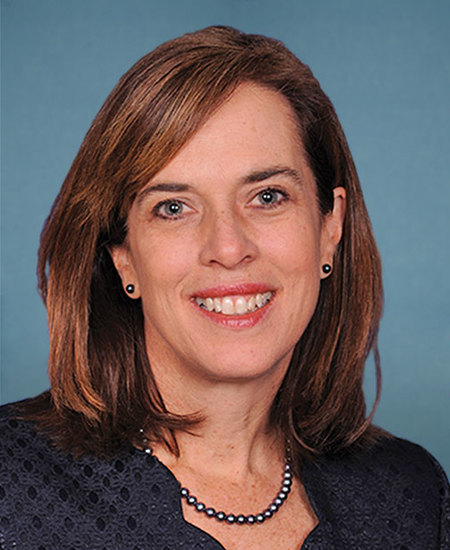
Rep. Katherine M. Clark
Sponsored bills
Assault Weapons Ban of 2022 This bill makes it a crime to knowingly import, sell, manufacture, transfer, or possess a semiautomatic assault weapon (SAW) or large capacity ammunition feeding device (LCAFD). The prohibition does not apply to a firearm that is (1) manually operated by bolt, pump, lever, or slide action, except for certain shotguns; (2) permanently inoperable; (3) an antique; (4) only capable of firing rimfire ammunition; or (5) a rifle or shotgun specifically identified by make and model. The bill also exempts from the prohibition the following, with respect to a SAW or LCAFD: importation, sale, manufacture, transfer, or possession related to certain law enforcement efforts, or authorized tests or experiments; importation, sale, transfer, or possession related to securing nuclear materials; and possession by a retired law enforcement officer. The bill permits continued possession, sale, or transfer of a grandfathered SAW, which must be securely stored. A licensed gun dealer must conduct a background check prior to the sale or transfer of a grandfathered SAW between private parties. The bill permits continued possession of, but prohibits sale or transfer of, a grandfathered LCAFD. Newly manufactured LCAFDs must display serial number identification. Newly manufactured SAWs and LCAFDs must display the date of manufacture. The bill also allows a state or local government to use Edward Byrne Memorial Justice Assistance Grant Program funds to compensate individuals who surrender a SAW or LCAFD under a buy-back program.
Original Slavery Remembrance Day Resolution of 2021 This resolution supports the designation of a Slavery Remembrance Day and condemns slavery and its progenies.
Shirley Chisholm Congressional Gold Medal Act This bill provides for the posthumous presentation of a Congressional Gold Medal in commemoration of Shirley Chisholm, in recognition of her activism, independence, and groundbreaking achievements in politics, election as the first African American woman in Congress, and campaign to be the first African American to gain the nomination of a major political party for President of the United States. Following its award, the gold medal shall be given to the Smithsonian Institution where it shall be available for display and research.
Trauma-Informed Schools Act of 2022 This bill provides for the use of trauma-informed practices in public elementary and secondary schools and allows states to use certain federal funds to train teachers and other staff in such practices. The bill defines t rauma-informed practices to include evidence-based professional development that promotes a shared understanding among teachers and other staff that adverse and potentially traumatic experiences are common among students and that school-wide learning environments where all students and adults feel safe, welcomed, and supported can enable students to succeed despite such experiences; adoption of disciplinary procedures and practices that utilize evidence-based restorative practices that build a culture of trust; and activities that engage teachers, other staff, and families in a process of school-based planning to help all students feel safe and connected to the school community.
Equal Access to Justice for Victims of Gun Violence Act of 2022 This bill removes limitations on the civil liability of gun manufacturers and the disclosure of gun trace data in civil actions. Specifically, the bill repeals the Protection of Lawful Commerce in Arms Act, which prohibits civil actions against a firearm or ammunition manufacturer, seller, importer, dealer, or trade association for damages resulting from the criminal or unlawful misuse of a firearm. Additionally, the bill states that firearms trace data maintained by the Bureau of Alcohol, Tobacco, Firearms and Explosives is not immune from legal process. Such data is subject to discovery; is admissible as evidence; and may be used, relied on, or disclosed in a civil action or administrative proceeding.
Right to Contraception Act This bill sets out statutory protections for an individual's right to access and a health care provider's right to provide contraception and related information. Contraception refers to an action taken to prevent pregnancy, including the use of contraceptives (i.e., a device or medication used to prevent pregnancy), fertility-awareness based methods, and sterilization procedures. Generally, the bill prohibits measures that single out and impede access to contraception and related information. However, a party may defend against a claim that a measure violates the bill's prohibitions by demonstrating, through clear and convincing evidence, that the measure significantly advances access to contraception and cannot be achieved through less restrictive means. The Department of Justice, individuals, or health care providers may bring a lawsuit to enforce this bill, and states are not immune from suits for violations.
No Tax Breaks for Union Busting (NTBUB) Act This bill denies employers a tax deduction for any expenditures incurred for attempting to influence their employees with respect to labor organizations or labor organization activities, such as elections, labor disputes, and collective actions. The bill requires employers to report on their attempts to influence their employees with respect to labor organizations and their activities.
Ensuring Women's Right to Reproductive Freedom Act This bill prohibits anyone acting under state law from interfering with a person's ability to access out-of-state abortion services. ( Abortion services includes the use of any drugs that are approved to terminate pregnancies and any health care services related to an abortion, whether or not provided at the same time or on the same day.) Specifically, the bill prohibits any person acting under state law from preventing, restricting, impeding, or retaliating against health care providers who provide legal abortion services to out-of-state residents, any person or entity who helps health care providers to provide such services, any person who travels to another state to obtain such services, any person or entity who helps another person travel to another state to obtain such services, or the movement in interstate commerce of drugs that are approved to terminate pregnancies. The Department of Justice may enforce this bill through civil actions; the bill also establishes a private right of action for violations.
LGBTQ I+ Data Inclusion Act This bill addresses federal data collection of voluntary, self-disclosed information on sexual orientation, gender identity, and variations in sex characteristics. Specifically, the bill requires federal agencies that collect information through a survey for statistical purposes that includes demographic data (where subjects self-report information or a proxy provides information about the subject or responds for all persons in a household) to review existing data sets to determine which data sets do not include information about sexual orientation, gender identity, and variations in sex characteristics. Such agencies must assess needed changes in survey methods related to asking questions on such matters. Agencies that publish reports relying on survey demographic data must include information on sexual orientation, gender identity, and variations in sex characteristics. Agencies may waive this publication requirement on a case-by-case basis if the confidentiality of the information cannot be maintained or if adding such information to the survey would impair the agency's ability to preserve the utility, accuracy, or objectivity of the survey while also generating relevant evidence about the LGBTQI+ community. The Government Accountability Office must report to Congress on the implementation of this bill's requirements by agencies.