

Dismemberment Abortion Ban Act of 2021 This bill restricts the performance of dismemberment abortions. It defines the term dismemberment abortion . Specifically, the bill prohibits a physician from knowingly performing a dismemberment abortion. It provides an exception for a dismemberment abortion that is necessary to save the life of a mother whose life is endangered by a physical disorder, illness, or condition. The bill establishes criminal penalties—a fine, a prison term of up to two years, or both—for a physician who performs a prohibited dismemberment abortion. It also authorizes civil remedies for a woman or parent of a minor who undergoes a dismemberment abortion. A woman who undergoes a dismemberment abortion may not be prosecuted or held civilly liable.
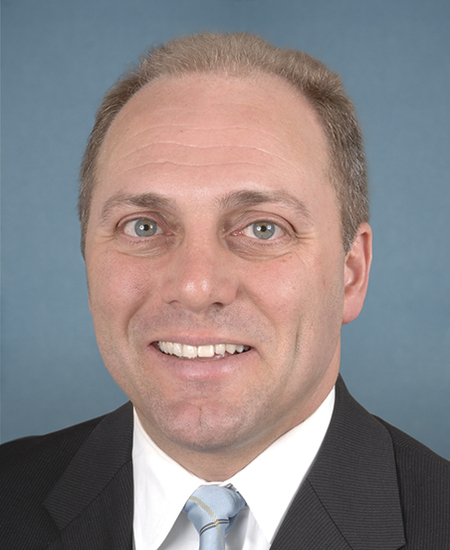
Rep. Steve Scalise
Sponsored bills
This resolution honors Officers Brian Sicknick and Howard Liebengood of the U.S. Capitol Police, and it commends the bravery and service demonstrated by officers of the U.S. Capitol Police, the Metropolitan Police Department of the District of Columbia, and the other law enforcement agencies and protective entities that assisted in responding to the January 6, 2021, attack on the U.S. Capitol.
Concealed Carry Reciprocity Act This bill establishes a federal statutory framework to regulate the carry or possession of concealed firearms across state lines. Specifically, an individual who is eligible to carry a concealed firearm in one state may carry or possess a concealed handgun (other than a machine gun or destructive device) in another state that allows its residents to carry concealed firearms. It sets forth requirements for the lawful concealed carry across state lines. The bill preempts most state and local laws related to concealed carry and establishes a private right of action for a person adversely affected by interference with a concealed-carry right established by this bill.
Keystone XL Pipeline Construction and Jobs Preservation Act This bill authorizes the TransCanada Keystone Pipeline to construct, connect, operate, and maintain the pipeline facilities in Phillips County, Montana, for the import of oil from Canada to the United States.
Protecting Our Wealth of Energy Resources Act or the POWER Act This bill requires the President and federal agencies to obtain the approval of Congress before prohibiting or substantially delaying certain new energy or mineral leases or permits on federal lands, including oil and gas leases, coal leases, hard rock leases, or critical minerals leases. In addition, the President and agencies must obtain the approval of Congress before withdrawing certain federal lands from mineral and geothermal leasing activities.
Conservation Funding Protection Act This bill requires the Department of the Interior to hold at least two region-wide oil and gas lease sales per year in the Gulf of Mexico. Each lease sale must include areas in the Central Gulf of Mexico Planning Area and the Western Gulf of Mexico Planning Area. In addition, the bill establishes deadlines for completing environmental reviews of the lease sales.
Reducing Antiquated Permitting for Infrastructure Deployment Act or the RAPID Act This bill modifies review requirements for deployment of a small personal wireless service facility and establishes a presumption related to the deployment of wireless facilities on properties owned by an Indian tribe or a Native Hawaiian organization. Specifically, the bill exempts the deployment of a small personal wireless service facility from specified environmental and historic preservation review requirements. The bill also establishes a rebuttable presumption that a wireless provider has completed a request for review if an Indian tribe or a Native Hawaiian organization has received certain completed forms with information reasonably necessary to ascertain whether historic properties of religious and cultural significance may be affected by the deployment of new or collocated wireless facilities.
Free Speech Fairness Act This bill permits a tax-exempt organization to make certain statements related to a political campaign without losing its tax-exempt status. An organization may not lose its tax-exempt status under section 501(c)(3) of the Internal Revenue Code or be deemed to have participated in, or intervened in any political campaign on behalf of (or in opposition to) any candidate for public office, solely because of the content of any statement that (1) is made in the ordinary course of the organization's regular and customary activities in carrying out its exempt purpose, and (2) results in the organization incurring not more than de minimis incremental expenses.
This resolution expresses the opposition of the House of Representatives to any plans by the Department of Defense to deliver COVID-19 (i.e., coronavirus disease 2019) vaccines to prisoners held at United States Naval Station, Guantanamo Bay, Cuba, until all Americans have had the opportunity to be vaccinated. Additionally, the resolution asserts that the government should prioritize U.S. citizens for COVID-19 vaccinations.
Reopen Schools Act This bill requires a local educational agency (LEA) to reopen its elementary and secondary schools as a condition for receiving certain supplemental education emergency relief funding. Specifically, an LEA must provide in-person instruction to at least 50% of its students in order to receive the full funding. An LEA that provides in-person instruction to at least some of its students shall have its funding reduced on a pro rata basis.