Emergency Supplemental Appropriations Resolution, 2021 This joint resolution provides $1 billion in supplemental appropriations for the Department of Defense to assist the government of Israel with the acquisition, enhancement, maintenance, and sustainment of the Iron Dome defense system to counter short-range rocket threats. The bill designates the funding as emergency spending, which is exempt from discretionary spending limits.
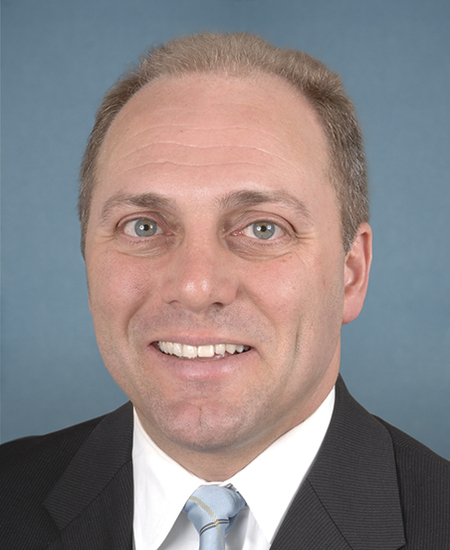
Rep. Steve Scalise
Sponsored bills
This concurrent resolution establishes the Joint Select Committee on the Events and Activities Surrounding China's Handling of the 2019 Novel Coronavirus to investigate and report to Congress and the executive branch specified information related to the coronavirus (i.e., the virus that causes COVID-19) pandemic. This report must include the origins and causes of the coronavirus; certain coronavirus-related policies, decisions, and activities by the government of China; accountability for policies, decisions, and activities related to influencing the World Health Organization's response to the coronavirus outbreak; vulnerabilities of the U.S. domestic and global supply chain to a global pandemic due to reliance on Chinese manufacturing; information related to lessons learned from China's handling of the coronavirus; and recommended actions the federal government should take in response to China's handling of the coronavirus.
Gulf Conservation and Recreation Funding Act This bill requires the Department of the Interior to annually pay Gulf producing states (Alabama, Louisiana, Mississippi, and Texas) and each of their coastal political subdivisions an amount equal to the amount of revenue they will not receive due to moratorium on new oil and natural gas leases in offshore waters. The moratorium was established under Executive Order 14008 on January 27, 2021.
Recognizing the Protection of Motorsports Act of 2019 or the RPM Act of 2019 [ sic ] This bill authorizes the modification of a vehicle's air emission controls for vehicles that are not legal for operation on a street or highway and are used solely for competition.
Modern Television Act of 2021 This bill establishes measures to prevent blackouts of television broadcast stations, including requiring good-faith negotiations in broadcast agreements and providing for outside arbitration of certain negotiation disputes. Specifically, the bill requires a station and a cable or satellite service to negotiate in good faith when attempting to reach a marketplace agreement, and it requires the cable or satellite service to retransmit the signal of a station for up to 60 days while the parties renegotiate an expired agreement. The Federal Communications Commission may require a station and a cable or satellite service to submit to binding arbitration to resolve any dispute that may arise (the parties must be retroactively paid for content aired during this time). Further, a station is prohibited from requiring payment from a cable or satellite service for customers of the cable or satellite service who do not receive the signals of the station from that service. Additionally, the bill repeals specified provisions, including those related to retransmission consent and compulsory copyright licenses. The bill also disallows federal, state, and local authorities from regulating the rates of a cable or satellite service. The Government Accountability Office must assess the impact of the bill.

Regulations from the Executive in Need of Scrutiny Act of 20 21 This bill revises provisions relating to congressional review of agency rulemaking. Specifically, the bill establishes a congressional approval process for a major rule. A major rule may only take effect if Congress approves of the rule. A major rule is a rule that results in (1) an annual effect on the economy of $100 million or more; (2) a major increase in costs or prices for consumers, individual industries, government agencies, or geographic regions; or (3) significant adverse effects on competition, employment, investment, productivity, innovation, or the ability of U.S.-based enterprises to compete with foreign-based enterprises. In addition, the bill establishes a congressional disapproval process for a nonmajor rule. A nonmajor rule may only take effect if Congress does not disapprove of the rule.
This concurrent resolution expresses the sense of Congress that a carbon tax would be detrimental to American families and businesses and is not in the best interest of the United States.
This bill extends the authority of the Department of the Interior to provide any assistance to the local coordinating entity for the Atchafalaya National Heritage Area in Louisiana.
Pain-Capable Unborn Child Protection Act This bill establishes a new criminal offense for performing or attempting to perform an abortion if the probable post-fertilization age of the fetus is 20 weeks or more. A violator is subject to criminal penalties—a fine, a prison term of up to five years, or both. The bill provides exceptions for an abortion (1) that is necessary to save the life of the pregnant woman, or (2) when the pregnancy is the result of rape or incest. A physician who performs or attempts to perform an abortion under an exception must comply with specified requirements. A woman who undergoes a prohibited abortion may not be prosecuted for violating or conspiring to violate the provisions of this bill.
No Taxpayer Funding for Abortion and Abortion Insurance Full Disclosure Act of 2021 This bill modifies provisions relating to federal funding for, and health insurance coverage of, abortions. Specifically, the bill prohibits the use of federal funds for abortions or for health coverage that includes abortions. Such restrictions extend to the use of funds in the budget of the District of Columbia. Additionally, abortions may not be provided in a federal health care facility or by a federal employee. Historically, language has been included in annual appropriations bills for the Department of Health and Human Services (HHS) that prohibits the use of federal funds for abortions—such language is commonly referred to as the Hyde Amendment. Similar language is also frequently included in appropriations bills for other federal agencies and the District of Columbia. The bill makes these restrictions permanent and extends the restrictions to all federal funds (rather than specific agencies). The bill's restrictions regarding the use of federal funds do not apply in cases of rape, incest, or where a physical disorder, injury, or illness endangers a woman's life unless an abortion is performed. The Hyde Amendment provides the same exceptions. The bill also prohibits qualified health plans from including coverage for abortions. Currently, qualified health plans may cover abortion, but the portion of the premium attributable to abortion coverage is not eligible for subsidies.