This resolution condemns recent attacks on pro-life facilities, groups, and churches and calls on the current presidential administration to use appropriate law enforcement authorities to support their safety.
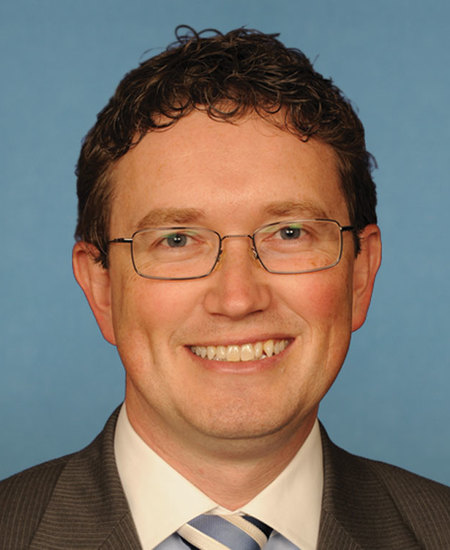
Rep. Thomas Massie
Sponsored bills
Maddy summaryHRES 493 is a non-binding House resolution expressing disapproval of President Biden's immigration enforcement actions. It specifically criticizes the 100-day pause on deporting individuals with final removal orders and the preservation of the DACA program, alleging these actions violate the President’s constitutional duty to "take Care that the Laws be faithfully executed." The resolution demands the removal of DHS Secretary Alejandro Mayorkas, calls for full enforcement of immigration laws, and asserts that the President has unlawfully usurped Congress’s legislative authority. It cites court rulings and a GAO opinion stating the President cannot substitute policy priorities for enacted laws. The resolution serves as a symbolic censure, not a policy change.
Espionage Act Reform Act of 2022 This bill limits the scope of certain criminal offenses relating to classified information. Under the bill, the offense of disclosing classified information to an unauthorized person may be committed only by an individual who is authorized to receive the classified information and has signed a nondisclosure agreement regarding such classified information (i.e., a covered person), whereas under current law any individual may be charged with this offense. Under the bill, this offense shall not apply to disclosures of information to any Member of Congress, a federal court, an inspector general in the intelligence community, or certain bodies such as the Federal Trade Commission. Similarly, under the bill, certain offenses related to gathering, transmitting, or losing defense information may be committed only by a covered person or a foreign agent, whereas currently such offenses may be committed by any person. Under the bill, an individual who is not a foreign agent may not be criminally charged for such offenses unless the individual meets certain requirements, such as having committed a felony under federal law in the course of committing the offense. An offense related to obtaining and copying a document connected with the national defense shall apply only to an unlawfully obtained nonpublic document, whereas the current statute does not limit the scope of this offense to such documents. An offense related to dispensing certain public property of value shall apply only to tangible things, whereas the current statute does not limit the scope of this offense to tangible things.

Shall Not Be Infringed Act This bill repeals the Bipartisan Safer Communities Act, which was signed into law on June 25, 2022. The act makes various changes to federal firearms laws, including to expand background check requirements, broaden the scope of existing restrictions, and establish new criminal offenses. The act also reauthorizes, funds, and supports various programs, grants, and activities to promote access to behavioral and mental health services, enhance school safety and security initiatives, and address gun violence in communities.
Fourth Amendment Restoration Act This bill limits surveillance conducted for foreign intelligence purposes. Specifically, the bill repeals provisions authorizing without a court order various types of searches and surveillance for foreign intelligence purposes, including electronic surveillance and access to business records. An officer of the U.S. government must obtain a warrant for certain search and surveillance activities against a U.S. citizen, including (1) conducting electronic surveillance, (2) conducting physical searches of property under a U.S. citizen's exclusive control, or (3) targeting a U.S. citizen to acquire foreign intelligence information. The bill provides for criminal penalties for a person who knowingly violates these requirements or otherwise obtains such information under color of law without statutory authorization. Information about a U.S. citizen acquired under Executive Order 12333 (relating to intelligence gathering) or during surveillance of a non-U.S. citizen shall not be used against the U.S. citizen in any civil, criminal, or administrative proceeding or investigation.
Maddy summaryHR 7415 would repeal the 1990 Gun-Free School Zones Act, which prohibited firearms within 1,000 feet of school grounds. It removes specific references to school zones from federal gun law provisions in Title 18 of the U.S. Code. This change would eliminate the federal prohibition on firearms in designated school zones, altering the scope of existing gun law enforcement. The bill does not create new safety measures but modifies how federal gun laws apply to school areas.
No Retaining Every Gun In a System That Restricts Your Rights Act This bill modifies the retention requirements for firearm transaction records of federal firearms licensees (FFLs) that go out of business. Current law generally requires FFLs that go out of business to deliver their firearm transaction records to the Bureau of Alcohol, Tobacco, Firearms and Explosives (ATF). This bill removes the requirement for FFLs that go out of business to deliver their firearm transaction records to the ATF. Further, the bill requires the ATF to destroy all out-of-business records it has collected from FFLs.
No Backdoor Gun Control Act of 2022 This bill removes the category of any other weapon from the definition of firearm under the National Firearms Act. The bill treats persons who acquire or possess any other weapon as meeting registration or licensing requirements under the National Firearms Act. The bill requires the Department of Justice to destroy any records relating to the registration of any other weapon not later than one year after the enactment of this bill.
Stop the Betrayal Act of 2022 This bill prohibits using federal funds to transport an unlawfully present non-U.S. national ( alien under federal law) into a U.S. region that is not within the border jurisdiction of U.S. Customs and Border Protection, unless such transportation is for (1) enforcing immigration laws, or (2) bringing an unaccompanied alien child to a Department of Health and Human Services facility.
Restoring America's Leadership in Innovation Act of 2021 This bill revises several aspects of patent law. The bill changes the U.S. patent system back to a first-to-invent system, in which the first inventor to conceive of an invention is entitled to a patent. Currently, the first person to file an application that meets all the necessary requirements is entitled to the patent. Several types of administrative patent challenge proceedings are abolished, as well as the Patent and Trademark Office (PTO) body that decides those proceedings. The bill relaxes the standard for what constitutes patent-eligible subject matter. The only ineligible inventions shall be those that exist in nature independent or prior to human activity or that exist solely in the human mind. The bill also makes it easier for a patent owner that has won an infringement case in court to secure a permanent injunction against the infringing defendant. Specifically, there shall be a presumption that further infringement would cause irreparable harm to the prevailing patent owner, and the burden shall be on the infringer to prove otherwise. (Currently, a prevailing patent owner seeking a permanent injunction must prove, among other things, that further infringement would cause irreparable harm.) The bill limits what types of publications shall be treated as prior art that could be used to make an invention be considered to be anticipated or obvious (and therefore not patentable). The bill authorizes the PTO to keep and spend all the fees that it collects.