

Promoting Local Management of the Lesser Prairie Chicken Act This bill prohibits any population of the lesser prairie-chicken ( Tympanuchus pallidicinctus ) in Kansas, Oklahoma, Texas, Colorado, or New Mexico from being listed as endangered or threatened under the Endangered Species Act of 1973 (ESA). The lesser prairie-chicken is a type of grouse. Currently, two distinct population segments (DPS) of the lesser prairie-chicken are listed under the ESA. The Southern DPS of the lesser prairie-chicken is listed as endangered and the Northern DPS is listed as threatened. The bill removes both populations from the list. In addition, the bill bans Interior from listing any population of the lesser prairie-chicken as endangered or threatened in the future.
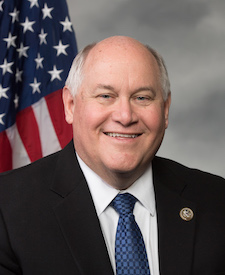
Rep. Ron Estes
Sponsored bills
Consumer and Fuel Retailer Choice Act This bill amends the Clean Air Act to address the limitations on Reid Vapor Pressure (a measure of gasoline's volatility) that are placed on gasoline during the summer ozone season, including by applying the Reid Vapor Pressure requirements that are applicable to gasoline blended with 10% ethanol (E10) to gasoline blended with more than 10% ethanol.
Maddy summaryHR 7075 designates a specific triangular area in Washington, D.C. (bounded by 22nd Street NW, P Street NW, and Florida Avenue NW) as "Ukrainian Independence Park," including National Park Service reservations 57D and 360 (which contains the Taras Shevchenko Memorial). The bill updates all federal references to this area to use the new name and authorizes signage highlighting Ukraine's independence and U.S.-Ukraine solidarity. This is a procedural designation bill with no substantive policy changes, solely renaming a park area.
The Jackie Walorski Maternal and Child Home Visiting Reauthorization Act of 2022 This bill reauthorizes through FY2027, increases funding for, and modifies the Maternal, Infant, and Early Childhood Home Visiting Program. This program supports home visits for expectant and new parents who live in communities that are at-risk for poor maternal and child health outcomes. Changes to the program include setting out requirements for allocating program funds; increasing the percentage of funds reserved for tribal entities; establishing a publicly available dashboard that reports program outcomes; requiring activities to reduce unnecessary data collection, reporting, and other administrative requirements of the program; and allowing for virtual home visits (provided certain conditions are met). The bill also reduces funding for the Medicare Improvement Fund.
Lymphedema Treatment Act This bill provides for Medicare coverage of lymphedema compression treatment items. Specifically, the bill provides for coverage of standard and custom fitted gradient compression garments and other approved items that are prescribed by a physician or other specified health care professional to treat lymphedema.
Chisholm National Historic Trail and Western National Historic Trail Designation Act This bill designates (1) the Chisholm National Historic Trail, and (2) the Western National Historic Trail. The Department of the Interior shall administer any portion of these trails that is located on nonfederal land only (1) with the voluntary consent of the owner of the nonfederal land, and (2) if the portion qualifies for certification as a component of the applicable trail. The approval by an owner of applicable nonfederal land of a certification agreement shall satisfy the voluntary consent requirement. A certification agreement may be terminated at any time. The establishment of these trails does not authorize any person to enter private property without the consent of the private property's owner. Interior may accept a donation of land or an interest in land for these trails, with specified exceptions. Land or an interest in land may not be acquired for these trails by eminent domain or condemnation.
This joint resolution nullifies the interim final rule submitted by the Department of Justice and the Department of Homeland Security and published on March 29, 2022, concerning procedures for the consideration of asylum claims and other related issues. (Among other changes, the interim final rule requires an asylum seeker subject to expedited removal to be screened by an asylum officer for a credible fear of persecution or torture, rather than a credible fear of persecution, reasonable possibility of persecution, or reasonable possibility of torture.)
Protecting Pain-Capable Unborn Children from Late-Term Abortions Act This bill establishes a new criminal offense for performing or attempting to perform an abortion if the probable gestational age of the fetus is 15 weeks or more. A violator is subject to criminal penalties—a fine, a prison term of up to five years, or both. The bill provides exceptions for an abortion (1) that is necessary to save the life of the pregnant woman, or (2) when the pregnancy is the result of rape or incest. A physician who performs or attempts to perform an abortion under an exception must comply with specified requirements. A woman who undergoes a prohibited abortion may not be prosecuted for violating or conspiring to violate the provisions of this bill.
Gas Prices Relief Act of 2022 This bill prohibits federal agencies from finalizing any regulations that would cause (1) a decrease in domestic oil, gas, or biofuels production; (2) an increase in gasoline prices; or (3) any negative effects on domestic energy production, domestic electricity generation, transmission of fuel or electricity, infrastructure development, or transportation fuels. The prohibition may not end until the earlier of January 1, 2023, or until the average gasoline price is $2.60 per gallon or less.
Midland Over Moscow Act This bill imposes sanctions related to the Nord Stream 2 pipeline and revises the expedited approval process for natural gas imports and exports in or out of the United States. (Nord Stream 2 is a pipeline constructed to increase the export of natural gas from Russia to Europe.) Within 10 days of this bill's enactment, the President must impose sanctions on any entity responsible for the planning, construction, maintenance, financing, or operation of Nord Stream 2, as well as any corporate officer or principal shareholder with a controlling interest in such an entity. The bill also revokes the President's authority to waive certain sanctions related to Nord Stream 2 and TurkStream, another Russian natural gas pipeline project. The bill also allows any nation, with specified exclusions, to use an expedited process to receive approval to import or export natural gas in or out of the United States (currently only a nation with a free trade agreement with the United States may use the expedited process). Specifically, the bill excludes any nation (1) subject to U.S.-imposed sanctions or trade restrictions, or (2) excluded by the President or Congress for national security reasons.