

Faster Payments to Veterans' Survivors Act of 2022 This act modifies policies and procedures related to the payment of benefits under certain life insurance programs administered by the Department of Veterans Affairs (VA). If a primary beneficiary has not made a claim for payment within one year (currently two years) after the death of the insured under the National Service Life Insurance (NSLI) program or the United States Government Life Insurance (USGLI) program, the VA is authorized to make payment to another designated beneficiary as if the primary beneficiary had predeceased the insured. If no designated beneficiary makes a claim within two years (currently four years) after the death of the insured, the VA is authorized to make a payment to a person the VA deems to be equitably entitled to such benefit. The act also modifies the beneficiary designation process under NSLI and USGLI. Specifically, if a person does not designate a beneficiary for insurance, or if the designated beneficiary predeceases the insured person, the VA must determine the beneficiary in a specified order of succession. Additionally, the act requires the VA to improve its processes and procedures with respect to identifying, locating, and paying hard-to-find beneficiaries of life insurance policies, including by improving its website search tools.
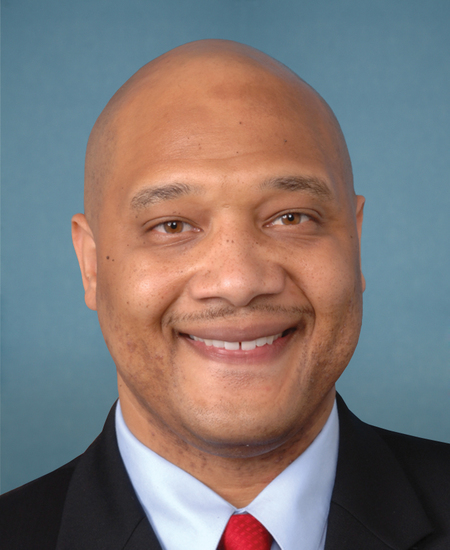
Rep. André Carson
Sponsored bills
21st Century President Act This act revises the definition of immediate family for purposes of a criminal offense involving a threat to kill, kidnap, or inflict bodily harm on a former President or a member of the immediate family of a former President. Specifically, it replaces gender-specific references to a former President's wife and widow with the gender-neutral terms spouse and surviving spouse .
Blocked Rail Crossings Safety Improvement Act of 2021 This bill addresses safety and congestion along railroad right-of-way and highway-rail grade crossings. For example, the bill directs the Department of Transportation (DOT) to provide grants to (1) assist state, local, and tribal governments in funding the cost of highway-rail grade crossing separation projects; and (2) help nonprofit organizations carry out public information and education programs to help prevent and reduce rail-related pedestrian, motor vehicle, and other incidents, injuries, and fatalities, and to improve awareness along railroad right-of-way and at highway-rail grade crossings. Additionally, the bill prohibits railroad carriers from obstructing travel at public highway-rail crossings for more than 10 minutes, except under limited circumstances (e.g., safety issues). Further, DOT must (1) establish a national blocked crossings database for the public to report blocked crossing incidents; (2) conduct a comprehensive review of the national highway-rail crossing inventory; and (3) revise its regulations, guidance, or other relevant agency documents to include the number of suicides on a railroad crossing or railroad right-of-way in the total number of rail fatalities it reports each year.
This resolution condemns the actions of a White supremacist mob that drove Black residents out of Atlanta, Georgia in 1906 and supports the designation of a national day of remembrance for the victims of forced migrations of Black Americans.
Justice For Journalists Act This bill requires the Federal Bureau of Investigation to conduct a criminal investigation of each nonnatural death of a U.S. journalist in a foreign country.
Black Lung Benefits Improvement Act of 2022 This bill revises requirements for miners' claims for pneumoconiosis (black lung disease) benefits. Specifically, the bill requires the Department of Labor to pay the attorneys' fees of specified parties on a qualifying benefit claim, give a claimant the opportunity to substantiate a claim for benefits through a pulmonary evaluation, authorize a CT (computerized tomography) scan in diagnosing complicated pneumoconiosis, and develop a strategy to reduce delays in adjudication of black lung disease benefits claims. The bill also establishes criteria that a mining operator must meet to self-insure against claims and increases from $1,000 to $25,000 the daily penalty amount that may be assessed against a mining operator that fails to make black lung benefits payments. The bill authorizes (1) black lung disease clinics to use federal funds to help individuals file claims, and (2) certain previously denied claimants to file a new claim for black lung disease benefits within one year. The bill prohibits a person from (1) knowingly and willfully making a false statement or misrepresentation in increasing or reducing black lung disease benefits, or (2) threatening or misleading a participant in a proceeding regarding such benefits. Further, the bill revises (1) the standards of medical evidence that establish a presumption that a miner is totally disabled by black lung disease, and (2) payments to such miners. Lastly, the bill provides statutory authority for the Office of Workers' Compensation Programs.
Aviation Funding Stability Act of 20 21 This bill provides continuing appropriations to the Federal Aviation Administration (FAA) from the Airport and Airway Trust Fund if an appropriations bill for the FAA has not been enacted before a fiscal year begins or a joint resolution making continuing appropriations for the FAA is not in effect. The bill provides appropriations at the rate of operations that was provided for the prior fiscal year to continue programs, projects, and activities for which funds were provided in the preceding fiscal year.
Rare disease Advancement, surveillance Research, and Education Act of 2022 or the RARE Act of 2022 The bill reauthorizes through FY2028 the National Institutes of Health Rare Disease Regional Centers of Excellence and expands activities to facilitate research and increase awareness of rare diseases and conditions. (Rare diseases and conditions are those with a prevalence of fewer than 200,000 individuals in the United States.) The Centers for Disease Control and Prevention may expand infrastructure and activities to track the epidemiology of up to four rare diseases and conditions and incorporate this information into a National Rare Disease or Condition Surveillance System. The Agency for Healthcare Research and Quality must expand its activities to increase health care providers' awareness of rare diseases and conditions. The National Academies of Sciences, Engineering, and Medicine, or another appropriate entity, must update the 2010 report Rare Diseases and Orphan Products: Accelerating Research and Development.
Interstate Teaching Mobility Act This bill authorizes the Department of Education to establish a voluntary interstate teaching application program for participating states. Under the program, a teacher in a participating state may obtain licensure or certification and apply for an open teaching position in another participating state without completing additional requirements.
Bus Rapid Transit Act This bill directs the Federal Transit Administration (FTA) to establish a grant program to provide grants to state, local, and tribal governments for the design and implementation of bus rapid transit systems, including for the redesign, retrofit, renovation, update, and repair of existing bus systems. As a condition of receiving a grant, eligible entities must certify that fares for riding the bus rapid transit system shall not increase solely due to improvements carried out with grant funds and for any reason for at least one year after completion of a project funded by the bill. In carrying out the program, the FTA must prioritize projects located in economically disadvantaged communities.