Maddy summaryHRES 580 is a symbolic resolution expressing the House's support for designating "Journeyman Lineworkers Recognition Day." It honors lineworkers who work in hazardous conditions (such as at heights near live wires) and respond to disasters like hurricanes and wildfires, while recognizing their contributions and the legacy of Henry Miller, an early electrical worker who died on the job. The resolution has no legal effect - it solely encourages public recognition and reflection on these workers' service.
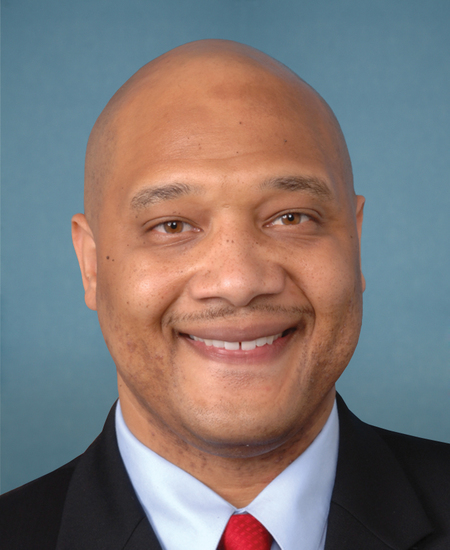
Rep. André Carson
Sponsored bills
Maddy summaryThe Algorithmic Justice and Online Platform Transparency Act requires major online platforms to disclose how they use personal information in algorithmic processes that recommend content, moderate posts, and target advertisements. Platforms must provide transparent notices to users about data collection and use, publish annual transparency reports showing content moderation decisions broken down by demographic information, and maintain an accessible advertisement library showing targeted ads. The bill prohibits algorithms from discriminating in housing, employment, credit, and education opportunities based on protected characteristics like race, gender, or disability. It establishes an interagency task force to study discriminatory algorithmic practices and empowers the Federal Trade Commission to enforce these requirements.
Maddy summaryThis bill increases funding for federal programs supporting small businesses owned by socially and economically disadvantaged individuals. It raises the annual cap for highway program supportive services from $10 million to $25 million and adds $5 million per year for transit program training and assistance. It also creates a new $5 million annual aviation program to help disadvantaged-owned businesses compete for airport-related contracts. These changes directly affect small businesses seeking federal contracting opportunities in transportation infrastructure projects.
Maddy summaryThe Water Infrastructure Enhancement Act of 2023 establishes a federal grant program to fund critical upgrades for public water systems. It directly affects water suppliers in rural areas (population ≤20,000) and communities designated as "areas of persistent poverty" (e.g., counties with 20%+ poverty for 30 years or census tracts with ≥20% poverty). The program allocates $800 million annually from 2024-2029, requiring at least 50% of funds to support rural areas and 15% to historically disadvantaged communities or persistent poverty zones. Grants cover up to 90% of costs for eligible activities like replacing pipes, upgrading treatment facilities, or modernizing monitoring systems, with the Administrator determining additional eligible projects.
Maddy summaryHR 4525, the Restroom Access Act of 2023, requires retail stores to allow customers with certain medical conditions to use their private restrooms during business hours under specific conditions. It directly affects customers with conditions like inflammatory bowel disease, ostomy devices, or pregnancy that require immediate restroom access when public facilities aren't available. Retailers must permit access if the customer shows a federally issued identification card (created by the Secretary of Labor within 180 days), two employees are present, and no health/safety risks exist. The law defines "eligible medical conditions" broadly to include specific diagnoses and pregnancy, ensuring access when public restrooms are inaccessible.
Candidate Voice Fraud Prohibition Act This bill prohibits the distribution of certain paid-for political communications that contain materially deceptive audio that is generated by artificial intelligence which impersonates a candidate's voice. It also establishes criminal penalties for related violations. The bill generally prohibits individuals, political committees, and other entities from distributing such a communication if the communication (1) contains materially deceptive audio that is generated by artificial intelligence which impersonates a candidate’s voice, (2) is distributed with actual malice, (3) is intended to injure the candidate’s reputation or to deceive a voter into voting against the candidate, and (4) is distributed within 60 or 90 days of an election (depending on the type of election). This prohibition does not apply to certain entities, such as radio or television broadcasting stations that broadcast the deceptive audio as part of a bona fide newscast. Additionally, the bill establishes a new criminal offense related to the distribution of materially deceptive audio that is generated by artificial intelligence which impersonates a candidate's voice. A violator is subject to criminal penalties—a fine, up to two years in prison, or both. The bill requires the Federal Election Commission to (1) promulgate regulations related to this bill, and (2) report to Congress on matters relating to compliance with and enforcement of this bill and recommendations to ensure compliance with this bill.

Maddy summaryThis bill creates a federal grant program to help communities address childhood trauma from violence or neglect. It authorizes $10 million annually (2024-2027) for states, local governments, tribes, and community organizations to establish "adverse childhood experiences response teams." These teams would develop protocols for trauma cases, connect families with mental health services, train first responders, and break down barriers to care. The program directly supports children exposed to trauma and the organizations providing services to them.
Maddy summaryThis bill establishes the Emmett Till and Mamie Till-Mobley and Roberts Temple National Historic Site in Chicago, Illinois, as a unit of the National Park System. It requires the Secretary of the Interior to create the site only after securing an agreement with Roberts Temple Church (the Roberts Temple) for public access, interpretation, and maintenance. The site preserves and interprets resources tied to the Great Migration, Emmett Till’s memorial service, Mamie Till-Mobley’s activism following her son’s murder, and the civil rights movement. The National Park Service will administer the site under standard park laws, with management plans developed in coordination with Roberts Temple. The site directly affects Roberts Temple Church (as the managing partner) and the public (through access to historical resources).
Child Care Investment Act of 2023 This bill increases the employer-provided child care tax credit, the amount excludable from gross income for dependent care flexible spending accounts, and makes the household and dependent care tax credit refundable. Among other provisions, the bill increases the rate of the employer-provided child care tax credit from 25% to 50% and increases the maximum credit amount from $150,000 to $500,000. It also increases (1) the pre-tax deduction for dependent care flexible spending accounts from $5,000 to $10,000, plus an additional $2,000 for each eligible dependent; and (2) the rate of the household and dependent care tax credit and makes such credit refundable.
Maddy summaryThe Veteran Service Recognition Act of 2023 requires the Department of Defense, Homeland Security, and Veterans Affairs to study noncitizen veterans removed from the U.S. between 1990 and 2023, documenting their service history and reasons for removal. It establishes a system to identify noncitizen veterans before removal proceedings and creates a Military Family Immigration Advisory Committee to review cases and recommend against removal for veterans. The bill also creates a program to facilitate citizenship for noncitizen service members and provides pathways for previously removed noncitizen veterans to adjust to lawful permanent residence. These provisions directly affect noncitizen veterans and their family members facing immigration proceedings, aiming to better recognize military service in immigration decisions.