

Maddy summaryThis bill establishes the Project Turnkey Program, allocating $1 billion annually to fund affordable housing and homelessness services. It directly helps vulnerable populations including homeless individuals, those at risk of homelessness, and victims fleeing domestic violence or trafficking. Key provisions allow funds for rental assistance, rehabilitating vacant properties (like hotels and motels), supportive services, and shelter operations, while requiring states to use funds to supplement - not replace - existing local housing investments. The program runs through 2034 with specific rules to streamline housing development and expand capacity for community organizations.
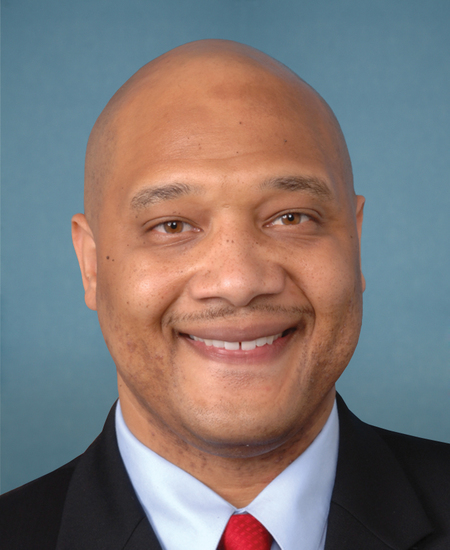
Rep. André Carson
Sponsored bills
Maddy summaryThe BUILD GREEN Infrastructure and Jobs Act establishes a $50 billion annual grant program (2025-2034) to fund electrified transportation infrastructure projects that reduce greenhouse gas emissions and improve transportation access. It prioritizes projects in frontline, vulnerable, or disadvantaged communities (requiring 40% of funds), with 30-40% allocated to rural areas and 60-70% to urban areas. The bill mandates recipients use 5% of grant funds for workforce training, pay a minimum wage of $17 per hour (increasing annually), and use renewable energy sources for project operations. Eligible projects include electric buses, rail systems, port infrastructure with EV charging, and micromobility initiatives that reduce emissions and improve transportation services.
Maddy summaryThe Educator Down Payment Assistance Act of 2024 creates a federal grant program to help eligible educators purchase homes. It authorizes HUD to award grants to local governments, school districts, or housing agencies to provide up to $25,000 (higher in high-cost areas) for down payments, closing costs, or interest rate reductions on eligible mortgages. To qualify, educators must be first-time homebuyers with at least 3 years of service in public K-12 schools, meet income limits (up to 180% of area median income in high-cost areas), and agree to live in the home as their primary residence for 3 years while continuing to work in education for 3 years. The program requires returning funds if these conditions are violated, except in cases of emergencies like military deployment or death.
Maddy summaryThis bill provides $280 million in funding for the Department of Education's Office for Civil Rights (OCR) for fiscal year 2024, with funds available through September 2025. The OCR investigates school discrimination complaints related to race, sex, disability, and other protected characteristics. This funding directly supports the OCR's ability to handle civil rights cases involving students and schools nationwide, without creating new student requirements or altering existing laws.
Payment Choice Act of 202 3 This bill requires retail businesses to accept cash as a form of payment for on-site sales of $500 or less, and it prohibits them from charging cash-paying customers a higher price compared to customers not paying with cash. Businesses covered by this bill are those engaged in the business of selling or offering goods or services at retail to the public that accept in-person payments at a physical location. The bill provides for enforcement through preventative relief, damages, and civil penalties.
Maddy summaryThis resolution (HRES 1198) commemorates the 105th anniversary of formal diplomatic relations between the United States and Poland, established in 1919. It honors historical milestones including Poland’s fight for independence, Polish-American contributions (like the Blue Army and figures such as Kosciuszko and Paderewski), and shared democratic values. The resolution highlights key events like the 1918 Fourteen Points and Poland’s NATO/EU membership, but does not create new laws or affect any individuals or entities. It serves as a ceremonial recognition of enduring U.S.-Poland ties, reaffirming mutual commitment to democracy and security. As a commemorative resolution, it has no legal effect beyond expressing congressional sentiment.
Maddy summaryHRES 1180 is a non-binding resolution recognizing the importance of diversity, equity, and inclusion (DEI) efforts in medical education. It affirms that a diverse medical workforce better serves the nation's diverse patient populations and supports medical schools in fostering inclusive environments to improve health equity. The resolution highlights existing disparities in health outcomes and representation, such as Black and Hispanic patients experiencing higher rates of chronic conditions compared to White patients, and notes that current medical school demographics (e.g., 10.8% Black or African American matriculants in 2023) do not reflect U.S. population diversity. It does not create new laws or funding but symbolically endorses DEI initiatives as essential for enhancing patient trust, clinical learning, and equitable care delivery.
Maddy summaryHR 8231, the James Earl Jones Congressional Gold Medal Act, authorizes a Congressional Gold Medal to be awarded to actor James Earl Jones in recognition of his distinguished career in theater and film, and his role in advancing inclusion and equal opportunities for people of all backgrounds in the entertainment industry. The Treasury will strike the medal with an image and inscription of Jones, and may produce and sell bronze duplicates to cover costs, with proceeds deposited into the U.S. Mint's public enterprise fund. This bill serves as a ceremonial honor with no new legal requirements or policy changes.
Maddy summaryThe CROWN Act of 2024 prohibits discrimination based on hair texture or style commonly associated with race or national origin, such as braids, locs, cornrows, twists, or afros. It directly affects individuals - particularly people of African descent - who face workplace, school, housing, or public accommodation discrimination due to natural or protective hairstyles. The bill expands existing federal civil rights laws (like Title VI, the Fair Housing Act, and Title VII) to explicitly include hair-based discrimination, requiring compliance in federally funded programs, housing, employment, and public spaces. It clarifies that grooming policies targeting these hairstyles violate anti-discrimination protections without creating new legal standards.
Maddy summaryHRES 1171 is a non-binding resolution recognizing the 30th anniversary of the 1994 Rwandan Genocide, where an estimated 800,000 Tutsis and others were killed. It expresses the House’s regret for U.S. and international inaction during the genocide, reaffirms U.S. commitment to genocide prevention under the 1948 Convention, and joins Rwanda and global communities in mourning victims. The resolution has no direct policy impact or effect on specific groups, as it is purely commemorative. It was introduced in the U.S. House of Representatives on April 26, 2024, by Representatives Omar, Jackson, Norton, Carson, and McGovern.