This resolution expresses the sense of the House of Representatives that Canada should not allow construction of a nuclear waste repository within the Great Lakes Basin and that the President and the Department of State should work with Canada to prevent such construction and craft a long-term solution for nuclear waste storage that does not threaten the Great Lakes.
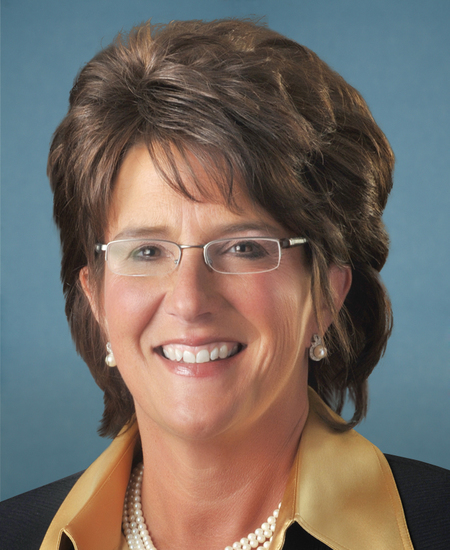
Rep. Jackie Walorski
Sponsored bills
Supporting Early-childhood Educators' Deductions Act or the SEED Act This bill expands the tax deduction for the expenses of elementary and secondary school teachers to include early childhood educators.
Relief for Working Families Act This bill modifies the tax credit for employer-paid family and medical leave. Specifically, it extends the credit for a five-year period after an employer plan for payment of family and medical leave benefits is established. The bill also provides for an increased credit for plans established by certain small employers (i.e., employers with gross receipts not exceeding $25 million and 50 or fewer employees during the taxable year).
This bill requires the Internal Revenue Service (IRS) to report to Congress on projections of the estimated tax gap (i.e., the difference between tax liabilities owed to the IRS and those liabilities that the IRS actually collects). The IRS may use artificial intelligence and related data analysis tools to calculate a tax gap projection. The bill also requires the Joint Committee on Taxation to issue periodic reports to the congressional tax committees on the tax gap projection. The bill restricts IRS funding to FY2021 levels for audits and enforcement until it publishes an updated tax gap projection. Funding is also restricted for certain purposes, including (1) targeting U.S. citizens who exercise their First Amendment rights, (2) targeting a group for regulatory scrutiny based on its ideological beliefs, and (3) auditing individual taxpayers with an adjusted gross income of less than $400,000. The bill directs the IRS to establish a fellowship program to recruit private sector tax experts to join the IRS to create and participate in the audit task force. The purposes of the tax force include performing audit case selection, educating IRS employees on emerging issues, auditing selected taxpayers, addressing offshore tax evasion, and identifying, mentoring, and training IRS junior employees with respect to audits.

Expanding Small Employer Pooling Options for Paid Family Leave Act of 2021 This bill expands the purposes for which small employers may combine their contributions under a multiple employer welfare arrangement to include paid family and medical leave benefits.
Puppies Assisting Wounded Servicemembers for Veterans Therapy Act or the PAWS for Veterans Therapy Act This bill implements a program and a policy related to service dog therapy for veterans. Specifically, the bill requires the Department of Veterans Affairs (VA) to implement a five-year pilot program to provide canine training to eligible veterans diagnosed with post-traumatic stress disorder as an element of a complementary and integrative health program. Eligible veterans are those who are enrolled in the VA health care system and have been recommended for participation by a qualified mental health care provider or clinical team. The VA must seek to enter agreements containing specified elements with accredited nongovernmental entities that have demonstrated ability to provide canine training. Veterans who participate in the program are authorized to adopt the dog they assisted in training if their health provider determines it is in the best interest of the veteran. The VA must establish processes to document and track the progress of participating veterans with respect to health benefits and improvements. The Government Accountability Office must brief Congress and submit a report on the program. The bill also authorizes the VA to provide service dogs to veterans with mental illnesses, regardless of whether they have a mobility impairment.
This resolution condemns the President's failure to heed military and intelligence advisors about the speed and nature of the Taliban offense in Afghanistan and urges the President to commit to maintaining the evacuation operation as long as necessary to evacuate any U.S. citizen, lawful permanent resident, or Afghan partner who requests evacuation assistance .
Border Security for America Act of 2021 This bill addresses border security and related issues. For example, the bill requires the Department of Homeland Security (DHS) to resume all activities to construct a border barrier system along the U.S.-Mexico border that were underway or planned prior to January 20, 2021; requires DHS to deploy, in addition to physical barriers, tactical infrastructure and technology to achieve situational awareness and operational control of the southwest border; authorizes U.S. Customs and Border Protection (CBP) to carry out a program to acquire innovative commercial items through a competitive selection of proposals; imposes certain requirements for DHS border security technology acquisition programs that have a total expenditure of at least $300 million; requires CBP to implement certain technologies, including a program to establish a biometric exit data system at ports of entry; requires CBP to increase or maintain certain staffing levels for agents, officers, processing coordinators, and other positions; requires CBP to implement a workload staffing model for the U.S. Border Patrol and for CBP's Air and Marine Operations; and provides statutory authority through FY2026 for Operation Stonegarden, a Federal Emergency Management Agency program that provides grants to states and territories involved in certain active CBP border security operations.
Fair Sugar Policy Act of 20 21 This bill makes several modifications to the Department of Agriculture's sugar program. Among other modifications, the bill decreases the rate for price support loans, repeals the marketing allotments, revises the administration of import quotas, and repeals the Feedstock Flexibility Program.
PACE Part D Choice Act of 2021 This bill allows Medicare-only beneficiaries who are enrolled in Programs of All-Inclusive Care for the Elderly (PACE) to choose prescription drug plans that are not operated by PACE. (PACE is a program under Medicare and Medicaid that provides in-home and community services for certain individuals as an alternative to nursing home care.) Specifically, the bill allows PACE enrollees who are Medicare (but not Medicaid) beneficiaries to choose a prescription drug plan that is not a Medicare Advantage plan or operated by PACE and for which annual out-of-pocket costs and federal subsidies are equal to or less than that under the applicable PACE prescription drug plan. The bill also allows for disenrollment from a chosen plan upon a change in medication or demonstration of an unexpected increase in out-of-pocket costs. PACE programs must conduct outreach, monitor data, and coordinate benefits with respect to such options.