

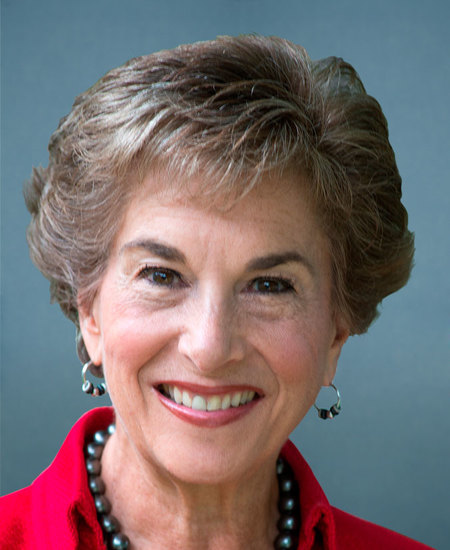
Photo of Janice D. Schakowsky
D United States House · District 9 · Illinois

Rep. Janice D. Schakowsky

Compare
Total votes
2,837
all sessions
Attendance
97%
99 missed
Lower than 88% of chamber peers
With party
97%
of cast votes
Higher than 80% of chamber peers
Bipartisan score
1%
crosses aisle rarely
Lower than 80% of chamber peers
Sponsored
2,564
bills & resolutions
Higher than 91% of chamber peers
Committees
3
assignments
2,564 bills and resolutions

Sponsored bills

Total
2,564
Primary
151
Co-sponsor
2,413
This page
2,564
matching current filters
Co-sponsor HR 7288
In committee · United States House · Co-sponsor
Armenian Protection Act of 2024

Maddy summaryHR 7288, the Armenian Protection Act of 2024, repeals the waiver authority that allows the President to bypass restrictions on U.S. aid to Armenia. Specifically, it prevents the waiver of Section 907 of the Freedom Support Act for fiscal years 2024 and 2025, which currently blocks U.S. assistance to Armenia due to historical disputes. This bill directly affects Armenia's eligibility for certain U.S. foreign aid programs by removing the possibility of executive branch waivers for those years. The key mechanism is the permanent removal of the waiver option under the specified appropriations law, changing the policy landscape for U.S.-Armenia aid relations.

In committee Feb 7, 2024 1 co-sponsor
Co-sponsor HR 7261
In committee · United States House · Co-sponsor
Reimagining Inclusive Arts Education Act

Maddy summaryHR 7261, the Reimagining Inclusive Arts Education Act, creates a federal grant program to improve arts education access for children with disabilities in K-12 schools. The bill authorizes $15 million over five years (2025-2029) to fund competitive grants for eligible entities like school districts, state agencies, or partnerships with colleges/nonprofits. Grant recipients must use funds to adapt arts curricula, provide professional development for arts educators, and incorporate creative arts therapies (like music or dance) to increase inclusion and accessibility for students with disabilities. Priority is given to schools receiving Title I funding, and grants last up to three years with possible renewal based on program success.

In committee Feb 6, 2024 1 co-sponsor
Co-sponsor HR 7244
In committee · United States House · Co-sponsor
End Tax Breaks for Dark Money Act

Maddy summaryHR 7244, the "End Tax Breaks for Dark Money Act," eliminates tax exemptions for political groups and certain nonprofits when they receive property that has increased in value (like stocks or real estate). It targets organizations that accept anonymous donations ("dark money") by removing their ability to avoid capital gains tax on such property transfers. The bill amends the tax code to require these groups to pay tax on the appreciated value when receiving property, rather than allowing them to bypass capital gains tax. This change directly affects political organizations under Section 527 and specific nonprofits under Section 501(c), applying to transfers after the bill's enactment.

In committee Feb 6, 2024 1 co-sponsor
Co-sponsor HR 793
In committee · United States House · Co-sponsor
JOBS Act of 2023

Maddy summaryThe JOBS Act of 2023 would expand Federal Pell Grant eligibility to cover certain short-term job training programs that prepare students for high-demand careers. It defines "eligible job training programs" as those offering 150-600 hours of instruction over 8-15 weeks, aligned with in-demand industry sectors, and leading to recognized credentials that help students meet hiring requirements and take licensure exams. The bill would allow students in these programs to receive Pell Grants under standard terms, with the minimum Pell Grant amount reduced from 10% to 5% of the maximum. It also requires accrediting agencies to evaluate these programs and creates data-sharing between Education and Labor departments to track program effectiveness.

In committee Feb 6, 2024 1 co-sponsor
Primary HR 7120
In committee · United States House · Lead sponsor
R U REAL Act

Maddy summaryHR 7120, the R U REAL Act, requires telemarketers using AI to mimic human voices or text in calls or messages to disclose at the start that AI is being used. It directly affects businesses engaging in AI-powered telemarketing that impersonates individuals or entities. The bill adds enhanced penalties, doubling civil fines for violations where AI is used deceptively to defraud or cause harm. These changes amend the Telemarketing Sales Rule and the Telemarketing and Consumer Fraud Act, effective after the bill's enactment.

In committee Feb 2, 2024 0 co-sponsors
Co-sponsor HR 7116
In committee · United States House · Co-sponsor
Do Not Disturb Act

Maddy summaryHR 7116, the Do Not Disturb Act, updates federal rules to combat robocalls and deceptive telemarketing. The bill requires clear disclosure when AI is used to mimic human voices in calls or messages, enhances penalties for AI impersonation scams, and mandates free robocall-blocking services for consumers. It also creates a tracking system for the top 100 illegal robocall campaigns and expands telemarketing regulations to include text messages, applying to telecommunications providers, VoIP services, and businesses making automated calls or sending text messages.

In committee Feb 2, 2024 1 co-sponsor
Co-sponsor HRES 989
In committee · United States House · Co-sponsor
Expressing support for the recognition of January as "Muslim-American Heritage Month" and celebrating the heritage and culture of Muslim Americans in the United States.

Maddy summaryThis symbolic resolution (HRES 989) urges the U.S. House of Representatives to recognize January as "Muslim-American Heritage Month" to honor the contributions of Muslim Americans. It highlights their historical and contemporary roles in U.S. society across fields like business, science, sports, and public service. The resolution calls for public observance through ceremonies and programs but has no legal effect or policy changes. It does not allocate funding, alter laws, or directly affect any specific group beyond raising awareness of Muslim-American heritage.

In committee Jan 31, 2024 1 co-sponsor
Co-sponsor HRES 990
In committee · United States House · Co-sponsor
Expressing the sense of the House of Representatives that paraprofessionals and education support staff should have fair compensation, benefits, and working conditions.

Maddy summaryHRES 990 is a non-binding resolution expressing the House of Representatives' support for fair treatment of paraprofessionals (like instructional assistants) and education support staff (such as clerical, custodial, and food service workers) in schools. It states these over 3 million frontline workers deserve livable wages, affordable health care, job security, paid leave, professional development, and safe working conditions. The resolution lists specific recommendations, including eligibility for family medical leave and protections against retaliation for reporting workplace issues. It does not create new laws but formally recognizes these staff as essential to school success and calls for policies addressing their current challenges.

In committee Jan 31, 2024 1 co-sponsor
Co-sponsor HR 7165
In committee · United States House · Co-sponsor
Credit for Caring Act of 2024

Maddy summaryThe Credit for Caring Act of 2024 creates a new federal tax credit for family caregivers. It allows eligible caregivers to claim a credit equal to 30% of qualified caregiving expenses (like home modifications, medical supplies, or respite care) exceeding $2,000 per year, capped at $5,000 annually. To qualify, caregivers must earn over $7,500 in income and provide care for a relative (like a spouse or parent) certified by a healthcare provider as needing long-term care for at least 180 days. The credit phases out for higher earners, with a $75,000 income threshold for single filers and $150,000 for joint returns.

In committee Jan 31, 2024 1 co-sponsor
Co-sponsor HR 7168
In committee · United States House · Co-sponsor
Investor Choice Act of 2024

Maddy summaryThe Investor Choice Act of 2024 prohibits financial firms (brokers, dealers, investment advisers) from requiring mandatory arbitration in disputes with retail investors. It bans clauses in contracts or bylaws that force investors to use arbitration instead of court or class action lawsuits. The bill voids such mandatory arbitration provisions in new agreements and existing contracts (except for arbitrations already started before enactment). This directly affects retail investors who gain the right to choose court or class action options for securities-related disputes.

In committee Jan 31, 2024 1 co-sponsor
Showing 931 to 940 of 2,564 bills
Previous 1 … 93 94 95 … 257 Next