

Transit to Trails Act of 2021 This bill directs the Department of Transportation (DOT) to establish the Transit to Trails Grant Program to award grants to certain governmental and private entities for projects that increase transportation access and mobility to public lands, inland and coastal waters, parkland, or monuments for critically underserved communities. For example, DOT must (1) prioritize approving certain projects, such as projects that use low-or zero-emission vehicles and those that provide free or discounted rates for low-income riders; (2) develop transportation planning procedures for projects conducted under the program that are consistent with metropolitan and statewide planning processes; and (3) ensure that all new transportation connectors and routes developed under the program are accessible to people with disabilities. The bill requires grant awards to be at least $25,000 and not more than $500,000. Further, the bill requires publicized schedules and routes for transportation systems that are developed after the receipt of a grant under the program.
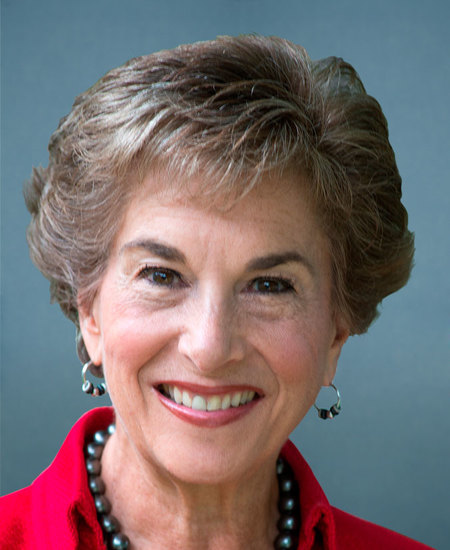
Rep. Janice D. Schakowsky
Sponsored bills
Transform, Heal, and Renew by Investing in a Vibrant Economy Act or the THRIVE Act This bill establishes a program to address the economy, racial justice, and climate change. The President must establish a board to advise the President and the heads of federal departments and agencies regarding the implementation of this bill. The President, in consultation with the board, must establish a 10-year plan to create a society that enables and supports greater racial, Indigenous, gender, environmental, and economic justice; work opportunities; healthy communities; a stable climate; and healthy ecosystems. In addition, the President, in consultation with the board, must implement a program that provides support to public or private entities that carry out qualified programs. The programs must meet certain labor, equity, and environmental conditions and support infrastructure, including to expand access to pollution-free, renewable, and affordable energy; care workers and social infrastructure (e.g., health care infrastructure); expanded access to housing; efforts to protect and restore biodiversity or natural habitats and efforts to remediate pollution in communities harmed by environmental, economic, or socioeconomic injustice; agriculture, including agricultural workers; or the development and transformation of the U.S. industrial base, including by expanding manufacturing of clean technologies.
Accessible Voting Act of 2021 This bill addresses voting accessibility for individuals with disabilities and older individuals. First, the bill establishes the Office of Accessibility within the Election Assistance Commission (EAC). The office must serve as the advocate on behalf of voters with access needs, ensure state and local election officials are maintaining voting systems that meet Department of Justice accessibility standards, and make payments to states to implement the accessibility requirements outlined by the bill. In addition, the office must establish and operate a National Resource Center on Accessible Voting to provide state and local election officials, poll workers, and volunteers with the information and technical assistance needed to provide accessible voting. The office must also work with state and local election officials to collect data and administer a public national voter accessibility website. The bill requires each state to (1) ensure election websites are accessible and meet specified requirements, (2) designate a single office to provide information on federal elections to individuals with disabilities and older individuals, (3) notify the public of changes to voting practices, (4) expand access to absentee registration procedures and no-excuse mail-in absentee voting in federal elections, and (5) ensure all polling places and voter drop boxes are accessible. The EAC must coordinate with specified agencies to make grants to eligible entities to study, test, and develop accessible voting options. The bill also permanently reauthorizes and expands a Department of Health and Human Services grant program for increasing accessibility to polling places.
Truth in Tuition Act of 2021 This bill requires institutions of higher education (IHEs) that participate in federal student-aid programs to provide admitted students with information related to tuition and fees. Specifically, the bill requires an IHE to provide to a student (1) a multi-year tuition and fee schedule; or (2) a single-year tuition and fee schedule and a nonbinding, multi-year estimate of net costs after financial aid is awarded. The Department of Education may waive this requirement under certain circumstances.
Creating Opportunities Now for Necessary and Effective Care Technologies (CONNECT) for Health Act of 2021 or the CONNECT for Health Act of 2021 This bill expands coverage of telehealth services under Medicare. Among other provisions, the bill allows the Centers for Medicare & Medicaid Services (CMS) to waive certain restrictions, such as restrictions on the types of technology that may be used; permanently removes geographic restrictions on originating sites (i.e., the location of the beneficiary) and allows the home of the beneficiary to serve as the originating site for all services; permanently allows federally qualified health centers and rural health clinics to serve as the distant site (i.e., the location of the health care practitioner); and allows the CMS to generally waive coverage restrictions during any public health emergency. Additionally, the CMS must report on the effects of expanded telehealth services during the COVID-19 public health emergency, including with respect to the utilization, quality, and outcomes of services. The Center for Medicare and Medicaid Innovation may also test alternative payment models relating to expanded telehealth services.
Ban Conflicted Trading Act This bill prohibits a Member of Congress or certain congressional officers or employees from (1) purchasing or selling specified investments, (2) entering into a transaction that creates a net short position in a security, or (3) serving as an officer or member of any board of any for-profit entity.
This concurrent resolution (1) affirms, on the 400th anniversary of the arrival of the first slave ship, that the nation owes a debt of remembrance not only to those who lived through the injustices of slavery but also to their descendants; and (2) urges the establishment of a U.S. Commission on Truth, Racial Healing, and Transformation to properly acknowledge, memorialize, and be a catalyst for progress, including toward permanently eliminating persistent racial inequities.
This joint resolution proposes a constitutional amendment declaring that women shall have equal rights in the United States and every place subject to its jurisdiction. The amendment prohibits the United States or any state from denying or abridging equal rights under the law on account of sex.
This resolution condemns and denounces all forms of anti-Asian sentiment, including those related to COVID-19 (i.e., coronavirus disease 2019), and calls on federal law enforcement officials, working with state and local agencies, to take specified steps. The resolution calls on federal officials to expeditiously investigate and document all credible reports of hate crimes, harassment, bullying, and threats against the Asian American and Pacific Islander communities; the Attorney General to work with state and local agencies and Asian American and Pacific Islander community-based organizations to prevent discrimination and to expand culturally competent and linguistically appropriate education campaigns on public reporting of hate crimes; and the Department of Health and Human Services to issue guidance describing best practices to mitigate racially discriminatory language in describing the pandemic. The resolution recommits the United States to serving as a world leader in building more inclusive, diverse, and tolerant societies by (1) prioritizing language access and inclusivity in communication practices, and (2) combating misinformation and discrimination that put Asian Americans and Pacific Islanders at risk.
Protecting America's Workers Act This bill expands the coverage of requirements governing workplace safety and health to include protection for federal, state, and local government employees. However, the bill does not cover working conditions otherwise covered by federal requirements for mine safety and health. The bill revises requirements governing worker protection, including by expanding protections for whistle-blowers, such as protections for employees who refuse to perform work because they reasonably believe the work would result in serious injury or illness and for employees who aid inspections; directing employers to furnish a hazard-free place of employment to all individuals performing work, not just employees; directing employers to report work-related deaths or certain injuries, illnesses, or hospitalizations; requiring the Department of Labor to investigate fatalities or significant incidents in the workplace; establishing rights for victims, or representatives of victims, with respect to inspections or investigations of work-related bodily injuries or deaths; setting the permitted period for employers to correct serious, willful, or repeated violations while citations for the violations are being contested; increasing civil and criminal penalties for certain violations; expanding enforcement requirements relating to state occupational safety and health plans; expanding requirements for workplace health hazard evaluations by the National Institute for Occupational Safety and Health; and requiring Labor to provide training programs concerning employee rights and employer responsibilities.