

Washington, D.C. Admission Act This bill provides for the establishment of the State of Washington, Douglass Commonwealth, and its admission into the United States. The state is composed of most of the territory of the District of Columbia (DC), excluding a specified area that encompasses the U.S. Capitol, the White House, the U.S. Supreme Court building, federal monuments, and federal office buildings adjacent to the National Mall and the U.S. Capitol. The excluded territory shall be known as the Capital and serve as the seat of the government of the United States, as provided for in Article I of the Constitution. The state may not impose taxes on federal property except as Congress permits. The bill provides for the DC Mayor to issue a proclamation for the first elections to Congress of two Senators and one Representative of the state. The bill eliminates the office of Delegate to the House of Representatives. The bill applies current DC laws to the state. DC judicial proceedings and contractual obligations shall continue under the state’s authority. The bill also provides for specified federal obligations to transfer to the state upon its certification that it has funds and laws in place to assume the obligations. These include maintaining a retirement fund for judges and operating public defender services. The bill establishes a commission that is generally comprised of members who are appointed by DC and federal government officials to advise on an orderly transition to statehood.
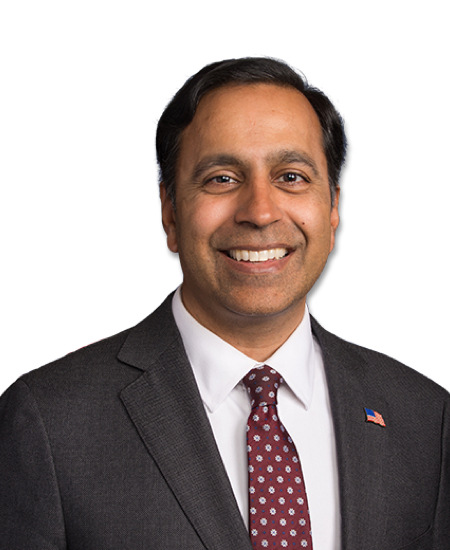
Rep. Raja Krishnamoorthi
Sponsored bills
Maddy summaryThe Treat and Reduce Obesity Act of 2023 expands Medicare coverage for obesity treatment by allowing a wider range of healthcare providers - including nurse practitioners, dietitians, psychologists, and community-based counseling programs - to deliver intensive behavioral therapy for obesity, provided they coordinate with primary care providers. It also adds Medicare Part D coverage for medications used to treat obesity or for weight loss management in overweight individuals with related health conditions like diabetes or high blood pressure. These changes directly affect Medicare beneficiaries, particularly older adults (65+), who face higher obesity rates and associated costs, including $50 billion annually in Medicare spending for obesity-related care. The bill requires annual reports to Congress on implementation to improve coordination of obesity care across federal health programs.
Maddy summaryThe Stop Campus Hazing Act requires colleges and universities to publicly report hazing incidents involving student organizations. It defines hazing as intentional acts causing physical or psychological harm during initiation or membership in student groups, including activities like forced substance consumption, sleep deprivation, or sexual acts. Institutions must include hazing statistics in annual security reports and publish a "Campus Hazing Transparency Report" on their websites by July 1, 2025, detailing findings about organizations violating hazing policies. The reports must include organization names, violation descriptions, and key dates while excluding personally identifiable student information. This applies to all colleges participating in federal student aid programs.
Maddy summaryThis bill, HR 1097 (Everett Alvarez, Jr. Congressional Gold Medal Act of 2023), authorizes the award of a Congressional Gold Medal to Everett Alvarez, Jr., in recognition of his service as a U.S. Navy pilot and Vietnam War prisoner of war. It directly honors Alvarez, who was the first U.S. pilot shot down in the Vietnam War, spent over 8.5 years in captivity, and later served in the Peace Corps and Veterans Administration. The bill’s key mechanism is directing the U.S. Mint to strike a gold medal bearing his name and image, with bronze duplicates available for sale to cover costs. It does not create new policies or affect any group beyond the honoree.
Maddy summaryHR 5401, the 9/11 Memorial and Museum Act, provides a one-time federal grant of $5 million to $10 million to the National September 11 Memorial & Museum (operated by the World Trade Center Foundation). The grant funds the museum's operations, security, and maintenance, with specific requirements including free admission for veterans, first responders, and victims' families, dedicated weekly free public hours, and annual financial audits. The museum must also report annually to Congress on how the funds were used. This bill directly affects the museum's financial operations and access policies, not broader legislative changes.
Maddy summaryThis bill codifies and expands existing U.S. sanctions targeting Chinese entities involved in fentanyl-related activities. It authorizes the President to impose financial sanctions on foreign persons - including Chinese government entities, ports, ships, manufacturers, and online marketplaces - that facilitate the international flow of illicit synthetic narcotics or their precursors. Key provisions include blocking U.S. financial transactions with targeted entities, requiring congressional reporting on enforcement, and excluding intelligence/law enforcement activities from sanctions. The bill directly affects Chinese entities operating in Hong Kong, Macau, or mainland China that contribute to fentanyl proliferation, with sanctions applying to property or transactions within U.S. jurisdiction.
Maddy summaryHR 10459 establishes a federal Joint Task Force to Counter Illicit Synthetic Narcotics (JTF-ISN) to coordinate agency efforts against synthetic opioid trafficking. The task force, led by a presidentially appointed Director reporting to the Attorney General, includes members from Justice (DEA, FBI), Treasury (FinCEN, IRS), Homeland Security (CBP, ICE), State, Commerce, Defense, and intelligence agencies. It requires regular congressional reports on operations, funding needs, and efforts to disrupt trafficking networks - particularly those linked to foreign entities like China - while explicitly limiting the task force to targeting large-scale trafficking, not personal use or low-level dealing. The bill does not create new agency powers but mandates better interagency coordination to address the opioid crisis through strategic operations and information sharing.
Maddy summaryThis bill requires Chinese shipping companies to properly declare fentanyl precursors and related chemicals on all shipments to the U.S., with strict customs reporting rules. It imposes civil penalties of up to $250,000 or 0.025% of a vessel’s cargo value for non-compliance, doubling for falsified records and escalating for repeated violations. The penalties collected fund U.S. drug enforcement efforts targeting fentanyl trafficking. It directly affects Chinese entities (including those with significant Chinese ownership) involved in shipping these chemicals to the U.S. or cooperating jurisdictions.
Maddy summaryThis bill extends Medicare payment adjustments for physicians and other practitioners through 2025 instead of ending in 2024. It specifically adds a 4.73% payment increase for services provided between January 1, 2025, and January 1, 2026. The legislation modifies existing Medicare payment rules to stabilize practice revenues during transition periods. It directly affects doctors and healthcare providers who bill Medicare for patient services. The key change is the extended timeframe and the defined 4.73% rate for the 2025-2026 period.
Maddy summaryHR 10050 requires the Health and Human Services Secretary to study pharmacy benefit manager (PBM) audit practices within one year of enactment. The study will assess financial impacts on independent pharmacies, evaluate if audit deadlines align with medication shelf lives (including FDA-approved 2+ year shelf lives), and examine audit transparency. It will also identify fairer audit processes to reduce burdens on pharmacists while maintaining audit integrity. The report must cover audits for Medicare, Medicaid, and insurance plans, including recommendations for transparency improvements.