

Maddy summaryThis bill requires companies that list securities in the United States to disclose whether their supply chains involve goods produced using forced labor in China's Xinjiang region. To comply, issuers must obtain independent audits from third-party auditors and publicly report detailed information about their sourcing, including specific facility names, revenue generated from affected products, and steps taken to avoid human rights abuses. The legislation defines forced labor broadly to include work under state-sponsored programs targeting specific ethnic groups in Xinjiang and mandates that these disclosure rules remain in effect for eight years unless the President certifies that such abuses have ended.
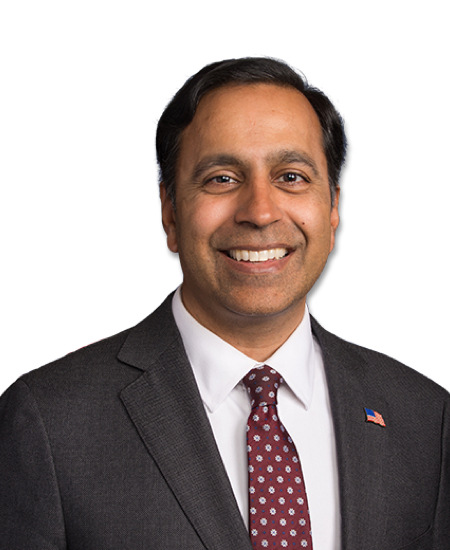
Rep. Raja Krishnamoorthi
Sponsored bills
Maddy summaryThe Universal School Meals Program Act of 2026 mandates that all public schools provide free breakfast and lunch to every enrolled student, regardless of income. It establishes specific funding rates for these meals, adjusts payments based on the use of locally sourced food, and eliminates the ability of schools to collect debt for unpaid charges. Additionally, the bill expands free meal access to summer programs, afterschool care, and incarcerated juveniles while updating poverty measurement standards across various federal education and nutrition laws.
Maddy summaryHRES 64 is a non-binding House resolution affirming the U.S.-South Korea alliance. It highlights historical ties (dating to 1882), economic partnerships (including 2023 trade data), and security cooperation (like the 1953 Mutual Defense Treaty), while celebrating Korean American contributions to U.S. society. The resolution formally supports strengthening security, economic, and cultural ties between the two nations and notes the 2025 anniversary of Korean liberation. It does not create new laws or funding, but serves as a symbolic statement of congressional support for the alliance.
Maddy summaryThis resolution reaffirms the House of Representatives' support for the Taiwan Relations Act and longstanding bipartisan U.S. policy toward Taiwan. It highlights key provisions such as maintaining commercial and cultural ties, emphasizing regional peace, and providing Taiwan with defensive arms. The document also reiterates the Six Assurances, which clarify that the U.S. does not set a date for ending arms sales, will not mediate between Taiwan and China, and will not pressure Taiwan to negotiate with China. By restating these principles, the bill aims to reinforce the current framework without introducing new legal obligations or changing existing policy.
Maddy summaryThe Connected Vehicle Security Act of 2026 restricts the importation, sale, and manufacture of vehicles and related technology from specific countries, including China, Russia, Iran, and North Korea, to address national security concerns. The law defines prohibited items as connected vehicles, their software, and hardware components and sets different effective dates, with vehicle bans starting in 2027 and hardware restrictions beginning in 2030. A government official can grant exceptions for specific items after reviewing security risks and notifying Congress, while the agency must publish annual reports on enforcement actions and compliance.
Maddy summaryThis resolution formally designates May 10, 2026, as National Asian American, Native Hawaiian, and Pacific Islander Mental Health Day to raise awareness about mental health within these communities. The text highlights that many individuals in this diverse group face barriers to care, including high costs, language differences, and cultural stigma, which result in low rates of treatment utilization. While the measure itself is symbolic and does not create new laws or funding, it encourages federal, state, and local agencies to develop policies that improve access to culturally and linguistically appropriate mental health services.
Maddy summaryThe Vote by Mail Protection Act of 2026 directly affects the federal government by nullifying Executive Order 14399, which previously required citizenship verification in federal elections. This legislation prohibits any federal agency from enforcing the order or using taxpayer funds to carry out its activities. By repealing the executive order, the bill removes the mandate for agencies to verify citizenship as a condition for voting in federal elections.
Maddy summaryThis bill is a non-binding resolution that expresses the House of Representatives' sentiment to honor public servants for their dedication to the United States. It specifically acknowledges the work of federal, state, and local government employees, as well as uniformed service members, who deliver essential services and support the economy. The resolution calls on the American public to observe Public Service Recognition Week with ceremonies and activities that recognize these contributions. Because it is a symbolic expression of the House's feelings rather than a law with enforceable rules, it does not create new policies or mandate specific actions.
Maddy summaryThis bill proposes to ban Members, officers, and employees of the House of Representatives from trading in prediction markets that bet on specific events or contingencies. The rule would prohibit these individuals from entering into contracts or agreements involving excluded commodities, though it explicitly allows for standard insurance policies and legal sports betting. Additionally, the resolution expresses the House's preference that the executive and judicial branches adopt similar restrictions to prevent conflicts of interest.
Maddy summaryH.R. 1243 is a House resolution that formally recognizes May as Asian American, Native Hawaiian, and Pacific Islander Heritage Month to celebrate the contributions of these communities to U.S. history. The bill highlights the diverse populations, historical milestones, and significant achievements of Asian Americans, Native Hawaiians, and Pacific Islanders in government, the military, and society. It also acknowledges the ongoing challenges faced by these groups, including a rise in hate crimes and historical discrimination. As a commemorative resolution, the measure does not create new laws or funding but serves to express official congressional appreciation and awareness.