

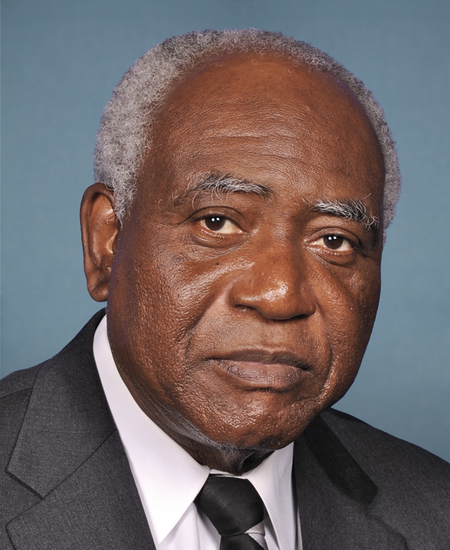
Photo of Danny K. Davis
D United States House · District 7 · Illinois

Rep. Danny K. Davis

Compare
Total votes
2,837
all sessions
Attendance
96%
112 missed
Lower than 76% of chamber peers
With party
98%
of cast votes
Higher than 85% of chamber peers
Bipartisan score
1%
crosses aisle rarely
Lower than 85% of chamber peers
Sponsored
1,985
bills & resolutions
Higher than 91% of chamber peers
Committees
3
assignments
1,985 bills and resolutions

Sponsored bills

Total
1,985
Primary
109
Co-sponsor
1,876
This page
1,985
matching current filters
Co-sponsor HR 1976
In committee · United States House · Co-sponsor
Woman on the Twenty Act of 2025

Maddy summaryThis bill mandates that all new $20 U.S. currency printed after December 31, 2028, must prominently feature Harriet Tubman's portrait on the front. It requires the Treasury Secretary to release a preliminary design for this updated $20 bill by December 31, 2026. The bill directly affects the U.S. Treasury Department, codifying a 2016 announcement to feature Tubman on the $20 note (replacing Andrew Jackson) and ending a historical pattern where no woman had appeared on U.S. paper money.

In committee Mar 10, 2025 1 co-sponsor
Co-sponsor HR 1954
In committee · United States House · Co-sponsor
Do No Harm Act

Maddy summaryHR 1954, the "Do No Harm Act," amends the Religious Freedom Restoration Act (RFRA) to clarify that RFRA does not override specific federal laws protecting against harm. It explicitly exempts provisions related to anti-discrimination (like the Civil Rights Act), workplace protections (wages, leave, collective activity), child safety, and healthcare access from RFRA's requirements. The bill ensures RFRA cannot be used to challenge government programs or contracts that provide these essential protections. It also clarifies that RFRA applies only to disputes involving government as a party, not private disputes between individuals. This change preserves existing legal safeguards while modifying RFRA's scope.

In committee Mar 6, 2025 1 co-sponsor
Co-sponsor HR 1903
In committee · United States House · Co-sponsor
Congressional Trade Authority Act of 2025

Congressional Trade Authority Act of 2025 This bill requires congressional approval for a presidential import adjustment due to a national security threat from an import and limits the adjustments to certain goods that are essential to national security. Specifically, the bill limits the President's authority for such import adjustments to goods related to the development, maintenance, or protection of military equipment, energy resources, or critical infrastructure essential to national security. The bill specifies that the term national security (1) means the protection of the United States from foreign aggression, and (2) does not otherwise include the protection of the general welfare of the United States. The bill requires the President to submit a proposal to Congress to adjust imports. Congress must then approve the proposal with a joint resolution before an import adjustment takes effect. Under current law, the President determines whether any adjustment of an import is necessary and must submit to Congress the reasons for any action taken or not taken. Currently, there is a congressional disapproval mechanism to override presidential actions related to petroleum imports. The bill also requires the Department of Defense (currently, the Department of Commerce) to investigate the effect of these imports on national security and submit a report before the President determines whether an adjustment to an import is necessary, establishes requirements for a process to grant requests to exclude certain goods from import adjustments, and  applies retroactively to any proposed action taken up to six years before the enactment of this bill.

In committee Mar 6, 2025 1 co-sponsor
Co-sponsor HR 1877
In committee · United States House · Co-sponsor
Protecting Americans’ Social Security Data Act

Protecting Americans’ Social Security Data Act This bill prohibits political appointees and special government employees from accessing Social Security data systems that contain personally identifiable information about Social Security beneficiaries. Specifically, political appointees and special government employees may not access systems maintained by the Social Security Administration (SSA) that issue or record Social Security account numbers, that are used to determine eligibility for or to pay Social Security benefits, or that otherwise contain personally identifiable information about individuals receiving or applying for benefits.  The bill also establishes a civil right of action for an individual whose information was negligently accessed or disclosed in violation of these provisions. The individual may bring suit against the United States if the violator was a U.S. employee or officer, or against the violator if they were not a U.S. employee or officer. Such a claim must be brought within two years of the affected individual’s discovery of the violation. Upon a finding of liability, defendants are liable for specified monetary damages.  If an individual is criminally charged or subject to proposed disciplinary or adverse action by a federal or state agency for having accessed or disclosed information in violation of these provisions, SSA must notify the individual whose information was accessed or disclosed of the violation as soon as practicable.  Finally, the bill requires the SSA Office of the Inspector General to investigate and report to Congress on any unauthorized access to or disclosure of information in a beneficiary data system.

In committee Mar 5, 2025 1 co-sponsor
Co-sponsor HR 1876
In committee · United States House · Co-sponsor
Keeping Our Field Offices Open Act

Maddy summaryHR 1876, the "Keeping Our Field Offices Open Act," prevents the Social Security Administration (SSA) from closing, consolidating, or restricting access to its field offices, hearing offices, or resident stations for 180 days after enactment, with exceptions for emergencies. The bill requires the SSA Commissioner to submit a detailed report to Congress by January 2029, analyzing closure criteria, transportation burdens for elderly/disabled users, cost-benefit impacts, and plans to replace lost services. For future closures, it mandates 120 days of public notice, two public hearings, and a final report to Congress, while ensuring total office numbers don’t fall below 2025 levels. This directly affects SSA field offices, their users (including elderly and disabled individuals), and employees. The bill’s key mechanism is a procedural safeguard to ensure transparency and minimize disruption before any office changes take effect.

In committee Mar 5, 2025 1 co-sponsor
Co-sponsor HR 14
In committee · United States House · Co-sponsor
John R. Lewis Voting Rights Advancement Act of 2025

Maddy summaryThis bill strengthens the Voting Rights Act of 1965 by clarifying how to prove voting discrimination and expanding requirements for preclearance of voting changes. It establishes new standards for determining when voting practices dilute minority voting strength or deny/abridge voting rights, requiring plaintiffs to show specific conditions for vote dilution claims and including factors like historical discrimination and racial polarization in court analyses. The bill modifies the criteria for determining which states and political subdivisions must seek preclearance for voting changes, and adds new transparency requirements for jurisdictions to publicly disclose changes to voting qualifications, polling locations, and election districts. It directly affects states and local governments that implement voting policies, particularly those with a history of voting rights violations or that make changes to voting qualifications, procedures, or district boundaries. The bill aims to prevent discriminatory voting practices by providing clearer standards for courts and requiring greater transparency in voting rule changes.

In committee Mar 5, 2025 1 co-sponsor
Co-sponsor HR 20
In committee · United States House · Co-sponsor
Richard L. Trumka Protecting the Right to Organize Act of 2025

Maddy summaryThe Richard L. Trumka Protecting the Right to Organize Act of 2025 strengthens workers' organizing rights by making it an unfair labor practice for employers to threaten permanent replacement of striking workers, discriminate against workers who support unions, or require employees to attend employer campaigns unrelated to their job duties. It expands the definition of "employee" to make it harder for companies to classify workers as independent contractors and requires employers to post notices about workers' rights in conspicuous locations. The bill establishes a new electronic voting system for union elections, creates a 90-day bargaining period before mediation can be requested, and increases penalties for violations of labor laws. These changes are intended to make it easier for workers to form unions and negotiate better wages and working conditions.

In committee Mar 5, 2025 1 co-sponsor
Co-sponsor HR 1841
In committee · United States House · Co-sponsor
Peace on the Korean Peninsula Act

Maddy summaryThis bill directs the State Department to review restrictions on U.S. citizens traveling to North Korea, particularly focusing on humanitarian visits for Americans with relatives there (estimated at 100,000 people). It requires the Secretary of State to submit a report within 180 days detailing how the U.S. will pursue a formal end to the Korean War through diplomatic negotiations with North and South Korea. The bill also mandates a separate report outlining a clear roadmap for achieving a binding peace agreement, including necessary negotiation steps and key stakeholders. These provisions aim to address the ongoing state of war, which the bill states prevents formal U.S.-North Korea relations and family reunifications.

In committee Mar 4, 2025 1 co-sponsor
Co-sponsor HR 1835
In committee · United States House · Co-sponsor
MERIT Act

Maddy summaryHR 1835 (MERIT Act) provides reinstatement or compensation to federal employees who were terminated during a specific mass layoff period (January 20, 2025, through the bill’s enactment date). Affected probationary employees - newly hired workers on a trial period or not yet permanent - can choose to return to a similar position with matching benefits or receive a lump-sum payment covering the pay difference between their terminated role and any new federal job they held during the layoff period. Agencies must notify affected employees within 30 days and offer reinstatement or payment within 90 days, with employees required to accept or decline within 30 days to avoid losing eligibility. The bill defines "mass termination" as 15+ separations in a 30-day period by a single agency.

In committee Mar 4, 2025 1 co-sponsor
Co-sponsor HRES 181
In committee · United States House · Co-sponsor
Original Black History Month Resolution of 2025

Maddy summaryHRES 181 is a symbolic resolution recognizing Black History Month by highlighting the historical and ongoing contributions of Black labor to the U.S. economy and society. It commemorates Black labor from slavery through modern times, including agricultural work, unionization efforts (like A. Philip Randolph’s Brotherhood of Sleeping Car Porters), and contemporary issues like the racial wage gap (where Black workers earned $878 weekly vs. $1,059 for others in 2023). The resolution does not create new laws or policies but formally acknowledges these contributions to raise public awareness. It is sponsored by 70+ House members and aligns with the 2025 Black History Month theme focused on "African Americans and Labor." As a commemorative resolution, it has no direct effect on individuals or legislation.

In committee Mar 3, 2025 1 co-sponsor
Showing 531 to 540 of 1,985 bills
Previous 1 … 53 54 55 … 199 Next