

Maddy summaryThis bill prohibits Medicaid from covering conversion therapy for any enrollee. It amends federal law to block Medicaid payments for any therapy aimed at changing a person's sexual orientation or gender identity (defined as "conversion therapy" in the bill), starting in the first full quarter after the law takes effect. The prohibition applies to all Medicaid providers who offer such therapy for compensation, but explicitly excludes support for gender transition, acceptance-based care, and interventions focused on safety or unlawful conduct. It directly affects Medicaid recipients seeking therapy and providers who previously billed for conversion therapy services.
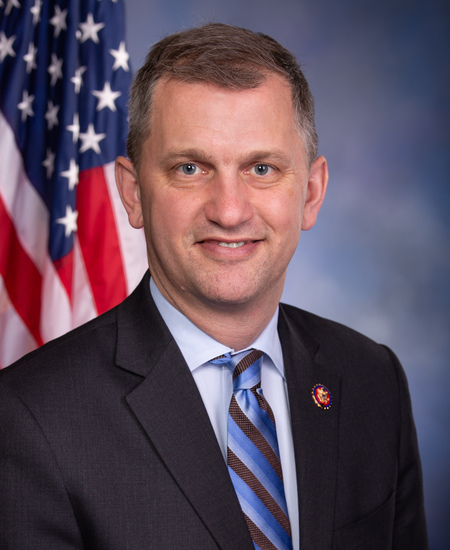
Rep. Sean Casten
Sponsored bills
Maddy summaryThis resolution (HRES 1558) is a symbolic House of Representatives measure supporting October as "National Domestic Violence Awareness Month." It does not create new laws or allocate funding but formally expresses the House's support for raising awareness about domestic violence and its impacts, and urges continued backing for existing programs that address domestic violence. The resolution cites statistics on domestic violence prevalence (e.g., 24 people per minute affected by intimate partner violence) to underscore the importance of the observance. It directly affects public awareness efforts but does not change policies or directly impact individuals.
Maddy summaryHR 10090, the "Keeping Guns from High-Risk Individuals Act," expands existing federal firearm prohibitions. It bars individuals convicted of a crime of violence (as defined in Section 16 of Title 18) within the last five years, or convicted of stalking, from purchasing or possessing firearms. This directly affects people with these specific recent convictions, adding them to the list of those prohibited under Section 922(d) (sales) and Section 922(g) (possession) of the U.S. Code. The bill makes concrete policy changes by broadening the categories of individuals barred from gun access based on certain criminal histories.
Maddy summaryHR 4206, the Bank Safety Act of 2024, requires large banks with over $100 billion in assets to include certain accounting adjustments (like unrealized gains or losses on investments) in their capital calculations for regulatory purposes. This directly affects major bank holding companies and large insured depository institutions, as defined by the bill. The key provision amends existing law to mandate this inclusion, excluding specific cash flow hedge adjustments. The rule must be implemented by federal banking agencies no later than December 31, 2024. This changes how these institutions measure their financial strength for regulatory capital requirements.
Maddy summaryThis bill requires the Comptroller General, working with the National Academy of Sciences, to study how to create a nonpartisan office or agency that would analyze whether federal legislation would likely increase or decrease greenhouse gas emissions. It directs a 2-year study to evaluate options for this office (including using existing agencies), ensure nonpartisanship, and involve experts across sectors like energy and agriculture. The study must also examine how state legislatures have handled similar "carbon scoring" for bills. The bill itself does not change emissions policies or impose new requirements; it only mandates this analysis framework for future congressional consideration of legislation.
Maddy summaryHR 10063, the FACES Act of 2024, requires the Attorney General to study how the existing Freedom of Access to Clinic Entrances Act (FACE Act) is enforced nationwide. The bill mandates a report within one year detailing current enforcement practices, barriers to prosecution, variations across judicial districts, and recommendations for improving enforcement. This procedural bill focuses solely on gathering data and analysis - no new policies or funding are created. It directly affects federal and local law enforcement agencies by requiring them to participate in the study of clinic access enforcement.
Maddy summaryThis bill requires the Department of Defense to offer voter registration assistance at military enlistment or commissioning, providing registration forms and helping complete them for members of the Army, Navy, Marine Corps, Air Force, Space Force, or merchant marines. It mandates electronic transmission of absentee ballots to military voters and requires states to update contact information for active-duty voters, including spouses and dependents. The bill also allows a single absentee ballot application to cover all future federal elections unless the voter leaves military service. It directly affects active-duty service members, their families, and merchant marines who vote absentee.
Maddy summaryThe Financial Empowerment and Protection Act requires companies like utilities, internet providers, landlords, and mortgage lenders to allow adults living together who agree to share a household to open joint accounts for managing services and bills. These accounts must be in both adults' names, and companies must provide access to account details, online portals, and billing information upon request. Companies must also notify cohabitating adults about shared information and comply with privacy notices, with individuals able to sue for up to $1,000 per violation for non-compliance. The law takes effect 180 days after enactment.
Maddy summaryThe VA Employee Fairness Act of 2024 modifies collective bargaining rules for employees of the Veterans Health Administration (VHA). It removes existing subsections (b), (c), and (d) from the law governing VHA employee bargaining and renumbers the remaining provision. This change streamlines the collective bargaining framework but does not alter the Secretary of Veterans Affairs' existing authorities over incentive pay and expedited hiring. The bill directly affects VHA employees by changing how their collective bargaining rights are structured under federal law. The law remains neutral, focusing solely on procedural adjustments to the existing bargaining framework.
Maddy summaryHRES 1537 is a non-binding House resolution condemning Hamas' October 7, 2023, attacks on Israel, which killed over 1,200 people and took 251 hostages, including 7 Americans still held captive. It calls on Hamas to immediately surrender, cease attacks, and release all hostages unconditionally, while reaffirming Israel's right to self-defense. The resolution also urges international organizations to condemn Hamas' actions and address the global surge in antisemitism following the attacks. As a symbolic statement, it does not create new laws or alter policy but expresses congressional position. The bill specifically references the ongoing captivity of seven U.S. citizens: Edan Alexander, Itay Chen, Sagui Dekel-Chen, Gadi Haggai, Judith Weinstein Haggai, Omer Neutra, and Keith Siegel.