

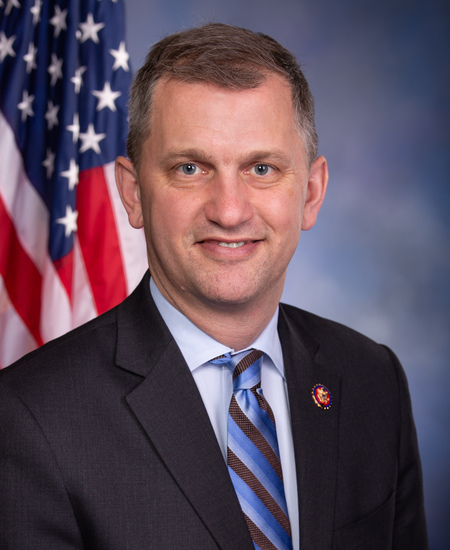
Photo of Sean Casten
D United States House · District 6 · Illinois On the 2026 ballot

Rep. Sean Casten

Compare
Total votes
2,837
all sessions
Attendance
98%
44 missed
Higher than 82% of chamber peers
With party
96%
of cast votes
Higher than 79% of chamber peers
Bipartisan score
2%
crosses aisle rarely
Lower than 79% of chamber peers
Sponsored
1,498
bills & resolutions
Near the chamber average
Committees
5
assignments
1,498 bills and resolutions

Sponsored bills

Total
1,498
Primary
110
Co-sponsor
1,388
This page
1,498
matching current filters
Co-sponsor HR 2692
In committee · United States House · Co-sponsor
No Tax Breaks for Union Busting (NTBUB) Act

Maddy summaryThe No Tax Breaks for Union Busting Act would deny tax deductions for employers who spend money to influence employees' decisions about union activities, such as union elections or collective bargaining. It defines "labor organization activities" broadly to include union elections, labor disputes, and collective actions. The bill requires employers to report such spending on tax returns and prevents them from deducting these expenses from taxable income. This would apply to employers using tactics like captive audience meetings, outside consultants, or other efforts to sway workers' union decisions. The policy aims to remove tax incentives for employers to interfere with workers' rights under labor law.

In committee Apr 7, 2025 1 co-sponsor
Co-sponsor HR 2680
In committee · United States House · Co-sponsor
Expanding Access to School Meals Act of 2025

Maddy summaryHR 2680, the Expanding Access to School Meals Act of 2025, ends reduced-price breakfast and lunch programs under federal law and expands free meal eligibility. It raises the income threshold for free lunch eligibility from 130% to 224% of the federal poverty level (Sec. 201) and allows schools to directly certify children receiving Medicaid benefits as eligible for free meals without additional applications (Sec. 202). The bill also permits schools to request retroactive reimbursement for meals served to eligible children starting the first day of the school year (Sec. 203) and increases the community eligibility program multiplier to 2.5 for schools serving high-poverty areas (Sec. 204). These changes directly affect public school students from low-income families and school districts receiving federal meal reimbursement funds.

In committee Apr 7, 2025 1 co-sponsor
Co-sponsor HR 2678
In committee · United States House · Co-sponsor
Ellie’s Law

Maddy summaryHR 2678, "Ellie’s Law," authorizes $20 million annually from fiscal years 2026 through 2030 for the National Institute of Neurological Disorders and Stroke to conduct new research on unruptured brain aneurysms. The funding specifically aims to study diverse patient populations by age, sex, and race, addressing gaps in current research. This bill directly affects the estimated 6.8 million Americans with unruptured brain aneurysms - particularly women and people of color, who face higher rupture risks - by advancing medical understanding of the condition. The law requires the funds to supplement, not replace, existing research budgets.

In committee Apr 7, 2025 1 co-sponsor
Co-sponsor HR 2671
In committee · United States House · Co-sponsor
Tax Fairness for Workers Act

Maddy summaryThe Tax Fairness for Workers Act (HR 2671) would allow certain employees to deduct work-related expenses directly from their gross income. Specifically, it creates an above-the-line deduction for union dues (amending IRC Section 62(a)(1)) and reinstates a deduction for other out-of-pocket work costs like uniforms or tools (amending IRC Section 67(g)), effective for 2025 tax years. This directly affects union members and workers with significant job-related expenses who previously could not deduct these costs. The bill removes the prior limitation that barred these deductions, making them available without needing to itemize. The policy change simplifies tax filing for affected workers by treating these expenses as deductible business costs.

In committee Apr 7, 2025 1 co-sponsor
Co-sponsor HR 2253
In committee · United States House · Co-sponsor
Puppy Protection Act of 2025

Maddy summaryThis bill, HR 2253 (Puppy Protection Act of 2025), sets new federal standards for commercial dog dealers who sell puppies to the public. It requires specific housing sizes based on dog size (e.g., 12-30 square feet per dog), daily exercise in safe outdoor areas, clean water and nutritious food twice daily, and annual veterinary exams including dental checks. The bill also limits breeding frequency (max 2 litters in 25 months), sets age minimums for breeding (18 months for small dogs, 2 years for large dogs), and mandates health screenings to prevent genetic diseases. These requirements apply directly to commercial dealers, with final regulations to be issued within 18 months of enactment.

In committee Apr 4, 2025 1 co-sponsor
Co-sponsor HR 2195
In committee · United States House · Co-sponsor
Feed Hungry Veterans Act of 2025

Maddy summaryHR 2195, the Feed Hungry Veterans Act of 2025, would expand eligibility for food assistance under the Supplemental Nutrition Assistance Program (SNAP) to more veterans. It adds four new qualifying categories to the existing rules: veterans with a "catastrophically disabled" determination under military disability law, veterans under 65 receiving a pension, and veterans meeting specific combined disability rating thresholds. The bill amends the Food and Nutrition Act to include these new groups in SNAP eligibility, directly affecting veterans who currently may not qualify under existing disability rating criteria. The changes would take effect on October 1, 2030.

In committee Apr 4, 2025 1 co-sponsor
Co-sponsor HR 2102
In committee · United States House · Co-sponsor
Major Richard Star Act

Maddy summaryThis bill, HR 2102 (Major Richard Star Act), allows veterans with combat-related disabilities to receive both full military retired pay and veterans' disability compensation simultaneously, without the previous offset that reduced retired pay. It directly affects veterans already eligible for both benefits due to combat-related injuries, removing the requirement that their retired pay be reduced by the disability compensation amount. The key provision amends Title 10 and Title 38 to eliminate the offset rule (sections 5304 and 5305 of Title 38) for these veterans. The change applies to payments starting after the bill’s enactment date, effective for all qualifying veterans. This is a policy change to increase financial support for affected veterans, not a new benefit.

In committee Apr 4, 2025 1 co-sponsor
Co-sponsor HR 2628
In committee · United States House · Co-sponsor
American Innovation Act

Maddy summaryHR 2628, the American Innovation Act, authorizes significant funding increases for federal science and innovation programs through fiscal year 2036. It sets annual funding levels for the National Science Foundation, Department of Energy’s Office of Science, Department of Defense science programs, National Institute of Standards and Technology, and NASA’s Science Mission Directorate, with amounts rising each year and adjusted annually for inflation using the Consumer Price Index. The bill also exempts these appropriations from automatic spending cuts (sequestration) under the Balanced Budget Act. This legislation directly affects federal research agencies by securing long-term funding for scientific development and technological advancement.

In committee Apr 3, 2025 1 co-sponsor
Co-sponsor HR 2618
In committee · United States House · Co-sponsor
Federal Firearm Licensee Act

Federal Firearm Licensee Act This bill establishes new security requirements and expands recordkeeping and reporting requirements for federally licensed dealers, importers, and manufacturers of firearms (i.e., federal firearms licensees, or FFLs). The bill also broadens the authority of the Bureau of Alcohol, Tobacco, Firearms and Explosives (ATF) to administer federal firearms laws and enforce violations. Specifically, bill requires FFLs to implement and comply with a plan to secure their business premises, conduct quarterly physical checks of their business inventories, maintain video surveillance of the area where firearms are sold or transferred, and initiate firearms-related background checks for employees. Additionally, the bill requires FFLs to report to the ATF any inventory firearm that is lost, stolen, or unaccounted for and to notify the ATF about default-proceed transactions (i.e., allowable firearm transfers to an unlicensed person prior to the completion of a background check when the submitted background check remains incomplete after three business days). Finally, the bill removes limits on the ATF's authority to conduct activities related to the administration of federal firearms laws. It enhances the ATF's inspection authority, including by removing the limit on the number of annual compliance inspections (currently, one), requiring inspections of high-risk FFLs, and authorizing an additional 650 investigators. Finally, the bill directs the ATF to deny an application for a federal firearms license if it would endanger public safety or if the applicant is unlikely to comply with the law.

In committee Apr 3, 2025 1 co-sponsor
Co-sponsor HRES 259
In committee · United States House · Co-sponsor
Of inquiry requesting the President to provide certain documents in the President's possession to the House of Representatives relating to the access provided to the staff and advisers of, including any individual working for or in conjunction with, the Department of Government Efficiency to the systems, applications, and accounts, and any information contained therein, of the Bureau of Consumer Financial Protection.

Maddy summaryHRES 259 is a House resolution requesting the President to provide documents about access to the Bureau of Consumer Financial Protection (CFPB) systems. It specifically asks for details on individuals from the "Department of Government Efficiency" (DOGE), including named staff like Elon Musk, who were granted access to CFPB systems, accounts, or information. The resolution demands records on the type of access granted, clearance levels, any sensitive data viewed, and documentation like access requests and training records. It also seeks employee headcount data for the CFPB as of specific dates. This is a procedural request for transparency, not a law changing policy.

In committee Apr 2, 2025 1 co-sponsor
Showing 301 to 310 of 1,498 bills
Previous 1 … 30 31 32 … 150 Next