

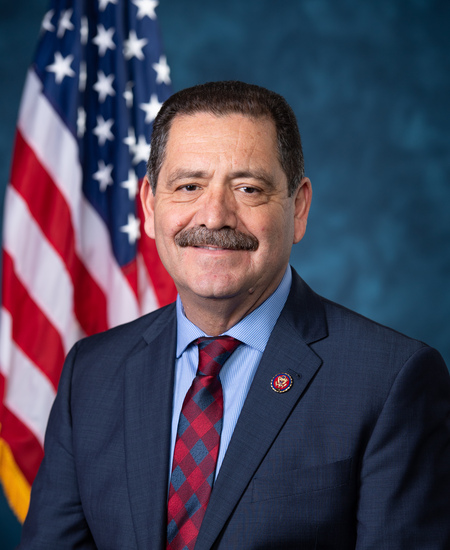
Photo of Jesús G. "Chuy" García
D United States House · District 4 · Illinois

Rep. Jesús G. "Chuy" García

Compare
Total votes
2,837
all sessions
Attendance
95%
135 missed
Near the chamber average
With party
95%
of cast votes
Near the chamber average
Bipartisan score
3%
crosses aisle rarely
Near the chamber average
Sponsored
1,948
bills & resolutions
Higher than 88% of chamber peers
Committees
7
assignments
1,948 bills and resolutions

Sponsored bills

Total
1,948
Primary
44
Co-sponsor
1,904
This page
1,948
matching current filters
Co-sponsor HR 2086
In committee · United States House · Co-sponsor
Rights for the TSA Workforce Act

Maddy summaryThis bill requires the Transportation Security Administration (TSA) to transition its workforce from a special personnel management system to the standard federal personnel system under Title 5 of the U.S. Code by December 31, 2025. It protects TSA employees by ensuring no reduction in pay, benefits, or retirement rights during the transition, while preserving collective bargaining rights for screening agents. The legislation also mandates consultation with labor unions during the process and requires several reports on workforce issues including recruitment, harassment policies, and workplace safety.

In committee Mar 11, 2025 1 co-sponsor
Co-sponsor HR 2040
In committee · United States House · Co-sponsor
NEWBORN Act

Maddy summaryHR 2040, the NEWBORN Act, creates federal grants for local health departments to run infant mortality pilot programs in the 50 highest-risk counties. The $10 million annual funding (2025-2029) requires grantees to develop community-specific plans addressing causes like preterm birth, maternal complications, and infant injuries. Programs must include outreach to at-risk mothers, standardized services (postpartum care, smoking cessation, nutrition counseling), rural health initiatives, and public education campaigns. Grantees must report annually on program outcomes, with funds limited to 10% for evaluation. The bill directly affects communities with high infant mortality rates and at-risk mothers and infants through these targeted, evidence-based interventions.

In committee Mar 11, 2025 1 co-sponsor
Co-sponsor HR 2045
In committee · United States House · Co-sponsor
Medicare Dental, Vision, and Hearing Benefit Act of 2025

Maddy summaryThis bill would expand Medicare to cover dental, vision, and hearing services for beneficiaries 65 and older (and some younger people with disabilities), effective January 1, 2026. It would provide 100% coverage for preventative dental services in 2026, with basic and major dental services gradually increasing to 80% coverage by 2029. Vision benefits would include 80% coverage for annual eye exams and specific limits on eyeglasses, frames, and contact lenses ($100 per year for lenses, $100 every two years for frames, $200 every two years for contacts). Hearing services would include 80% coverage for hearing exams and hearing aids, with a limit of one hearing aid per ear every 48 months. The bill also adds oral health professionals to the United States Preventive Services Task Force to help guide coverage decisions.

In committee Mar 11, 2025 1 co-sponsor
Co-sponsor HR 2064
In committee · United States House · Co-sponsor
Home of Your Own Act of 2025

Maddy summaryHR 2064 establishes a federal grant program through HUD to provide up to $30,000 in assistance per household for first-time homebuyers purchasing qualifying homes. The program helps low-to-moderate income individuals (earning ≤120% of local median income, or 150% in high-cost areas) cover down payments, closing costs, or home modifications needed for occupancy. Recipients must live in the home as a primary residence for 5 years; failure to do so requires partial repayment proportional to non-occupancy. The bill authorizes $6.7 billion annually (2026-2030), reserves 3% for tribes, and excludes assistance from federal taxation.

In committee Mar 11, 2025 1 co-sponsor
Co-sponsor HR 1918
In committee · United States House · Co-sponsor
Farewell to Foam Act of 2025

Maddy summaryHR 1918, the Farewell to Foam Act of 2025, prohibits the sale of most foam food containers, packaging peanuts, and foam coolers starting January 1, 2028. It directly affects restaurants, grocery stores, food vendors, manufacturers, and retailers who sell these items, excluding medical coolers used for drugs or medical products. The bill imposes escalating civil penalties for violations: $250 for the second offense, $500 for the third, and $1,000 for fourth or subsequent violations, with reduced penalties for small businesses under specific revenue thresholds. Enforcement is led by the EPA Administrator, with states allowed to enforce under federal guidelines.

In committee Mar 6, 2025 1 co-sponsor
Co-sponsor HR 1877
In committee · United States House · Co-sponsor
Protecting Americans’ Social Security Data Act

Protecting Americans’ Social Security Data Act This bill prohibits political appointees and special government employees from accessing Social Security data systems that contain personally identifiable information about Social Security beneficiaries. Specifically, political appointees and special government employees may not access systems maintained by the Social Security Administration (SSA) that issue or record Social Security account numbers, that are used to determine eligibility for or to pay Social Security benefits, or that otherwise contain personally identifiable information about individuals receiving or applying for benefits.  The bill also establishes a civil right of action for an individual whose information was negligently accessed or disclosed in violation of these provisions. The individual may bring suit against the United States if the violator was a U.S. employee or officer, or against the violator if they were not a U.S. employee or officer. Such a claim must be brought within two years of the affected individual’s discovery of the violation. Upon a finding of liability, defendants are liable for specified monetary damages.  If an individual is criminally charged or subject to proposed disciplinary or adverse action by a federal or state agency for having accessed or disclosed information in violation of these provisions, SSA must notify the individual whose information was accessed or disclosed of the violation as soon as practicable.  Finally, the bill requires the SSA Office of the Inspector General to investigate and report to Congress on any unauthorized access to or disclosure of information in a beneficiary data system.

In committee Mar 5, 2025 1 co-sponsor
Co-sponsor HR 14
In committee · United States House · Co-sponsor
John R. Lewis Voting Rights Advancement Act of 2025

Maddy summaryThis bill strengthens the Voting Rights Act of 1965 by clarifying how to prove voting discrimination and expanding requirements for preclearance of voting changes. It establishes new standards for determining when voting practices dilute minority voting strength or deny/abridge voting rights, requiring plaintiffs to show specific conditions for vote dilution claims and including factors like historical discrimination and racial polarization in court analyses. The bill modifies the criteria for determining which states and political subdivisions must seek preclearance for voting changes, and adds new transparency requirements for jurisdictions to publicly disclose changes to voting qualifications, polling locations, and election districts. It directly affects states and local governments that implement voting policies, particularly those with a history of voting rights violations or that make changes to voting qualifications, procedures, or district boundaries. The bill aims to prevent discriminatory voting practices by providing clearer standards for courts and requiring greater transparency in voting rule changes.

In committee Mar 5, 2025 1 co-sponsor
Co-sponsor HR 20
In committee · United States House · Co-sponsor
Richard L. Trumka Protecting the Right to Organize Act of 2025

Maddy summaryThe Richard L. Trumka Protecting the Right to Organize Act of 2025 strengthens workers' organizing rights by making it an unfair labor practice for employers to threaten permanent replacement of striking workers, discriminate against workers who support unions, or require employees to attend employer campaigns unrelated to their job duties. It expands the definition of "employee" to make it harder for companies to classify workers as independent contractors and requires employers to post notices about workers' rights in conspicuous locations. The bill establishes a new electronic voting system for union elections, creates a 90-day bargaining period before mediation can be requested, and increases penalties for violations of labor laws. These changes are intended to make it easier for workers to form unions and negotiate better wages and working conditions.

In committee Mar 5, 2025 1 co-sponsor
Co-sponsor HR 1841
In committee · United States House · Co-sponsor
Peace on the Korean Peninsula Act

Maddy summaryThis bill directs the State Department to review restrictions on U.S. citizens traveling to North Korea, particularly focusing on humanitarian visits for Americans with relatives there (estimated at 100,000 people). It requires the Secretary of State to submit a report within 180 days detailing how the U.S. will pursue a formal end to the Korean War through diplomatic negotiations with North and South Korea. The bill also mandates a separate report outlining a clear roadmap for achieving a binding peace agreement, including necessary negotiation steps and key stakeholders. These provisions aim to address the ongoing state of war, which the bill states prevents formal U.S.-North Korea relations and family reunifications.

In committee Mar 4, 2025 1 co-sponsor
Co-sponsor HR 1835
In committee · United States House · Co-sponsor
MERIT Act

Maddy summaryHR 1835 (MERIT Act) provides reinstatement or compensation to federal employees who were terminated during a specific mass layoff period (January 20, 2025, through the bill’s enactment date). Affected probationary employees - newly hired workers on a trial period or not yet permanent - can choose to return to a similar position with matching benefits or receive a lump-sum payment covering the pay difference between their terminated role and any new federal job they held during the layoff period. Agencies must notify affected employees within 30 days and offer reinstatement or payment within 90 days, with employees required to accept or decline within 30 days to avoid losing eligibility. The bill defines "mass termination" as 15+ separations in a 30-day period by a single agency.

In committee Mar 4, 2025 1 co-sponsor
Showing 511 to 520 of 1,948 bills
Previous 1 … 51 52 53 … 195 Next