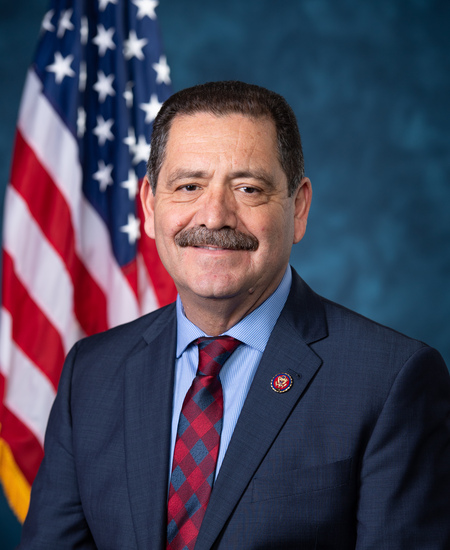
Photo of Jesús G. "Chuy" García
D United States House · District 4 · Illinois

Rep. Jesús G. "Chuy" García

Compare
Total votes
2,837
all sessions
Attendance
95%
135 missed
Near the chamber average
With party
95%
of cast votes
Near the chamber average
Bipartisan score
3%
crosses aisle rarely
Near the chamber average
Sponsored
1,948
bills & resolutions
Higher than 88% of chamber peers
Committees
7
assignments
1,948 bills and resolutions

Sponsored bills

Total
1,948
Primary
44
Co-sponsor
1,904
This page
1,948
matching current filters
Co-sponsor HR 3355
In committee · United States House · Co-sponsor
SAFE Act of 2021

Save America’s Forgotten Equines Act of 2021 or the SAFE Act of 2021 This bill prohibits the transporting, receiving, possessing, purchasing, selling, or donation by a person of an equine (e.g., horse) that the person has reason to believe will be slaughtered for human consumption.

In committee Jun 23, 2022 1 co-sponsor
Primary HR 5912
In committee · United States House · Lead sponsor
Close the ILC Loophole Act

Close the ILC Loophole Act This bill limits the exemption from certain banking regulations applicable to industrial loan companies to those companies approved to receive Federal Deposit Insurance Corporation insurance before September 23, 2021, or companies with an application pending as of September 23, 2021. Industrial loan companies are state chartered institutions that provide several services similar to banks, such as originating loans and processing payments. Parent companies of such industrial loan companies are subject to the supervision of the Board of Governors of the Federal Reserve System. The bill also sets forth procedures regarding a change in control of an industrial loan company. The Government Accountability Office must report on the effects of industrial loan companies, industrial banks, and other similar institutions on the economy, including the effect on competitiveness, market structure, and different industries.

In committee Jun 22, 2022 0 co-sponsors
Co-sponsor HR 4495
In committee · United States House · Co-sponsor
Downpayment Toward Equity Act of 2021

Downpayment Toward Equity Act of 2021 This bill establishes a grant program through the Department of Housing and Urban Development for states and other entities to provide qualifying assistance to certain first-time, first-generation home buyers in purchasing their first homes. Qualifying assistance includes assistance for mortgage down payments, mortgage closing costs, reduction of mortgage interest rates, subsidies for shared equity homes, or for certain preoccupancy modifications to a home to accommodate persons with disabilities. The bill also establishes grant requirements regarding home buyer income, types of housing, homeowner occupancy, types of mortgages, and home buyer counseling.

In committee Jun 22, 2022 1 co-sponsor
Co-sponsor HR 3111
In committee · United States House · Co-sponsor
Grandfamily Housing Act of 2021

Grandfamily Housing Act of 2021 This bill establishes grants through the Department of Housing and Urban Development for owners of intergenerational dwellings. Grants must be used to (1) provide services such as tutoring, health care services, and after-school care; (2) perform outreach to intergenerational families in the surrounding community; and (3) maintain spaces within the property to be used for programs and services for intergenerational families.

In committee Jun 22, 2022 1 co-sponsor
Co-sponsor HR 2543
Passed · United States House · Co-sponsor
Federal Reserve Racial and Economic Equity Act

Financial Services Racial Equity, Inclusion, and Economic Justice Act This bill address access to financial services, diversity in various financial institutions and establishments, and other related issues. Access to credit, mortgages, and banking services are expanded, including by prohibiting discrimination with respect to credit transactions on the basis of an applicant's sexual orientation, gender identity, or location based on zip code or census tract; establishing language translation requirements for residential mortgage applications; and providing funding set-asides for minority lending institutions. The bill expands the support of, and access to, minority depository institutions and community development financial institutions and establishes an impact bank designation for small institutions that predominately lend to low-income borrowers. Further, the Federal Reserve Board must carry out its duties in a manner that supports the elimination of racial and ethnic disparities in employment, income, wealth, and access to affordable credit. Additionally, the bill requires financial institutions to report information relating to diversity policies and lending practices. Retail businesses must accept cash as a form of payment for sales in amounts less than $2,000 and are prohibited from charging cash-paying customers a higher price. Finally, the bill commissions various reports and studies, including a report from the Government Accountability Office on public housing for the homeless.

Passed Jun 21, 2022 1 co-sponsor
Primary HR 8105
In committee · United States House · Lead sponsor
Good Jobs for Good Airports Act

Good Jobs for Good Airports Act This bill addresses pay, benefits, and labor standards for certain airport service workers. Airport service workers include security officers, food service workers, cleaning staff, ticketing agents, and retail service workers. Specifically, the bill establishes a minimum wage and benefit standard for such airport service workers at large, medium, and small hub airports. It also prohibits small, medium, and large hub airports from accessing federal funds for airport development projects unless the airports certify that such airport service workers are paid no less than the higher of $15 per hour, the applicable state or local minimum wage and fringe benefits, or the prevailing wage and fringe benefits required under the Service Contract Act as established by the Department of Labor.

In committee Jun 17, 2022 0 co-sponsors
Co-sponsor HR 2773
Passed · United States House · Co-sponsor
Recovering America’s Wildlife Act of 2021

Recovering America’s Wildlife Act of 2022 This bill provides funding for the conservation or restoration of wildlife and plant species of greatest conservation need, including endangered or threatened species, and establishes related requirements. TITLE I--WILDLIFE CONSERVATION AND RESTORATION (Sec. 101) This title establishes and funds a subaccount of the Wildlife Conservation and Restoration Account, which was established under the Pittman-Robertson Wildlife Restoration Act. The subaccount must be used to support efforts of states, territories, or the District of Columbia to recover and manage wildlife and plant species of greatest conservation need. The Department of the Interior must use a portion of the funding from the subaccount for grants to state fish and wildlife departments, the District of Columbia fish and wildlife department, fish and wildlife departments of territories, nonprofit organizations, or regional associations of fish and wildlife departments. The grants must be used for innovative recovery efforts for species of greatest conservation need, species listed as endangered or threatened species, or the habitats of such species. Funding for the subaccount must supplement existing funds available to the states from funds distributed under the Dingell-Johnson Sport Fish Restoration Act and the Wildlife Conservation and Restoration Account. Recipients of the funding from the subaccount must match federal funds as specified by the title. The Government Accountability Office must study and report on the progress of states, territories, the District of Columbia, and Indian tribes in protecting species of greatest conservation need, endangered species, and threatened species. TITLE II--TRIBAL WILDLIFE CONSERVATION AND RESTORATION (Sec. 201) This title establishes and funds a Tribal Wildlife Conservation and Restoration Account to support Indian tribes' efforts to recover and manage wildlife and plant species of greatest conservation need. Indian tribes are not required to provide matching funds. TITLE III--ENDANGERED SPECIES RECOVERY AND HABITAT CONSERVATION LEGACY FUND (Sec. 301) This title establishes and funds through FY2026 the Endangered Species Recovery and Habitat Conservation Legacy Fund. The U.S. Fish and Wildlife Service must use the fund to (1) implement an Endangered Species Recovery Grant Program; (2) address its interagency consultation responsibilities under the Endangered Species Act of 1973; (3) work with nonfederal entities to conserve wildlife habitat and at-risk species, threatened or endangered species, or species proposed to be listed as threatened or endangered species; or (4) address the development and permitting of voluntary conservation agreements under such act. Amounts made available under the fund must supplement other federal amounts made available to carry out such activities. The President must annually submit to Congress, together with the annual budget of the United States, a list of threatened species and endangered species for which recovery plans will be developed or implemented with amounts from the Endangered Species Recovery and Habitat Conservation Legacy Fund. TITLE IV--REPORT (Sec. 401) Interior must also report on information concerning the amount of grants and contracts that were awarded or are allocated under this bill to Historically Black Colleges and Universities, Hispanic-serving educational institutions, tribally controlled colleges and universities, minority-serving educational institutions, minority-owned business enterprises, women-owned business enterprises, and community-based organizations that are principally administered by, operated by, or serving minority communities.


Passed Jun 15, 2022 1 co-sponsor
Co-sponsor HR 8040
In committee · United States House · Co-sponsor
People Over Pentagon Act of 2022

Maddy summaryThis non-binding resolution (HR 8040) expresses Congress's view that many national security threats are non-military and calls for reducing the Pentagon's 2023 budget by $100 billion. It directs the Secretary of Defense to consider a 2021 CBO report when implementing potential cuts, while exempting specific accounts like military personnel pay and defense health programs from reductions. The resolution proposes reallocating the savings to address non-military national priorities. It does not alter actual funding but sets a policy direction for the Department of Defense budget.

In committee Jun 13, 2022 1 co-sponsor
Co-sponsor HR 8005
In committee · United States House · Co-sponsor
Social Security Expansion Act

Social Security Expansion Act This bill increases benefits and certain taxes related to the Social Security program. Changes to benefits include (1) increasing the primary insurance amount for certain beneficiaries; (2) revising the method of calculating cost-of-living adjustments; (3) establishing a new minimum benefit for certain low earners; and (4) allowing certain children of retired, deceased, or disabled workers to receive benefits until age 22 if they are a full-time student. Changes to taxes include (1) increasing the net investment income tax and making active trade or business income subject to this tax; and (2) extending payroll taxes on wages, salaries, and self-employment earnings to income above $250,000 (the maximum amount subject to the Social Security payroll tax is currently $147,000 for 2022). The bill also combines the existing Federal Old-Age and Survivors Insurance Trust Fund and the Federal Disability Insurance Trust Fund into a single Social Security Trust Fund.

In committee Jun 10, 2022 1 co-sponsor
Showing 1,391 to 1,400 of 1,948 bills