

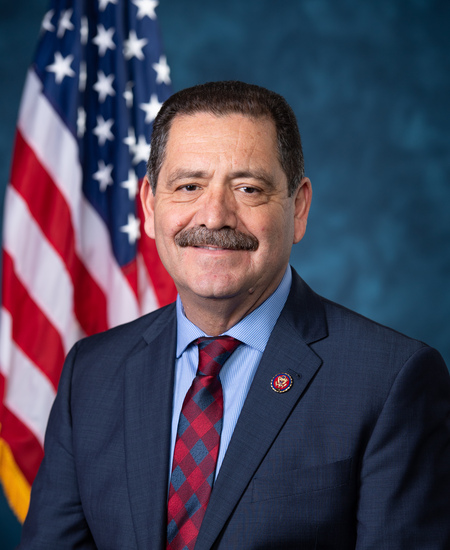
Photo of Jesús G. "Chuy" García
D United States House · District 4 · Illinois

Rep. Jesús G. "Chuy" García

Compare
Total votes
2,837
all sessions
Attendance
95%
135 missed
Near the chamber average
With party
95%
of cast votes
Near the chamber average
Bipartisan score
3%
crosses aisle rarely
Near the chamber average
Sponsored
1,948
bills & resolutions
Higher than 88% of chamber peers
Committees
7
assignments
1,948 bills and resolutions

Sponsored bills

Total
1,948
Primary
44
Co-sponsor
1,904
This page
1,948
matching current filters
Co-sponsor HR 4766
In committee · United States House · Co-sponsor
Supreme Court Ethics Act

Supreme Court Ethics Act This bill establishes a new statutory requirement for the Judicial Conference of the United States to issue a judicial code of conduct for judges and justices of U.S. courts, including Justices of the Supreme Court. Currently, the Judicial Conference issues a code of conduct for judges of U.S. courts (but not for Justices of the Supreme Court).

In committee Nov 1, 2022 1 co-sponsor
Co-sponsor HR 4496
In committee · United States House · Co-sponsor
Ending Homelessness Act of 2021

Ending Homelessness Act of 2021 This bill expands the housing choice voucher program and provides assistance to homeless individuals and families. Specifically, the bill provides FY2022-2025 funding for the expansion of the housing choice voucher program for certain extremely low income families. Furthermore, beginning in FY2026, the bill creates and funds an entitlement to housing choice vouchers for certain extremely low income families. Eligibility for the entitlement expands annually, extending to low-income families by FY2030. The bill also reduces the geographic area used to calculate an area's fair market rent for purposes of voucher payment standards and prohibits the use of criminal history in determining eligibility for certain housing assistance. Additionally, the bill prohibits housing discrimination on the basis of a renter's source of income or a renter's veteran status. The bill also provides additional FY2022-FY2026 funding for the Department of Housing and Urban Development (HUD) to assist the homeless, including to award emergency relief grants in jurisdictions with the highest need and award grants to provide outreach and coordinate services. Furthermore, the bill provides additional FY2022-FY2026 funding for the Housing Trust Fund, which provides affordable housing for extremely low-income and very low-income families. While this additional funding is available, HUD must ensure that priority for occupancy in assisted units is given to individuals and families who are homeless. Finally, the bill permanently reauthorizes certain homeless assistance grants and makes permanent the U.S. Interagency Council on Homelessness.

In committee Nov 1, 2022 1 co-sponsor
Co-sponsor HR 4497
In committee · United States House · Co-sponsor
Housing is Infrastructure Act of 2021

Housing is Infrastructure Act of 2021 This bill generally addresses housing affordability and infrastructure. The bill authorizes the Department of Housing and Urban Development (HUD) to provide grants, programs, and other support related to public housing, affordable housing preservation and construction, and mortgage access. The bill also establishes and funds the National Investment Authority (NIA) which must design, finance, and implement a strategy of long-term national economic growth and development. The NIA must select projects that coordinate investment of public and private capital in equitable, inclusive, and sustainable growth of the economy. Furthermore, the bill establishes the National Infrastructure Bank (NIB) to implement the strategy by engaging in credit market activities that support public and private investment in critical public infrastructure projects. The bill gives the NIA bond issuing authority and authorizes the Board of Governors of the Federal Reserve System to purchase these bonds. The Federal Reserve must lend funds on a short-term basis upon the request of the NIB and other subsidiaries. Additionally, the Department of the Treasury must provide for a line of credit not to exceed 100% of the NIA's total assets. Finally, the bill (1) authorizes HUD to provide support for fair housing organizations, and (2) requires consultation with a fair housing enforcement organization as part of an application for certain housing grants or funds.

In committee Nov 1, 2022 1 co-sponsor
Co-sponsor HR 4331
In committee · United States House · Co-sponsor
America’s Cultivation of Hope and Inclusion for Long-term Dependents Raised and Educated Natively Act of 2021

America's Cultivation of Hope and Inclusion for Long-term Dependents Raised and Educated Natively Act of 2021 or the America's CHILDREN Act of 2021 This bill provides lawful permanent resident status to certain college graduates who entered the United States as children and addresses other immigration-related issues. Specifically, this bill allows an alien to apply for lawful permanent resident status if the alien (1) was lawfully admitted into the United States as a dependent child of an alien on a temporary worker visa, (2) was in the United States with such status for at least four years, (3) has graduated from an institution of higher education in the United States, and (4) is not deportable or otherwise inadmissible. In addition, the alien must have been lawfully present in the United States for at least 10 years at the time of the application. The bill also modifies various provisions related to the calculation of an alien's age for immigration purposes and the priority date of certain immigration-related applications.

In committee Nov 1, 2022 1 co-sponsor
Co-sponsor HR 4194
In committee · United States House · Co-sponsor
The People’s Response Act

The People's Response Act This bill establishes multiple grant programs and requirements to promote qualified approaches to community safety. These are programs or services that are disconnected from carceral institutions (e.g., law enforcement, child welfare services, and immigration enforcement). Specifically, the bill establishes the Division of Community Safety within the Department of Health and Human Services (HHS) to administer the grants and carry out related activities. These include grants for community-based organizations to support qualified approaches to community safety, such as unarmed first responder agencies and 9-1-1 diversion programs; neighborhood-level interventions, including safe passage to school and violence interruption programs; behavioral health treatment, nutrition support, and other public health programs; housing security programs; and programs for youth and families, survivors of violence, and individuals exiting incarceration or criminal supervision. Additionally, the division must administer grants pertaining to qualified approaches for community safety for state and local governments and hiring and training first responders. The bill also establishes an advisory board to oversee the division's activities. Membership on the board must reflect the racial, ethnic, and other demographic diversities of the United States. The board must also include members who have personal experience with the criminal justice system. Furthermore, HHS must set up (1) a federal health response unit to respond to any public health emergency, assist with qualified approaches to community safety, and provide resources for safe and inclusive schools; and (2) an interagency task force to promote qualified approaches to community safety across federal programs.

In committee Nov 1, 2022 1 co-sponsor
Co-sponsor HR 4163
In committee · United States House · Co-sponsor
Even Playing Field Act

Even Playing Field Act This bill addresses pay equity for amateur athletes and other personnel. It allows recognition, or continued recognition, of a national governing body of an amateur sports organization only if it provides equal investment, promotional support, working conditions (including staff support and facilities and equipment for training and competition), and wages and other compensation to all amateur athletes, without discrimination based on sex. National governing bodies must report periodically to Congress regarding pay equity. Each report shall include (1) the median compensation for amateur athletes, coaches, trainers, managers, administrators, and officials, disaggregated by race, gender, and employment category; and (2) the minimum and maximum compensation paid to such personnel, disaggregated by race, gender, and employment category.

In committee Nov 1, 2022 1 co-sponsor
Co-sponsor HR 4137
In committee · United States House · Co-sponsor
Veterans Visa and Protection Act of 2021

Veterans Visa and Protection Act of 2021 This bill provides permanent resident status and citizenship eligibility to certain noncitizen veterans and addresses related issues. The Department of Homeland Security (DHS) must establish a program that allows (1) eligible noncitizen veterans outside of the United States to be admitted as permanent residents, and (2) eligible noncitizen veterans in the United States to obtain permanent resident status.  Generally, an eligible noncitizen veteran under this bill is one who was not removed from the United States for certain crimes related to violence or national security. DHS may waive these eligibility requirements for humanitarian, family unity, public interest, or exceptional military service reasons. A noncitizen veteran who obtains permanent resident status under this bill shall be eligible for (1) naturalization through service in the Armed Forces, and (2) military and veterans benefits as if they had not been removed (or ordered removed) from the United States. For a noncitizen veteran in removal proceedings or subject to a final removal order, the Department of Justice (DOJ) must determine whether the veteran is eligible for permanent resident status under this bill. If the veteran is eligible, DOJ must adjust the veteran's status. The bill also protects noncitizen veterans or service members from being removed from the United States unless the veteran has been convicted of a crime of violence.

In committee Nov 1, 2022 1 co-sponsor
Co-sponsor HR 4020
In committee · United States House · Co-sponsor
Drug Policy Reform Act of 2021

Drug Policy Reform Act of 2021 or the DPR Act of 2021 This bill transfers federal regulatory authority over controlled substances, eliminates federal penalties for some drug-related offenses, and removes some collateral consequences for certain criminal convictions. A collateral consequence is a penalty (e.g., a restriction on access to a program or service) imposed on an individual in addition to the penalty associated with the sentence. Specifically, the bill transfers regulatory authority over controlled substances from the Department of Justice to the Department of Health and Human Services (HHS). Additionally, the bill directs HHS to establish a commission to determine a benchmark amount of a controlled substance for personal use supply. The bill eliminates federal criminal and civil penalties for simple possession of a controlled substance in an amount equal to or less than the benchmark. Finally, the bill removes the collateral consequences of certain convictions. For example, the bill removes some restrictions on eligibility for federal assistance and benefits for individuals who are convicted of certain drug-related offenses, reinstates the right to vote in federal elections for persons convicted of criminal offenses, and repeals the requirement for states to revoke or suspend driver's licenses of individuals who are convicted of drug offenses as a condition of receiving a full allocation of certain federal grant funds.

In committee Nov 1, 2022 1 co-sponsor
Co-sponsor HR 3993
In committee · United States House · Co-sponsor
Stop Shackling and Detaining Pregnant Women Act

Stop Shackling and Detaining Pregnant Women Act This bill prohibits the Department of Homeland Security (DHS) from detaining an individual during pregnancy or postpartum recovery and addresses related issues. DHS must immediately release any detainee found to be pregnant, unless the detainee presents an immediate and serious threat of hurting themselves or others. A DHS detention facility may not use a restraint on a detainee who is known to be pregnant, including during labor, transport to a medical facility or birthing center, and delivery, or during postpartum recovery, except for medical or safety purposes. The bill requires DHS to use the least restrictive restraint necessary and prohibits certain specified restraint types, including four-point restraints and binding hands behind the detainee's back. The bill prohibits DHS detention officers from being present during a detainee's pelvic exam, labor, delivery, or treatment relating to a pregnancy, unless specifically requested by medical personnel. If a detention officer is requested by medical personnel, such officer shall be female, if practicable, and remain at a reasonable distance from the detainee. A pregnant detainee must have access to health care services, including comprehensive services relating to reproductive health care and pregnancy. DHS must provide annual training about this bill's requirements to each employee who has a role in the detention or care of a pregnant detainee or a postpartum parent of a newborn. DHS must also provide each detainee notice of their rights under this bill in the detainee's native language.

In committee Nov 1, 2022 1 co-sponsor
Co-sponsor HR 4011
In committee · United States House · Co-sponsor
Counseling Not Criminalization in Schools Act

Counseling Not Criminalization in Schools Act This bill prohibits the use of federal funds for law enforcement officers in schools. It also establishes a grant program to replace law enforcement officers in schools with personnel and services that support mental health and trauma-informed services. Specifically, the bill prohibits the use of federal funds to hire, maintain, or train law enforcement officers in elementary or secondary schools. Further, it prohibits the use of public safety and community policing grants for law enforcement officers in schools. Additionally, the bill directs the Department of Education to award grants to local educational agencies to (1) replace law enforcement officers in elementary and secondary schools with personnel and services that support mental health and trauma-informed services, and (2) reform school safety and disciplinary policies to reflect evidence-based practices that do not rely on the criminal justice system. A recipient must use grants funds to hire or train specified staff. The bill prohibits the use of grant funds for (1) establishing or enforcing zero-tolerance school discipline policies, (2) purchasing or installing surveillance equipment (e.g., metal detectors), or (3) arming teachers or other school personnel.

In committee Nov 1, 2022 1 co-sponsor
Showing 1,311 to 1,320 of 1,948 bills