Maddy summaryHR 2884 establishes a National Center on Antiracism and Health within the CDC to address structural racism as a public health crisis. The center will research how racism impacts health outcomes, collect disaggregated data by race, ethnicity, and other factors, and develop antiracist interventions for public health systems. It requires CDC to create regional centers in minority communities, build a public data clearinghouse, and train health professionals on racism's health effects. The bill also directs the CDC to research police violence's public health impacts and develop prevention strategies, requiring annual reports to Congress on these efforts.
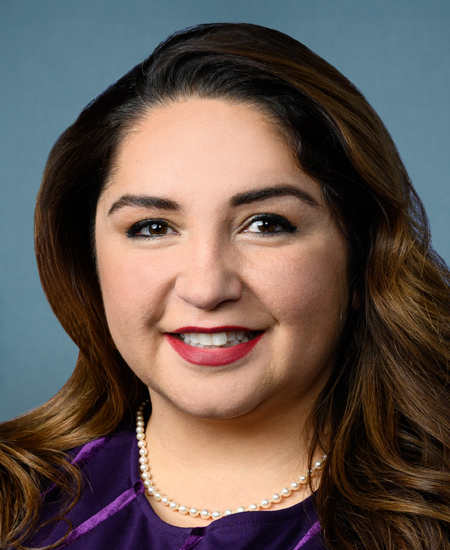
Rep. Delia C. Ramirez
Sponsored bills
Working for Immigrant Safety and Empowerment Act or the WISE Act This bill expands eligibility for U nonimmigrant visas (victims of criminal activity) and prohibits immigration enforcement activities in specified areas. Generally, U visas are for victims of specified crimes (e.g., rape, trafficking, or domestic violence) who assist with the investigation or prosecution of the crime. The bill adds hate crimes, child abuse, and elder abuse as crimes that may qualify a victim for a U visa and removes criteria related to the victim's assistance with the investigation or prosecution of the crime. Furthermore, the Department of Homeland Security (DHS) must provide work authorization to U visa applicants, whereas currently DHS may grant work authorization but is not required to do so. The bill also eliminates the annual numerical cap on U visas. The bill establishes a rebuttable presumption that certain individuals, including U visa applicants and T visa (victims of human trafficking) applicants, shall not be detained while the application is pending. Additionally, the bill provides immigration-related protections, such as by extending the admission period and providing work authorization, to the spouse or child of a nonimmigrant visa holder who subjected that spouse or child to battery or extreme cruelty. Further, the bill prohibits, with some exceptions for exigent circumstances, U.S. Immigration and Customs Enforcement or U.S. Customs and Border Protection from conducting immigration enforcement actions within 1,000 feet of a school, health care facility, place of worship, or other location specified in the bill.

Maddy summaryThis bill amends the Homeland Security Act of 2002 to strengthen the role of the Department of Homeland Security (DHS) Officer for Civil Rights and Civil Liberties. It requires the DHS Secretary to assign permanent staff and dedicated resources to support the officer's duties, ensuring they have consistent capacity to address civil rights concerns. The bill directly affects DHS agencies and the public interacting with them, as it mandates structural support for the officer's oversight role. The key change is the requirement for permanent staffing and resources, moving beyond temporary arrangements to provide ongoing civil rights oversight within DHS.
Maddy summaryHR 2837 establishes an Advisory Council under the Department of Health and Human Services to improve access to existing resources for victims of gun violence. The council, composed of federal agency heads and appointed victims/support professionals, will assess needs, identify effective programs, and compile a public resource hub with contact information for medical, financial, mental health, legal, and government support services. It requires a detailed report within 180 days of enactment and a follow-up report within two years, focusing on gaps in current assistance and coordination. The bill directly affects individuals defined as victims of gun violence (including those wounded, threatened, witnessing incidents, or related to victims) and aims to connect them to existing federal, state, and nonprofit resources without authorizing new funding. The council will sunset after five years.
Maddy summaryHRES 317 is a non-binding resolution urging the U.S. government to lead global efforts to halt and reverse the nuclear arms race. It calls on the President to pursue negotiations with nuclear-armed states to reduce arsenals, end the U.S. policy allowing first use of nuclear weapons, eliminate immediate launch readiness, stop developing new weapons, and support communities affected by nuclear programs. The resolution emphasizes diplomatic action over military modernization to reduce nuclear risks and prevent catastrophic conflict.
Maddy summaryThe GOSAFE Act prohibits the sale, manufacture, transfer, and possession of gas-operated semi-automatic firearms and large capacity ammunition feeding devices (those holding more than 10 rounds). It defines gas-operated firearms as those that use gas from fired cartridges to cycle the action, requiring the Attorney General to publish a list of prohibited firearms within 180 days. The bill establishes a process for manufacturers to seek approval for new firearm designs before selling to civilians and creates a "Firearm Safety Trust Fund" to cover related costs. Certain firearms are exempt, including single-shot, muzzle-loading, and firearms with permanently fixed magazines holding 10 or fewer rounds. Violations could result in fines up to $5,000 or up to 12 months in prison.
Maddy summaryThe American Family Act (HR 2763) establishes a new refundable child tax credit that provides monthly payments to eligible families with children. It would pay $300 per month for each child under age 6 and $360 per month (120% of $300) for each child age 6 or older, with income limits of $150,000 for joint filers and $112,500 for other filers. The bill creates a "period of presumptive eligibility" to determine eligibility for monthly payments, allowing families to receive advance payments based on information from previous tax returns. This would directly affect millions of families with children who meet the income requirements, providing more consistent financial support throughout the year rather than an annual tax credit.
Maddy summaryHR 2799, the Closing the Bump Stock Loophole Act of 2025, prohibits the sale, possession, and modification of devices that increase the firing rate of semi-automatic firearms to mimic machine guns (commonly called "bump stocks"). It specifically bans manual, power-driven, or electronic devices designed to speed up firing, as well as modified firearms that achieve this effect. Owners of pre-existing modified firearms must register them within 120 days of the law's enactment, with exemptions for government entities and firearms already lawfully modified and registered before the bill passes. The bill does not restrict standard semi-automatic firearms or require registration of unmodified guns.
Maddy summaryThis bill expands the Earned Income Tax Credit (EITC) for low-income workers by lowering the minimum age to claim the credit from 25 to 19 (with exceptions for students, former foster youth, and homeless youth), removing the maximum age limit of 65, and doubling the credit percentage from 7.65% to 15.3%. It also increases the income thresholds for eligibility, raising the phaseout starting point from $4,220 to $9,820 for single filers and $5,280 to $11,610 for joint returns. The credit amounts and income limits will now adjust annually for inflation using specific Consumer Price Index (CPI) benchmarks. Additionally, taxpayers can elect to use their prior year’s earned income to calculate the credit if it was higher than the current year’s, effective for 2026 tax returns.
Maddy summaryHR 2753, the Hands Off Medicaid and SNAP Act of 2025, is a procedural bill that would prevent Congress from using budget reconciliation to cut Medicaid or SNAP benefits. It amends the Congressional Budget Act to block reconciliation bills or amendments that reduce Medicaid enrollment/benefits (under Social Security Act Title XIX) or SNAP eligibility/benefits (under the Food and Nutrition Act of 2008). This rule would apply until January 20, 2029, and only affects the budget reconciliation process, not the programs themselves. The bill does not change current benefit levels or eligibility rules for Medicaid or SNAP recipients.