

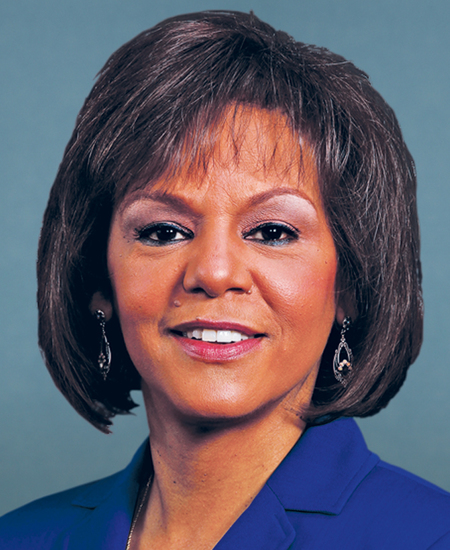
Photo of Robin L. Kelly
D United States House · District 2 · Illinois

Rep. Robin L. Kelly

Compare
Total votes
2,837
all sessions
Attendance
98%
67 missed
Near the chamber average
With party
98%
of cast votes
Higher than 86% of chamber peers
Bipartisan score
1%
crosses aisle rarely
Lower than 86% of chamber peers
Sponsored
1,332
bills & resolutions
Higher than 79% of chamber peers
Committees
4
assignments
1,332 bills and resolutions

Sponsored bills

Total
1,332
Primary
72
Co-sponsor
1,260
This page
1,332
matching current filters
Co-sponsor HJRES 193
In committee · United States House · Co-sponsor
Proposing an amendment to the Constitution of the United States providing that there is no immunity from criminal prosecution for an act on the grounds that such act was within the constitutional authority or official duties of an individual, and providing that the President may not grant a pardon to himself or herself.

Maddy summaryH.J. Res. 193 proposes a constitutional amendment to eliminate legal immunity for federal officials, including the President, from criminal prosecution for actions taken while performing official duties. It also prohibits the President from granting a pardon to themselves. The amendment would apply to all federal officers (such as the President, Vice President, and members of Congress) except for Congress members acting in their legislative role as defined in the Constitution. If ratified by 38 states, this change would become part of the U.S. Constitution, requiring no further congressional action.

In committee Jul 24, 2024 1 co-sponsor
Primary HR 9104
In committee · United States House · Lead sponsor
Access to Birth Control Act

Maddy summaryHR 9104, the Access to Birth Control Act, requires pharmacies that normally stock contraception to provide birth control or related medications without delay if in stock, or immediately offer alternatives like referrals to other pharmacies or expedited orders if unavailable. It prohibits pharmacists from intimidating customers, misrepresenting availability, breaching confidentiality, or refusing to fill valid prescriptions for birth control. Pharmacies violating these rules face civil penalties up to $1,000 per day or private lawsuits. The law specifically applies to pharmacies that routinely carry contraception and excludes cases where a valid prescription is missing or payment cannot be made. It aims to address documented refusals to dispense birth control, particularly following the Dobbs decision.

In committee Jul 23, 2024 0 co-sponsors
Co-sponsor HR 4581
Signed into law · United States House · Co-sponsor
Maternal and Child Health Stillbirth Prevention Act of 2024

Maddy summaryHR 4581, the Maternal and Child Health Stillbirth Prevention Act of 2024, amends Title V of the Social Security Act to explicitly allow federal funds to support stillbirth prevention efforts. The bill directs states receiving Title V maternal and child health funds to use these resources for evidence-based programs and research aimed at reducing stillbirths, including tracking fetal movements, screening for growth issues, smoking cessation, and community support. It directly affects state maternal health programs by clarifying that existing funding can now cover specific stillbirth prevention activities previously not explicitly permitted. The law changes how Title V funds may be spent, adding clear provisions for research and programs targeting stillbirth reduction. This is a policy change that updates funding guidelines without creating new programs or mandates.

Signed into law Jul 12, 2024 1 co-sponsor
Co-sponsor HR 8825
In committee · United States House · Co-sponsor
Right to Vote Act

Maddy summaryHR 8825, the Right to Vote Act, establishes a fundamental right for all citizens of legal voting age to vote in federal elections. It directly affects voters across all states and territories by prohibiting government actions that make voting harder (like restrictive ID laws or reduced polling places) unless those actions are the least restrictive way to serve a significant government interest. The bill creates two legal standards: "retrogression" (diminishing voting access) and "substantial impairment" (making voting significantly harder), allowing voters to sue in federal court to challenge such restrictions. Courts must expedite these cases, and the law applies to all federal elections occurring on or after September 1, 2024.

In committee Jul 10, 2024 1 co-sponsor
Co-sponsor HCONRES 118
In committee · United States House · Co-sponsor
Recognizing the significance of equal pay and the disparity in wages paid to men and to Black women.

Maddy summaryHCONRES 118 is a symbolic congressional resolution recognizing the wage disparity faced by Black women in the U.S. It specifically highlights that Black women earn 69 cents for every dollar earned by White, non-Hispanic men, as noted in Census Bureau data. The resolution marks July 9, 2024, as Black Women’s Equal Pay Day to symbolize how long into 2024 Black women must work to earn what White men earned in 2023. It does not create new laws or policies but formally acknowledges this disparity and reaffirms congressional support for equal pay for equal work.

In committee Jul 9, 2024 1 co-sponsor
Co-sponsor HRES 1337
In committee · United States House · Co-sponsor
Remembering the lives lost and honoring the survivors two years after the Independence Day Parade shooting that occurred on July 4, 2022, in Highland Park, Illinois.

Maddy summaryHRES 1337 is a ceremonial resolution commemorating the July 4, 2022, Highland Park, Illinois, Independence Day Parade shooting. It honors the seven victims (Katie Goldstein, Irina McCarthy, Kevin McCarthy, Stephen Strauss, Jacquelyn Sundheim, Nicolas Toledo-Zaragoza, and Eduardo Uvaldo) and over 40 wounded survivors, while acknowledging the community's healing two years post-tragedy. The resolution expresses the House's solidarity with Highland Park residents, first responders, and healthcare providers who aided victims. It does not enact new laws or policies but serves as a symbolic tribute to the victims and survivors. This is a procedural resolution with no concrete policy changes, solely focused on remembrance and support.

In committee Jun 28, 2024 1 co-sponsor
Co-sponsor HRES 1332
In committee · United States House · Co-sponsor
Original LGBTQIA+ Pride Month Resolution of 2024

Maddy summaryHRES 1332 is a symbolic resolution recognizing June as LGBTQIA+ Pride Month. It encourages the celebration of Pride Month to honor the historical struggles and achievements of LGBTQIA+ people in the United States, while acknowledging the ongoing challenges they face. This resolution does not create new laws or policies, but serves as a formal recognition of LGBTQIA+ rights as human rights and highlights their integral role in American history. The resolution was introduced by multiple members of Congress and passed by the House of Representatives.

In committee Jun 28, 2024 1 co-sponsor
Co-sponsor HR 8858
In committee · United States House · Co-sponsor
Securing Elections From AI Deception Act

Maddy summaryThis bill bans developers and deployers of AI algorithms from using them to deceive voters about election procedures (like voting locations or registration rules) or intimidate people from voting. It requires clear disclaimers - such as "AI Disclaimer: This output was generated by artificial intelligence" - on AI-generated election content, including fake candidate videos or altered voting information. The law sets safety standards for election-related AI, requiring developers to ensure algorithms are "safe and effective" before use. The Federal Trade Commission enforces these rules, with violations potentially leading to fines or up to one year in prison.

In committee Jun 27, 2024 1 co-sponsor
Co-sponsor HR 3018
In committee · United States House · Co-sponsor
Federal Extreme Risk Protection Order Act of 2023

Maddy summaryThis bill creates a federal framework for "extreme risk protection orders" (ERPOs) that temporarily remove firearms from individuals who pose a risk of harming themselves or others. Family members or law enforcement officers can petition a federal court for a temporary order (up to 14 days) based on probable cause, followed by a hearing within 72 hours to determine if a longer-term order (up to 180 days) is warranted. The bill requires clear and convincing evidence of risk at the hearing and mandates respondents to surrender firearms to law enforcement within 48 hours. It also includes provisions for reporting, training law enforcement on ERPOs, and a federal grant program to support state ERPO implementation, without preempting state laws.

In committee Jun 26, 2024 1 co-sponsor
Co-sponsor HR 8828
In committee · United States House · Co-sponsor
Gun Theft Prevention Act

Maddy summaryThe Gun Theft Prevention Act requires licensed firearm dealers to implement specific security measures, including locked cabinets, security systems, and site hardening, to prevent gun thefts. It mandates annual security plan certifications with inventory reconciliation, employee background checks before firearm possession, and 30-day reporting of stolen firearms to authorities. The bill increases inspections (annual for high-risk dealers, triennial for others) and establishes civil penalties of up to $20,000 for violations. These requirements apply to all federally licensed gun dealers nationwide, with a one-year transition period for implementation, while maintaining state law authority over firearm dealing.

In committee Jun 25, 2024 1 co-sponsor
Showing 561 to 570 of 1,332 bills
Previous 1 … 56 57 58 … 134 Next