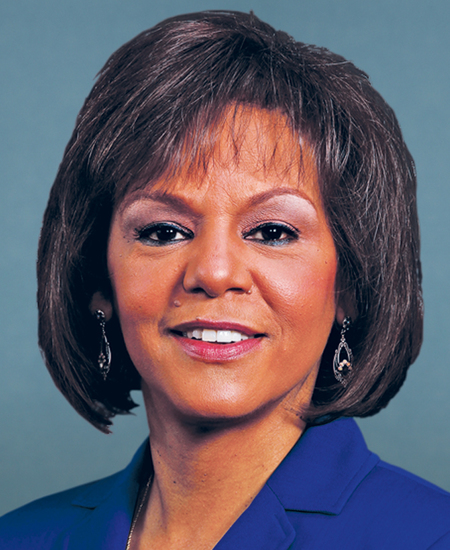
Photo of Robin L. Kelly
D United States House · District 2 · Illinois

Rep. Robin L. Kelly

Compare
Total votes
2,837
all sessions
Attendance
98%
67 missed
Near the chamber average
With party
98%
of cast votes
Higher than 86% of chamber peers
Bipartisan score
1%
crosses aisle rarely
Lower than 86% of chamber peers
Sponsored
1,328
bills & resolutions
Higher than 79% of chamber peers
Committees
4
assignments
1,328 bills and resolutions

Sponsored bills

Total
1,328
Primary
72
Co-sponsor
1,256
This page
1,328
matching current filters
Co-sponsor HR 2650
In committee · United States House · Co-sponsor
End Gun Violence Act of 2025

Maddy summaryThis bill prohibits firearm sales or transfers to individuals convicted of a "violent misdemeanor" within the past five years. A "violent misdemeanor" is defined as a state or local offense involving physical force, a deadly weapon, or intent to cause injury - requiring the original conviction to have included legal representation and a jury trial (or valid waiver). The law excludes expunged convictions or pardons unless civil rights restoration explicitly allows firearm possession. It directly affects people with recent violent misdemeanor convictions, blocking their access to firearms under federal law.

In committee Apr 3, 2025 1 co-sponsor
Co-sponsor HR 2648
In committee · United States House · Co-sponsor
Secure Background Checks Act of 2025

Maddy summaryHR 2648, the Secure Background Checks Act of 2025, amends federal law to add two new restrictions to firearm purchase background checks. It prohibits individuals who fail to meet their state's age requirements or who do not reside in (or maintain a business in) the state where the gun seller operates, unless an exception applies. The bill directly affects prospective gun buyers who would now be blocked from purchasing firearms under these new criteria. These changes modify existing provisions in Title 18 of the U.S. Code to expand the categories of people barred from gun purchases based on state residency and age compliance.

In committee Apr 3, 2025 1 co-sponsor
Primary HR 2618
In committee · United States House · Lead sponsor
Federal Firearm Licensee Act

Federal Firearm Licensee Act This bill establishes new security requirements and expands recordkeeping and reporting requirements for federally licensed dealers, importers, and manufacturers of firearms (i.e., federal firearms licensees, or FFLs). The bill also broadens the authority of the Bureau of Alcohol, Tobacco, Firearms and Explosives (ATF) to administer federal firearms laws and enforce violations. Specifically, bill requires FFLs to implement and comply with a plan to secure their business premises, conduct quarterly physical checks of their business inventories, maintain video surveillance of the area where firearms are sold or transferred, and initiate firearms-related background checks for employees. Additionally, the bill requires FFLs to report to the ATF any inventory firearm that is lost, stolen, or unaccounted for and to notify the ATF about default-proceed transactions (i.e., allowable firearm transfers to an unlicensed person prior to the completion of a background check when the submitted background check remains incomplete after three business days). Finally, the bill removes limits on the ATF's authority to conduct activities related to the administration of federal firearms laws. It enhances the ATF's inspection authority, including by removing the limit on the number of annual compliance inspections (currently, one), requiring inspections of high-risk FFLs, and authorizing an additional 650 investigators. Finally, the bill directs the ATF to deny an application for a federal firearms license if it would endanger public safety or if the applicant is unlikely to comply with the law.


In committee Apr 3, 2025 0 co-sponsors
Co-sponsor HR 2598
In committee · United States House · Co-sponsor
IDEA Full Funding Act

Maddy summaryThe IDEA Full Funding Act (HR 2598) mandates specific annual federal funding levels for the Individuals with Disabilities Education Act (IDEA), directly affecting schools and students with disabilities nationwide. It requires the federal government to appropriate either a fixed dollar amount or a specified percentage (increasing annually from 4.5% to 40%) of a calculated total - based on the number of eligible students and average per-pupil costs - starting in fiscal year 2026 through 2035. The bill sets clear, escalating funding targets, with the higher of two calculated amounts (dollar figure or percentage) becoming available for obligation each fiscal year. This establishes a binding financial commitment to address long-standing underfunding of special education services under IDEA.

In committee Apr 2, 2025 1 co-sponsor
Co-sponsor HR 2531
In committee · United States House · Co-sponsor
Workplace Violence Prevention for Health Care and Social Service Workers Act

Workplace Violence Prevention for Health Care and Social Service Workers Act This bill requires the Department of Labor to address workplace violence in health care, social service, and similar sectors. Specifically, Labor must issue an occupational safety and health standard that requires certain employers to take actions to protect workers and other personnel from workplace violence. The standard applies to employers in the health care sector, in the social service sector, and in sectors that conduct activities similar to those in the health care and social service sectors. Among other elements, the standard must require each employer to (1) develop a workplace violence prevention plan, (2) promptly investigate incidents of workplace violence, and (3) provide relevant training and education to employees.  The bill requires certain hospitals and skilled nursing facilities to comply with this standard as a condition of Medicare participation.

In committee Apr 1, 2025 1 co-sponsor
Primary HR 2506
In committee · United States House · Lead sponsor
AID Youth Employment Act

Maddy summaryThe AID Youth Employment Act creates federal grant programs to support summer and year-round employment for youth aged 14-24, with special focus on marginalized youth including those who are homeless, in foster care, or involved in the justice system. The bill allocates $1.8 billion for summer employment programs and $2.4 billion for year-round programs, requiring eligible entities to form partnerships with educational agencies, workforce development organizations, and community partners. It establishes performance metrics to track employment rates, education enrollment, and credential attainment for participants, with specific requirements that 20% of summer funding support rural areas and 5% support tribal areas. The law includes special provisions for tribal communities and requires annual evaluations to ensure program quality and effectiveness.

In committee Mar 31, 2025 0 co-sponsors
Primary HR 2507
In committee · United States House · Lead sponsor
Helping to Encourage Real Opportunities (HERO) for Youth Act of 2025

Maddy summaryHR 2507 (HERO for Youth Act of 2025) expands a federal tax credit for employers hiring youth. It allows the credit for year-round employment (not just summer) for young workers attending school 20+ hours weekly between September 16 and April 30. The bill also creates a new credit for employers hiring "disconnected youth" - defined as individuals aged 16-25 not enrolled in school or employed for six months, or foster youth aged 16-21. The credit amount is increased, and related tax code provisions are updated to reflect these changes.

In committee Mar 31, 2025 0 co-sponsors
Co-sponsor HR 1661
In committee · United States House · Co-sponsor
SAFE Act of 2025

Save America's Forgotten Equines Act of 2025 or the SAFE Act of 2025 This bill permanently prohibits the slaughter of equines (e.g., horses and mules) for human consumption. (Current law prohibits the slaughter of dogs and cats for human consumption. This bill extends the prohibition to equines.) Specifically, this bill prohibits a person from knowingly (1) slaughtering an equine for human consumption; or (2) shipping, transporting, possessing, purchasing, selling, or donating an equine to be slaughtered for human consumption or equine parts for human consumption. The bill subjects a violator to a fine. The bill applies to conduct in or affecting interstate or foreign commerce or within the special maritime and territorial jurisdiction of the United States. However, it does not apply to an activity carried out by an Indian for a religious ceremony. As background, in recent years, the appropriations acts have prohibited the Department of Agriculture (USDA) from using federal funds to inspect horses before they are slaughtered for human consumption. Therefore, there are currently no USDA-inspected horse slaughter facilities in the United States.

In committee Mar 28, 2025 1 co-sponsor
Co-sponsor HR 1271
In committee · United States House · Co-sponsor
To provide additional funding for scholarships for students at 1890 institutions, and for other purposes.

Maddy summaryHR 1271 increases funding for scholarships at 1890 institutions - historically Black colleges and universities established under the Second Morrill Act - by adding mandatory annual support. It amends existing law to explicitly include bachelor's and graduate programs in scholarship eligibility and requires $15 million annually from the Commodity Credit Corporation starting in fiscal year 2025, to remain available until spent. This funding directly supports students at these institutions by expanding access to financial aid for higher education. The bill updates previous funding language to ensure ongoing support beyond 2023.

In committee Mar 28, 2025 1 co-sponsor
Co-sponsor HR 2439
In committee · United States House · Co-sponsor
Support UNFPA Funding Act

Maddy summaryHR 2439 authorizes $50 million for fiscal year 2026 and $55 million for 2027 to fund the United Nations Population Fund (UNFPA), directly supporting its global programs. The bill specifies that these funds will help end preventable maternal deaths, address unmet contraceptive needs, combat gender-based violence, and end harmful practices like child marriage and female genital mutilation. UNFPA operates in over 150 countries, primarily aiding women and girls in developing nations and crisis zones, including those affected by conflict or natural disasters. The bill emphasizes UNFPA’s compliance with U.S. restrictions (not funding abortion) and its role in advancing U.S. strategic interests through voluntary family planning and reproductive health services.

In committee Mar 27, 2025 1 co-sponsor
Showing 361 to 370 of 1,328 bills
Previous 1 … 36 37 38 … 133 Next