

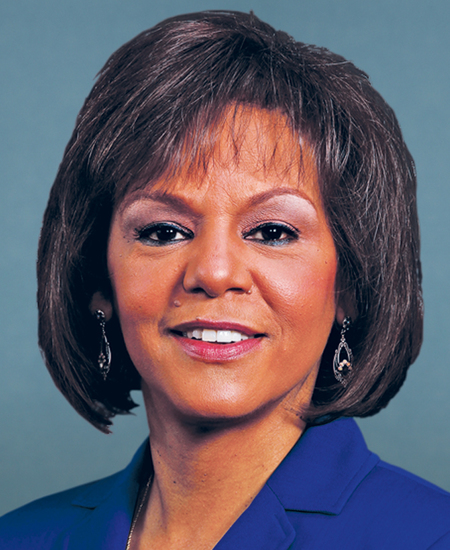
Photo of Robin L. Kelly
D United States House · District 2 · Illinois

Rep. Robin L. Kelly

Compare
Total votes
2,837
all sessions
Attendance
98%
67 missed
Near the chamber average
With party
98%
of cast votes
Higher than 86% of chamber peers
Bipartisan score
1%
crosses aisle rarely
Lower than 86% of chamber peers
Sponsored
1,328
bills & resolutions
Higher than 79% of chamber peers
Committees
4
assignments
1,328 bills and resolutions

Sponsored bills

Total
1,328
Primary
72
Co-sponsor
1,256
This page
1,328
matching current filters
Co-sponsor HR 5674
In committee · United States House · Co-sponsor
Emergency Relief for Federal Workers Act of 2025

Maddy summaryThis bill allows federal employees who are furloughed or working without pay during a government shutdown (defined as a funding lapse of at least two weeks) to withdraw up to $30,000 from their Thrift Savings Plan (TSP) retirement savings without the usual 10% early withdrawal penalty. The $30,000 limit adjusts annually for inflation and applies per shutdown period. It also ensures missed TSP loan payments during a shutdown are not treated as taxable distributions, and employees can later contribute back up to the withdrawn amount without penalty. The bill directly affects federal workers facing financial hardship due to funding lapses, providing immediate relief through modified TSP rules.

In committee Oct 3, 2025 1 co-sponsor
Co-sponsor HR 842
In committee · United States House · Co-sponsor
Nancy Gardner Sewell Medicare Multi-Cancer Early Detection Screening Coverage Act

Maddy summaryThis bill adds Medicare coverage for multi-cancer early detection screening tests (blood or biological tests analyzing cell-free DNA) starting January 1, 2028. It directly affects Medicare beneficiaries aged 68 and older (starting in 2028, with the age limit increasing by 1 year annually), requiring tests to be FDA-cleared and deemed reasonable/necessary by the Secretary for early cancer detection across multiple organ sites. Payment will initially match current stool DNA test rates before 2031, then shift to a lower rate or new payment system after 2031, with limits preventing more than one test per year. The bill explicitly states it does not alter coverage for existing cancer screenings like breast, colorectal, or prostate cancer tests.

In committee Oct 3, 2025 1 co-sponsor
Co-sponsor HR 5657
In committee · United States House · Co-sponsor
Fair Pay for Federal Contractors Act of 2025

Fair Pay for Federal Contractors Act of 2025 This bill provides back pay to employees of federal contractors who lost pay due to a lapse in appropriations (i.e., government shutdown) in FY2026. Specifically, the bill provides appropriations for federal agencies that are subject to a lapse in appropriations in FY2026 to adjust the price of contracts to compensate federal contractors for providing back pay to employees who were affected by the lapse in appropriations.  The agencies must adjust the price of any contract for which the contractor stopped, suspended, delayed, or interrupted all or part of the work under the contract due to the lapse in appropriations. The price adjustment must compensate the contractor for reasonable costs incurred to (1) compensate employees who were furloughed or laid off, were not working, or experienced a reduction of hours or compensation due to the lapse in appropriations; or (2) restore paid leave taken by employees during the lapse in appropriations if the contractor required or permitted employees to use paid leave as a result of the lapse in appropriations. The maximum amount of weekly compensation of an employee for which an adjustment may be made under this bill may not exceed the lesser of (1) the employee's actual weekly compensation, or (2) $1,442 (or a lesser amount pro-rated for an employee who works less than 40 hours per week). The bill also requires the Office of Federal Procurement Policy to submit a report to Congress on the adjustments made under this bill.

In committee Sep 30, 2025 1 co-sponsor
Co-sponsor HR 5660
In committee · United States House · Co-sponsor
Pay Our Military Act

Maddy summaryHR 5660, the Pay Our Military Act, ensures military personnel and support staff receive pay during a government funding gap in fiscal year 2026. It appropriates funds from the Treasury to cover pay and allowances for active-duty troops, reservists, Department of Defense civilian employees, and contractors supporting military operations, if Congress hasn’t passed regular funding by then. The funding remains available until either regular appropriations are enacted or January 1, 2027, whichever comes first. This is a temporary measure to prevent disruptions in military pay during budget negotiations.

In committee Sep 30, 2025 1 co-sponsor
Co-sponsor HR 5655
In committee · United States House · Co-sponsor
No Shame at School Act of 2025

Maddy summaryHR 5655, the "No Shame at School Act of 2025," requires schools to eliminate stigma around unpaid meal fees for students. It mandates that school districts automatically certify eligible students for free/reduced meals (replacing "may" with "shall"), prohibits physical segregation or public identification of students with unpaid fees (like special tokens or name lists), and bans withholding grades or activities due to meal debt. The bill also prevents schools from using debt collectors for meal fees and requires adjustments to past meal claims when eligibility is later confirmed. This directly affects schools, local educational agencies, and students from households with outstanding meal fees.

In committee Sep 30, 2025 1 co-sponsor
Co-sponsor HR 5604
In committee · United States House · Co-sponsor
National Guard Proper Use Act

Maddy summaryHR 5604, the National Guard Proper Use Act, prohibits military and National Guard personnel from being ordered to enforce federal immigration laws. It adds new sections to military law (Title 10 for active forces and Title 32 for the National Guard), explicitly stating members cannot be directed to perform duties related to immigration enforcement. This directly affects military commanders who might attempt to assign such tasks and ensures National Guard members remain focused on their core missions, not civilian immigration enforcement. The bill references the Posse Comitatus Act (18 U.S.C. §1385), a longstanding law that limits military involvement in domestic law enforcement. It clarifies existing legal boundaries without creating new programs or funding.

In committee Sep 26, 2025 1 co-sponsor
Co-sponsor HR 5603
In committee · United States House · Co-sponsor
Emergency Responder Protection Act

Maddy summaryThe Emergency Responder Protection Act (HR 5603) prohibits U.S. Immigration and Customs Enforcement (ICE) and U.S. Customs and Border Protection (CBP) officers from conducting immigration enforcement actions within 1,000 feet of protected emergency response locations - such as hospitals, shelters, disaster relief sites, or evacuation routes - except in clear cases of immediate danger to life or national security. It requires officers to consult supervisors in real-time if circumstances are unclear, mandates detailed annual reports to Congress on any enforcement near these sites, and creates penalties for violations, including barring evidence from removal proceedings. The law specifically exempts rare, premeditated arrests of terrorism suspects or individuals posing extraordinary public safety threats, with prior written approval. This directly affects ICE and CBP officers, requiring them to adjust operations near active emergency scenes.

In committee Sep 26, 2025 1 co-sponsor
Co-sponsor HRES 748
In committee · United States House · Co-sponsor
Condemning attempts to use Federal regulatory power or litigation to suppress lawful speech, particularly speech critical of a political party or the President of the United States, and warning against the rise of authoritarianism.

Maddy summaryThis resolution condemns the use of federal regulatory agencies (like the FCC) or lawsuits to suppress lawful speech critical of political parties or the President, specifically referencing concerns about tactics mirroring authoritarian practices. It does not create new laws but formally warns that such actions undermine First Amendment protections and democratic norms. The resolution directly affects media organizations, journalists, and public discourse by calling on government agencies to avoid using their power for political retaliation. It reaffirms the House’s commitment to protecting free expression and urges officials to refrain from pressuring media to silence criticism.

In committee Sep 19, 2025 1 co-sponsor
Co-sponsor HRES 754
In committee · United States House · Co-sponsor
Recognizing the psychological impact of immigration enforcement overreach on individuals, their families, and their community.

Maddy summaryHRES 754 is a House resolution recognizing the psychological harm caused by current immigration enforcement practices, specifically affecting undocumented immigrants, their families (including 5.5 million U.S.-citizen children living with undocumented relatives), and communities. It condemns ICE tactics that undermine due process and Fourth Amendment rights, such as expedited deportations and courthouse arrests, and calls for Congress to oversee ICE detention centers and monitor policy implementation. The resolution also requests federal agencies collect data on mental health impacts and collaborate with nonprofits to provide culturally appropriate mental health services to affected communities. As a non-binding resolution, it does not change laws but formally acknowledges documented psychological effects like anxiety, family separation trauma, and disrupted community stability.

In committee Sep 19, 2025 1 co-sponsor
Co-sponsor HR 5536
In committee · United States House · Co-sponsor
HEADACHE Act

Maddy summaryThe HEADACHE Act establishes a National Headache Disorders Initiative (NHDI) under the Department of Health and Human Services to address conditions like migraines, cluster headaches, and other headache disorders affecting vulnerable groups including children, pregnant women, and older adults. It creates an Advisory Council with patient advocates, healthcare providers, and federal agency representatives to guide research, improve diagnosis protocols, and reduce disparities in care. The bill requires federal agencies to share headache-related data and mandates an annual congressional report evaluating progress, disparities across demographics, and recommendations for better access to treatment and stigma reduction, with the initiative set to expire after five years.

In committee Sep 19, 2025 1 co-sponsor
Showing 201 to 210 of 1,328 bills
Previous 1 … 20 21 22 … 133 Next