

Zero-Emission Nuclear Power Production Credit Act of 2021 This bill allows a new business-related tax credit through 2030 for the production of electricity from zero-emission nuclear power. It also allows taxpayers to elect direct payments of such credit and requires a recapture of credit amounts for contractors who fail to pay their employees the prevailing wage rate. The bill requires the Government Accountability Office to report on the effectiveness of the credit in ensuring grid reliability and on ratepayer savings. Contractors must ensure that at least 15% of their workforce is composed of qualified apprentices unless there is a lack of availability of qualified apprentices in the applicable geographic area.
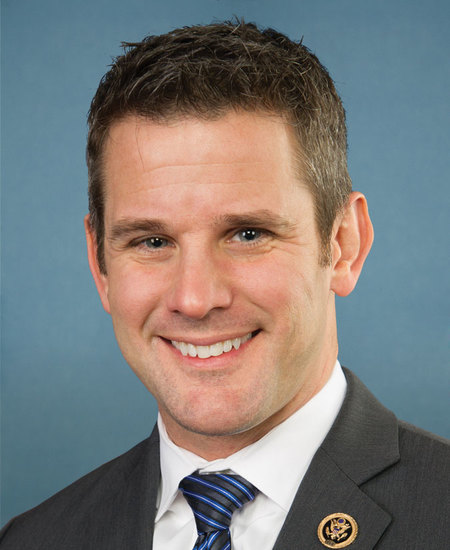
Rep. Adam Kinzinger
Sponsored bills
Online Retailer Product Origin Disclosure Act This bill requires sellers to conspicuously disclose the country of origin of imported foreign products sold over the internet.
Internet Application Integrity and Disclosure Act or the Internet Application I.D. Act This bill requires websites and online sellers or distributors of mobile applications that are located in China, or owned by the Chinese Communist Party, to conspicuously disclose that location or ownership to users. The bill provides for enforcement of this requirement by the Federal Trade Commission.
Shark Fin Sales Elimination Act of 20 21 This bill addresses the sale of shark fins and the inclusion of rays and skates in the Seafood Traceability Program. The Seafood Traceability Program has data reporting and recordkeeping requirements at the time of entry for imported fish or fish products entered into U.S. commerce. The bill makes it illegal to possess, buy, or sell shark fins or any product containing shark fins, except for certain dogfish fins. A person may possess a shark fin that was lawfully taken consistent with a license or permit under certain circumstances. Penalties are imposed for violations under the Magnuson-Stevens Fishery Conservation and Management Act. The Department of Commerce must revise its regulations to include rays and skates as species that are subject to the Seafood Traceability Program.
Critical Mineral Access Act This bill authorizes the U.S. International Development Finance Corporation to provide support to high-income economy countries for developing and processing specified critical materials if such support furthers U.S. national security interests. Critical materials include, for example, rare earth elements, aluminum, and uranium. A high-income economy country is one with a per capita gross national income (GNI) that exceeds $12,695 for 2021. Current law limits the corporation's activities to facilitating the economic development of countries with a per capita GNI below that amount.
Trillion Trees Act This bills establishes a variety of requirements and incentives to plant trees and conduct other land management practices for the purposes of capturing and storing carbon in domestic and international trees and forests. Additionally, the bill provides incentives to research or develop other carbon sequestration tools. Specifically, the bill directs the Department of Agriculture (USDA) to set targets to increase forest carbon stock through January 1, 2100, for the purposes of sequestering and storing carbon in U.S. forests. It also establishes and provides funding for the Trillion Trees Challenge Fund to provide grants to nonfederal entities for activities related to reforestation efforts on public or private lands. In addition, it raises the cap on the Reforestation Trust Fund to enhance forest health in the National Forest System and requires the USDA to establish a Tree City USA Grant Program. The bill also allows the U.S. Agency for International Development to enter into an agreement with a nonprofit organization to establish an International Forest Foundation to promote reforestation and prevent deforestation. Additionally, it establishes requirements and incentives to address seedling shortages and support nurseries. Finally, the bill provides market incentives to research or develop other carbon sequestration tools relating to biochar, sustainable building practices, biochemical and bioplastic products, and biomass energy.
Flexible Financing for Rural America Act This bill allows rural utility service providers to submit to the Department of Agriculture (USDA) a request to adjust the interest rate or modify the terms of certain loans. The request shall include a report summarizing how the adjustment or modification will assist the borrower in providing critical utility services to a rural community. Specifically, on receipt of a request, USDA or the Department of the Treasury (in the case of a loan owned by the Federal Financing Bank) must adjust the interest rate on the loan to match certain interest rates for obligations of comparable maturity to the term remaining on the loan (or a higher rate requested by the borrower), and make modifications to the loan terms as necessary to address changes in the financial position of the borrower due to the COVID-19 public health emergency and to promote the financial sustainability of the borrower. In carrying out the adjustments or modifications, USDA or Treasury shall not impose or collect any fee from, or impose any penalty on, a borrower. The bill also provides funding to implement the adjustments and modifications and for the liquidation of residual intragovernmental amounts owed by the Federal Financing Bank in connection with certain loans.
National Heritage Area Act of 2021 This bill establishes a National Heritage Areas System to recognize certain areas of the United States that tell nationally significant stories and to conserve, enhance, and interpret the areas' natural, historic, scenic, and cultural resources that illustrate significant aspects of U.S. heritage, and authorizes appropriations through FY2034 for each National Heritage Area. Through such system, the Department of the Interior may provide technical and financial assistance to local coordinating entities to support the establishment, development, and continuity of such areas. The bill extends the authority for the Erie Canalway National Heritage Corridor Commission and the Gullah/Geechee Cultural Heritage Corridor Commission until September 30, 2034. The local coordinating entity of a National Heritage Area, not later than three years after the area is included in the National Heritage Area System, shall submit to Interior a management plan for approval. Interior, not later than one year before the authorization for federal funding expires for a National Heritage Area, shall (1) conduct an evaluation of the accomplishments of that area, and (2) submit a report detailing the evaluation to specified congressional committees. Based upon the evaluation, Interior shall prepare a report with recommendations for the National Park Service's continued role, if any, with respect to the area. Interior may carry out or certify a study to assess the suitability and feasibility of designating a specific geographic area as a National Heritage Area to be included in the National Heritage Area System.
Cahokia Mounds Mississippian Culture National Historical Park Act This bill provides for the establishment of the Cahokia Mounds Mississippian Culture National Historical Park in Collinsville, Illinois; Monroe, Madison, and St. Clair Counties, Illinois; and St. Louis City County, Missouri, as a unit of the National Park System. The Department of the Interior may acquire lands and interests within the boundary of the park by donation, purchase, or exchange, except that land owned by such states or their political subdivisions may only be acquired by donation. Interior may enter into cooperative agreements with such states and their political subdivisions, colleges and universities, nonprofit organizations, Indian tribes, and individuals to (1) mark, interpret, and restore nationally significant historic or cultural and natural resources related to the life of the Mississippi culture within the park, if the agreement provides for reasonable public access; and (2) conduct research related to Mississippi culture.
Safely Ensuring Lives Future Deployment and Research In Vehicle Evolution Act or the SELF DRIVE Act This bill establishes the federal role in ensuring the safety of highly automated vehicles by encouraging the testing and deployment of such vehicles. A highly automated vehicle is a motor vehicle, other than a commercial motor vehicle, that is equipped with an automated driving system capable of performing the entire dynamic driving task on a sustained basis. The bill preempts states from enacting laws regarding the design, construction, or performance of highly automated vehicles or automated driving systems unless such laws enact standards identical to federal standards. The Department of Transportation (DOT) must require safety assessment certifications for the development of a highly automated vehicle or an automated driving system. Manufacturers of highly automated vehicles must develop written cybersecurity and privacy plans for such vehicles prior to offering them for sale. The bill applies certain safety exemptions and testing standards to highly automated vehicles. DOT must (1) inform prospective buyers of highly automated vehicles of the capabilities and limitations of such vehicles; (2) establish the Highly Automated Vehicle Advisory Council to, among other things, develop guidance regarding mobility access for the disabled, elderly, and underserved populations; (3) require all new passenger motor vehicles less than 10,000 pounds to be equipped with a rear seat occupant alert system; and (4) research updated safety standards for motor vehicle headlamps.