

Manufacturing American Dynamism in Entrepreneurship and Harnessing Education to Retool Employees Act or the MADE HERE Act This bill requires the National Institute of Standards and Technology, the Department of Energy, and the Department of Defense to establish a manufacturing cluster program to award resources and grants to eligible manufacturing clusters, and it establishes an interagency entity to oversee and coordinate the activities of manufacturing cluster programs at federal agencies. A manufacturing cluster is a geographic concentration of companies and institutions within a particular field of manufacturing that engage collaboratively in workforce development, technology development, supply chain sourcing, and other activities. The program shall be comprised of three phases wherein awards shall be distributed to manufacturing clusters for (1) the development of a detailed implementation plan, (2) the implementation of such plan, and (3) continuing the activities of the cluster. Phase two and three awards may be used for purposes such as developing and deploying educational programs for cluster members, funding efforts with respect to supply chain sourcing and innovation, and developing shared infrastructure or resources for cluster members.
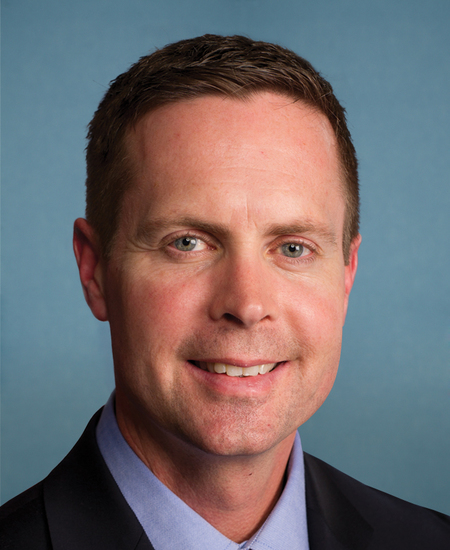
Rep. Rodney Davis
Sponsored bills
Protecting Financial Privacy Act of 2021 This bill prohibits a federal agency from creating, implementing, or administering a program that requires financial institutions or individuals to report on the balances of, transactions involving, or transfers into and out of financial accounts. This prohibition does not apply to laws or regulations in effect on September 1, 2021, or to the Bank Secrecy Act (laws that require financial institutions and other entities to report on certain financial transactions to prevent money laundering, the financing of terrorism, and other criminal activity). This prohibition does apply, however, to regulations issued under the Bank Secrecy Act after September 1, 2021.
One-Stop Pilot Program Act of 2021 This bill authorizes the Transportation Security Administration (TSA) to conduct a pilot program at not more than six foreign last point of departure airports to permit passengers and their accessible property to bypass domestic security rescreening at a connecting airport in the United States. Screening may be bypassed if (1) the country of departure has an aviation screening agreement with the United States setting standards and protocols comparable to those in the United States; (2) passengers cannot access their checked baggage until arriving at their final destination; and (3) upon arrival in the United States, passengers do not come into contact with other arriving international passengers (or their property) or persons who have not been screened. The TSA must ensure there is no reduction in the level of security or specific aviation security standards and requirements for screening passengers and their property prior to boarding an international flight bound for the United States, including standards or requirements regarding (1) high risk passengers; and (2) weapons, explosives, and incendiaries. If the TSA determines that the foreign countries participating in the screening agreements have not maintained and implemented comparable standards and protocols to those in the United States, it must ensure that passengers and their property arriving from the foreign airports are rescreened in the United States before they are permitted into sterile areas of the airports. The pilot program shall terminate six years after the enactment of the bill.
Israel Relations Normalization Act of 2021 This bill requires the Department of State to take certain actions promoting the normalization of relations between Israel, Arab states, and other relevant countries and regions. Specifically, the State Department must develop a strategy on expanding and strengthening the Abraham Accords (the term used to refer collectively to agreements between Israel and the United Arab Emirates and between Israel and Bahrain marking the public normalization of relations between the two Arab countries and Israel). The strategy must include a description of how the U.S. government will encourage further normalization of relations with Israel. In addition, the State Department must report on options for U.S. international efforts to promote the strengthening of ties between Israel, Arab states, and other relevant countries and regions. The State Department must also report on the status of the normalization of relations with Israel, including information on (1) laws that punish individuals for people-to-people relations with Israelis (i.e., anti-normalization laws), and (2) evidence of steps taken by Arab governments toward permitting or encouraging normalized relations between their citizens or residents and Israeli citizens.
Save our Stages Extension Act This bill extends to March 11, 2023, the time frame during which Shuttered Venue Operators Grant recipients may use grant funds to cover their expenses. These grants provide funds to certain types of entities in the arts and entertainment industry affected by the COVID-19 pandemic. Currently, a recipient may use such funds to cover expenses incurred between March 1, 2020, and December 31, 2021.
This resolution recognizes the importance of ending the stigmatization of substance use disorder.
Front-Loaded Aid Transparency Act or the FLAT Act This bill directs the Government Accountability Office to study and report on the front-loading of grant aid by institutions of higher education (IHEs) for FY2007-FY2020. Front-loading refers to the practice of providing first-year students with a higher amount or percentage of grant aid than the IHE provides to second-year, third-year, or fourth-year students.
Military Suicide Prevention in the 21st Century Act This bill requires the Department of Defense to carry out a two-year pilot program to program suicide prevention resources onto smart devices issued to members of the Armed Forces and to provide training on these resources.
Chinese Military and Surveillance Company Sanctions Act of 2021 This bill requires the President to impose property-blocking sanctions on Communist Chinese military companies upon certain findings. Specifically, if the President determines that imposing sanctions on a foreign person would address certain threats related to the financing of Chinese Communist military companies, the President must impose sanctions on that person provided that the person is identified (1) as a Communist Chinese military company in a specified report to Congress or in a November 17, 2020, executive order, or (2) by the Department of the Treasury as having engaged in transactions in the publicly traded securities (or derivatives) of a Communist Chinese military company.
This resolution expresses support for the designation of Rail Safety Week.