IDEA Full Funding Act This bill provides permanent, mandatory funding for the grant program that assists states and outlying areas in providing special education and related services to children with disabilities.
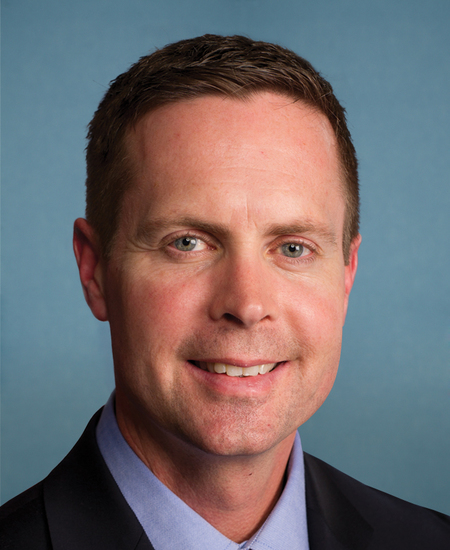
Rep. Rodney Davis
Sponsored bills
Leveraging and Energizing America's Apprenticeship Programs Act or the LEAP Act This bill allows employers a business-related tax credit of $1,500 for hiring an apprenticeship employee who has not attained age 25 at the close of the taxable year or $1,000 for an apprenticeship employee who has attained age 25. The bill allows the credit for no more than two taxable years with respect to any apprenticeship employee. An apprenticeship employee is an employee who is employed in an officially-recognized apprenticeable occupation pursuant to an apprentice agreement registered with the Office of Apprenticeship of the Employment and Training Administration of the Department of Labor or a state apprenticeship agency. The Office of Management and Budget must coordinate with federal departments and independent agencies to (1) determine which government publications could be available on government websites and no longer printed, (2) devise a strategy to reduce overall government printing costs over the 10-year period beginning with FY2020, (3) establish government-wide guidelines on employee printing, and (4) issue guidelines for publicly disclosing information about the publication of government documents.
This resolution requires the Joint Committee on the Library to approve or deny the statue of Rev. Billy Graham for placement in the National Statuary Hall within 30 days after North Carolina submits (1) photographs of the statue, (2) dimensions of the statue and pedestal, (3) the final weight of the statue and pedestal, and (4) any inscriptions on the statue.
This resolution supports the designation of National Microtia and Atresia Awareness Day. Microtia is a congenital condition affecting the outer ear; it is often accompanied by aural atresia (the absence or closure of the external ear canal resulting in hearing loss).
This concurrent resolution declares that Congress should not impose any new performance fee, tax, royalty, or other charge relating to the public performance of sound recordings on a local radio station for broadcasting sound recordings over the air, or on any business for such public performance of sound recordings.
Veterans' Preference Parity Act This bill modifies the eligibility criteria for certain veterans to qualify for a preference in the federal hiring process. Specifically, an individual who is honorably discharged from active duty service is eligible for a veterans' preference, if the active duty service was performed for more than 180 total days (currently, consecutive days). Additionally, a retired member of the Armed Forces is eligible for a veterans' preference, even if the retiree (1) is not a disabled veteran and (2) retired at or above the rank of major or its equivalent.
Temporary Family Visitation Act This bill establishes a new nonimmigrant visa classification for an alien temporarily entering the United States to visit a relative who is a U.S. citizen or lawful permanent resident. The maximum period of stay for a family visitor visa shall be 90 days. An alien seeking such a visa must have health insurance for the duration of the stay. An alien who holds such a visa may not change to another nonimmigrant visa classification except in certain limited instances. If an alien has been approved for a family-based immigrant visa and is waiting for one to become available, the alien may obtain a family visitor visa if the alien meets the eligibility requirements.
David Dorn Back the Blue Act This bill directs the Department of Justice (DOJ) to provide programs to support the hiring and retention of law enforcement personnel and to increase their salaries. Further, DOJ may make grants to state and local law enforcement agencies for this purpose.
Protect and Serve Act of 2021 This bill establishes a new criminal offense for knowingly assaulting a law enforcement officer and causing serious bodily injury (or attempting to do so) in circumstances that affect interstate commerce. It imposes criminal penalties—a prison term, a fine, or both—on a violator.
Common Sense Cannabis Reform for Veterans, Small Businesses, and Medical Professionals Act This bill removes federal restrictions on, and creates new protections for, marijuana-related conduct and activities that are authorized by state or tribal law. Among other things, the bill does the following: removes marijuana from the list of scheduled substances under the Controlled Substances Act and eliminates criminal penalties for an individual who manufactures, distributes, or possesses marijuana; directs the Food and Drug Administration and the Alcohol and Tobacco Tax and Trade Bureau of the Department of the Treasury to issue rules to regulate marijuana that are similar to the federal rules regulating alcohol; creates protections for depository institutions that provide financial services to marijuana-related businesses; creates protections for veterans who use, possess, or transport medical marijuana; and requires the National Institutes of Health to study and report on the effects of medical marijuana on individuals who are impaired or in pain and the relationship between state-approved treatment programs involving medical marijuana, access to such programs, and a reduction in opioid abuse.