

Maddy summaryHRES 533 is a non-binding House resolution calling on the President to lift the indefinite suspension of U.S. refugee admissions, which has left over 100,000 refugees stranded in limbo since January 2025. It specifically references Executive Order 14163 (2025) that halted refugee arrivals, citing the plight of refugees conditionally approved for resettlement, including Afghans, Rohingya, and Sudanese. The resolution reaffirms U.S. commitments under the Refugee Act of 1980 and international obligations, urging restoration of the U.S. Refugee Admissions Program to protect vulnerable refugees. It also calls for increased international cooperation, support for frontline host countries, and meeting global refugee protection pledges. The resolution does not create new law but expresses congressional intent to address the refugee crisis.
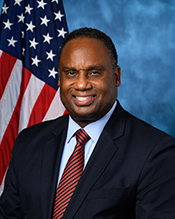
Rep. Jonathan L. Jackson
Sponsored bills
Maddy summaryHR 4083, the Marshall “Major” Taylor Congressional Gold Medal Act, authorizes the posthumous presentation of a Congressional Gold Medal to honor cyclist Marshall Walter "Major" Taylor (1878-1932), recognizing his pioneering achievements as a Black athlete who broke racial barriers in professional cycling during the late 19th and early 20th centuries. The bill directs the Secretary of the Treasury to strike the medal with his name and image, to be presented to Taylor’s great-granddaughter, Karen Donovan. It also permits the sale of bronze duplicates to cover costs, classifying all medals as national commemorative items under U.S. law. This is a ceremonial bill with no policy changes, solely focused on commemorating Taylor’s legacy.
Maddy summaryThe Insurrection Act of 2025 would clarify and limit when the President can deploy military forces domestically to address insurrections, rebellions, or widespread violence. It requires state and local authorities to be unable to handle the situation, with specific circumstances including obstruction of voting rights or Federal law, and mandates the state governor's request for assistance. The bill requires the President to consult Congress, issue a proclamation ordering lawbreakers to disperse, and submit a detailed report before deployment, with military action limited to 7 days unless Congress passes a joint resolution approving it for up to 14 days. The bill explicitly prohibits using National Guard members on training duty for these purposes and provides for judicial review of deployments.
Maddy summaryThe Occupational Therapy Mental Health Parity Act requires the U.S. Department of Health and Human Services to provide education and outreach about Medicare coverage for occupational therapy services treating mental health and substance use disorders. Specifically, it directs the Secretary to clarify how these services are covered under the Medicare Benefit Policy Manual using standard medical billing codes (HCPCS). This education must be completed within one year of the bill's enactment. The goal is to improve understanding of existing Medicare coverage for occupational therapy in mental health and substance use treatment, without changing current benefit rules.
Maddy summaryHCONRES 37 is a non-binding congressional resolution urging the President to establish a U.S. Commission on Truth, Racial Healing, and Transformation. The resolution does not create the commission itself but calls for its formation to acknowledge historical racial injustices (like discriminatory housing policies, the Chinese Exclusion Act, and forced Native American boarding schools) and catalyze efforts to eliminate racial inequities. The commission would focus on dismantling the "belief in a hierarchy of human value" and advancing racial healing, complementing ongoing efforts like H.R. 40 (the reparations study bill). It directly affects federal leadership (via the President) and aims to guide national policy, though it has no legal force.
Maddy summaryHRES 509 is a symbolic resolution expressing the U.S. House of Representatives' support for designating June 2025 as "Black Music Month." It does not create new laws or directly affect any individuals or entities; instead, it urges the public to recognize and celebrate Black music's cultural impact through voluntary actions like promoting artists and spreading awareness. The resolution highlights Black music's historical influence across genres - from spirituals to hip-hop - and calls for honoring its legacy in education, media, and community initiatives. It follows a tradition started by President Carter in 1979 but has no legal force.
Maddy summaryThe PHARA Act of 2025 requires the National Institutes of Health (NIH) to immediately release all required funding for existing research grants and rapidly pay pending reimbursements. It prohibits NIH from terminating active research grants (entered after the bill's enactment) solely due to shifting agency priorities or program goals, and mandates new termination clauses requiring 90 days' written notice and attempts to amend terms before ending agreements. This directly affects researchers and institutions receiving NIH grants, ensuring funding continuity for ongoing projects. The bill aims to prevent abrupt halts in scientific research by restructuring grant termination processes.
Maddy summaryThe Domestic Workers Bill of Rights Act (HR 3971) would establish key labor protections for domestic workers, including nannies, housekeepers, and caregivers who work in private homes. The bill requires written agreements for workers employed 8+ hours per week, provides earned sick days (1 hour for every 30 hours worked), mandates fair scheduling practices with 72-hour notice for schedule changes, and extends overtime protections to live-in domestic employees. It also prohibits unfair wage deductions, guarantees meal and rest breaks, and ensures privacy protections including no monitoring in private living spaces. The bill directly affects approximately 2.2 million domestic workers across the U.S., who are disproportionately women of color and immigrants. Enforcement would be handled by the Department of Labor through new complaint resolution mechanisms and oversight.
Maddy summaryHR 3906, the Medical Research for Our Troops Act, restores funding levels for military medical research by increasing the Defense Health Agency's research budget from $40.395 billion to $41.576 billion in the 2025 appropriations act. It ensures Congressionally Directed Medical Research Programs funds are used consistently with the Consolidated Appropriations Act, 2024, requiring the Defense Secretary to support all previously identified research programs and maintain existing funding allocations. The bill directly affects military medical research initiatives and the Defense Health Agency's budget implementation. This is a procedural funding adjustment, not a new policy, maintaining continuity for ongoing research projects.
Maddy summaryThis bill updates Veterans Health Administration (VHA) anesthesia practice standards to align with Defense Health Agency (DHA) guidelines, directly affecting VA-employed anesthesia providers (including physician anesthesiologists and certified registered nurse anesthetists). It requires VHA to recognize certified registered nurse anesthetists as licensed independent practitioners under DHA’s 2023 standards and mandates certification from specific bodies for all anesthesia staff. Additionally, it sets a 25-hour minimum requirement for direct patient care experience for all VA anesthesia professionals and allows suspension for non-compliance. The bill also requires annual GAO reports comparing outcomes and costs across three anesthesia delivery models (anesthesiologist-led, CRNA-supervised, and CRNA-only) to be submitted to Congress.