

Anti-Racism in Public Health Act of 2021 This bill establishes within the Centers for Disease Control and Prevention (CDC) a National Center on Antiracism and Health and a law enforcement violence prevention program. Among other activities, the new center must declare racism a public health crisis, collect and analyze data, and administer research and grant programs to address racism and its impact on health and well-being. Additionally, the bill specifically directs the CDC's National Center for Injury Prevention and Control, in coordination with the Department of Justice and other relevant stakeholders, to carry out the law enforcement violence prevention program by conducting research and supporting other activities pertaining to law enforcement violence and public health.
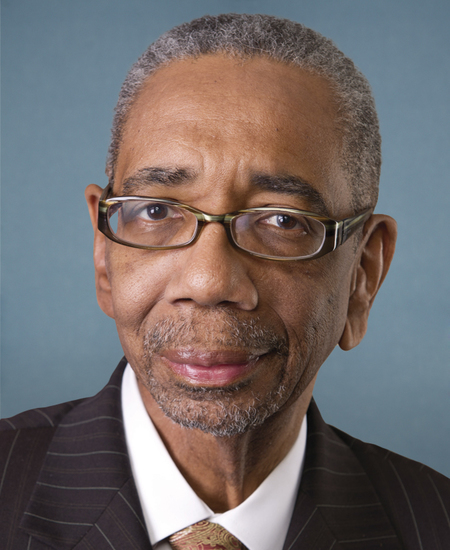
Rep. Bobby L. Rush
Sponsored bills
Public Health Emergency Privacy Act This bill imposes privacy, confidentiality, and security requirements on the use and disclosure of COVID-19 (i.e., coronavirus disease 2019) emergency health data. This is data that is linked to an individual or device, such as test results. The requirements apply to organizations that collect, use, or disclose emergency health data electronically or that manage websites or applications for contact tracing and other COVID-19 response activities. These organizations must provide notice of privacy and other policies. They must also ensure the accuracy of, prevent discrimination based on, and limit disclosure of the data. If an organization collects data from at least 100,000 individuals, it must publicly report additional information about how it uses and discloses the data. Furthermore, the bill prohibits the use of emergency health data for commercial advertising or in ways that restrict access to opportunities, services, and other accommodations. It also prohibits government entities and organizations from using this data to infringe on the right to vote. The Department of Health and Human Services must report on the civil rights impact of the collection, use, and disclosure of health data. The bill provides for enforcement by the Federal Trade Commission, states, and a private right of action. It further specifies that certain dispute resolution mechanisms, such as arbitration, are unenforceable with respect to disputes arising under the bill.
Emergency Water is a Human Right Act This bill creates a grant program, administered by the Department of Health and Human Services, to provide funds to states and Indian tribes to assist low-income households that pay a high proportion of household income for drinking water and wastewater services. Further, any entity receiving financial assistance under this grant program must ensure that no home energy service or public water system service is or remains disconnected or interrupted during the COVID-19 (i.e., coronavirus disease 2019) public health emergency.
Ally's Act This bill requires private health insurance plans to cover certain hearing devices and systems (e.g., bone-anchored auditory implants) and related items and services. The bill also imposes limits on cost sharing.
Improving Social Determinants of Health Act of 2021 This bill requires the Centers for Disease Control and Prevention (CDC) to establish a program to improve health outcomes and reduce health inequities by, for example, coordinating activities across the CDC. As part of the program, the CDC must award grants to eligible organizations to build capacity to address social determinants of health. The CDC shall provide for an independent evaluation of certain grants and report findings to Congress.
Women and Climate Change Act of 2021 This bill addresses climate change and its effects on women and girls. Specifically, the bill establishes the Federal Interagency Working Group on Women and Climate Change within the Department of State. The bill outlines the functions of the working group, including the coordination of agencies' policies and activities relating to combating the effects of climate change on women and improving the government's response to and strategy for climate change. In addition, the Office of Global Women's Issues of the State Department must submit a strategy to prevent and respond to the effects of climate change on women.
End Diaper Need Act of 2021 This bill establishes and expands programs to increase access to diapers and related supplies primarily for low-income families. The Department of Health and Human Services must award demonstration grants to entities with experience in community distribution of basic necessities or other community services to meet diapering needs of eligible families with infants and toddlers. Additionally, the bill permits states to use Medicaid funds to provide medically necessary diapers and supplies to certain low-income families. These families must have a child who is over age three and diagnosed with a serious condition such as bowel or bladder incontinence. It also allows individuals to buy medically necessary diapers and supplies with funds from health savings accounts and other tax-advantaged accounts for health care expenses.
Blue Collar to Green Collar Jobs Development Act of 2021 This bill reauthorizes and modifies the Department of Energy's (DOE) Office of Minority Economic Impact. Specifically, the bill (1) renames the office as the Office of Economic Impact, Diversity, and Employment; and (2) directs the office to establish and carry out a comprehensive nationwide program to improve education and training for jobs in energy-related industries, with emphasis on increasing the number of skilled individuals from underrepresented communities trained to work in those jobs. DOE, in collaboration with the Bureau of Labor Statistics, the Department of Commerce, the Bureau of the Census, and energy-related industries, shall establish a clearinghouse to develop resources training programs for jobs in energy-related industries and act as a resource for educational institutions and covered organizations and programs that seek to develop and implement training programs for such jobs. In carrying out the program, DOE, in collaboration with the Department of Education, Commerce, the Department of Labor, and the National Science Foundation, shall develop voluntary guidelines or best practices for educational institutions to help provide students with the skills necessary for jobs in energy-related industries. The office shall establish and carry out a program to provide grants to certain businesses, labor organizations, nonprofit organizations, or qualified youth or conservation corps to pay the eligible wages or stipends for individuals receiving training to work for businesses that provide services related to renewable electric energy generation and energy efficiency.
Nationally Enhancing the Well-being of Babies through Outreach and Research Now Act or the NEWBORN Act This bill establishes a pilot program through which the Health Resources and Services Administration must award grants to territorial, tribal, and local health departments in areas with the highest rates of infant mortality to address birth defects, premature births, and other leading causes of infant death.
Abolish the Last Great Plantation in America Resolution This resolution establishes the Commission on Addressing Racism and Ensuring Diversity in the United States Government. The commission must study the presence of systemic racism and the lack of diversity in the federal government and recommend steps to eliminate racism and promote diversity in the government.