This resolution acknowledges the impact of redlining (i.e., geographic discrimination) and states that the federal government has a responsibility to ameliorate its effects, including through the creation, preservation, and maintenance of equitable economic opportunities and recovery efforts in response to the COVID-19 (i.e., coronavirus disease 2019) pandemic.
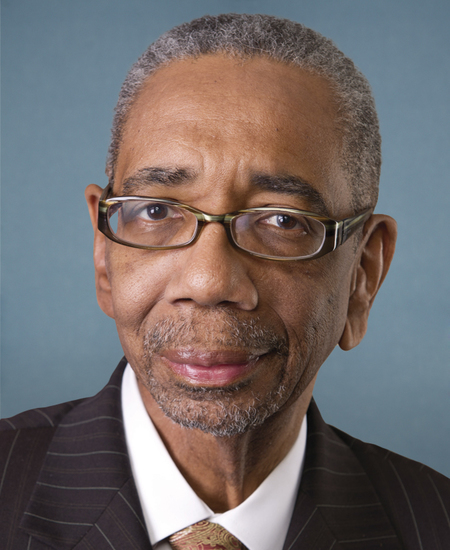
Rep. Bobby L. Rush
Sponsored bills
Children’s Health Insurance Program Permanency Act or the CHIPP Act This bill permanently extends the Children's Health Insurance Program (CHIP) and related measures, programs, and authorities. Specifically, the bill permanently funds CHIP and related programs that support the development of child health quality measures and outreach and enrollment efforts. The bill also permanently authorizes the Medicaid and CHIP express lane eligibility option, which allows states to use information from designated programs (e.g., the Supplemental Nutrition Assistance Program) to streamline eligibility determinations for children. Additionally, under the bill, states may expand eligibility to children whose family income exceeds the otherwise applicable limits.
Ensuring Kids Have Access to Medically Necessary Dental Care Act This bill modifies dental coverage under the Children's Health Insurance Program (CHIP). Specifically, the bill prohibits lifetime or annual limits on CHIP dental coverage. It also requires states to offer dental-only supplemental coverage under CHIP to children who have other health insurance but are otherwise eligible for CHIP (i.e., wraparound coverage); such coverage is currently at the option of the state.
This resolution expresses support for the designation of Pi Day.
Preventing Real Online Threats Endangering Children Today or the PROTECT Kids Act This bill addresses the online collection of personal information from children. Specifically, the bill raises the age for parental consent protections for children online from under 13 to under 16, adds geolocation and biometric information to protected personal information, and extends all protections for children online to mobile applications. The bill also requires the operator of a website, online service, or mobile application to delete a child's personal information upon the verified request of a parent, and it prohibits such operator from terminating service to a child whose parent has refused to permit further collection or use of that child's personal information. Additionally, the Federal Trade Commission must study and report on the appropriateness of the existing actual knowledge standard (preventing an operator from collecting personal information without meeting certain requirements when it has actual knowledge that it is collecting such information from a child) and what effects changing such standard will have on children's online privacy.
Protecting the Right to Organize Act of 20 21 This bill expands various labor protections related to employees' rights to organize and collectively bargain in the workplace. Among other things, it (1) revises the definitions of employee , supervisor , and employer to broaden the scope of individuals covered by the fair labor standards; (2) permits labor organizations to encourage participation of union members in strikes initiated by employees represented by a different labor organization (i.e., secondary strikes); and (3) prohibits employers from bringing claims against unions that conduct such secondary strikes. The bill also allows collective bargaining agreements to require all employees represented by the bargaining unit to contribute fees to the labor organization for the cost of such representation, notwithstanding a state law to the contrary; and expands unfair labor practices to include prohibitions against replacement of, or discrimination against, workers who participate in strikes. The bill makes it an unfair labor practice to require or coerce employees to attend employer meetings designed to discourage union membership and prohibits employers from entering into agreements with employees under which employees waive the right to pursue or a join collective or class-action litigation. The bill further prohibits employers from taking adverse actions against an employee, including employees with management responsibilities, in response to that employee participating in protected activities related to the enforcement of the prohibitions against unfair labor practices (i.e., whistleblower protections). Such protected activities include providing information about a potential violation to an enforcement agency, participating in an enforcement proceeding, initiating a proceeding concerning an alleged violation or assisting in such a proceeding, or refusing to participate in an activity the employee reasonably believes is a violation of labor laws. Finally, the bill addresses the procedures for union representation elections, provides employees with the ability to vote in such elections remotely by telephone or the internet, modifies the protections against unfair labor practices that result in serious economic harm, and establishes penalties and permits injunctive relief against entities that fail to comply with National Labor Relations Board orders.
For the People Act of 2021 This bill addresses voter access, election integrity and security, campaign finance, and ethics for the three branches of government. Specifically, the bill expands voter registration (e.g., automatic and same-day registration) and voting access (e.g., vote-by-mail and early voting). It also limits removing voters from voter rolls. The bill requires states to establish independent redistricting commissions to carry out congressional redistricting. Additionally, the bill sets forth provisions related to election security, including sharing intelligence information with state election officials, supporting states in securing their election systems, developing a national strategy to protect U.S. democratic institutions, establishing in the legislative branch the National Commission to Protect United States Democratic Institutions, and other provisions to improve the cybersecurity of election systems. Further, the bill addresses campaign finance, including by expanding the prohibition on campaign spending by foreign nationals, requiring additional disclosure of campaign-related fundraising and spending, requiring additional disclaimers regarding certain political advertising, and establishing an alternative campaign funding system for certain federal offices. The bill addresses ethics in all three branches of government, including by requiring a code of conduct for Supreme Court Justices, prohibiting Members of the House from serving on the board of a for-profit entity, and establishing additional conflict-of-interest and ethics provisions for federal employees and the White House. The bill requires the President, the Vice President, and certain candidates for those offices to disclose 10 years of tax returns.

Jack Reynolds Memory MediGap Expansion This bill expands guaranteed issue rights with respect to Medigap policies (Medicare supplemental health insurance policies) to all beneficiaries with end-stage renal disease. (Guaranteed issue rights require that a policy be offered to any eligible applicant without regard to health status.)
This resolution expresses support for the goals and ideals of National Colorectal Cancer Awareness Month.
Stop Militarizing Law Enforcement Act This bill restricts the Department of Defense (DOD) from transferring certain surplus military property to federal, state, or local law enforcement agencies. Specifically, DOD may not transfer to such agencies specified property such as controlled firearms, ammunition, grenade launchers, explosives, certain vehicles or trucks, armored or weaponized drones, certain controlled aircraft, silencers, or long-range acoustic devices. DOD may waive this limitation and transfer certain vehicles or trucks if DOD determines that the transfer is necessary for disaster or rescue purposes or for another purpose where life and public safety are at risk. As a condition for a transfer of allowable property, DOD must require the federal or state agency that receives the property to return the property if the agency is investigated by the Department of Justice for civil liberties violations or is otherwise found to have engaged in widespread abuses of civil liberties. DOD must also periodically submit certain transfer-related information and certifications to Congress. Furthermore, as a condition for transfer, the recipient must receive the approval of its local governing body, provide specified notice to the local community, and submit specified information and certifications to DOD. A federal or state agency that receives controlled property under such a transfer may never take ownership of the property. The bill also eliminates the requirement for DOD to give preference to transfers of property that will be used in counter-drug, counterterrorism, disaster-related emergency preparedness, or border security activities.