

Securing Universal Communications Connectivity to Ensure Students Succeed Act or the SUCCESS Act This bill provides additional funding for the Emergency Connectivity Fund, which supports remote learning during the COVID-19 emergency period by covering reasonable costs of laptop and tablet computers, Wi-Fi hotspots, modems, routers, and broadband connectivity purchases for off-campus use by students, school staff, and library patrons.
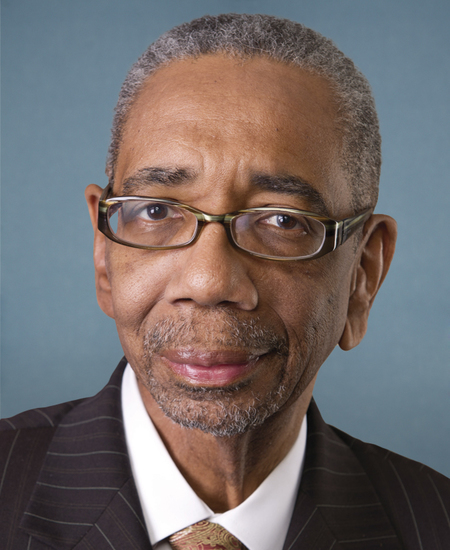
Rep. Bobby L. Rush
Sponsored bills
Consumer Protection and Recovery Act This bill authorizes the Federal Trade Commission (FTC) to seek monetary relief in federal court from businesses that engage in unlawful commercial practices such as false advertising, consumer fraud, and anticompetitive conduct. Specifically, the FTC may seek restitution in these cases for losses, rescission or reformation of contracts, refund of money, return of property, or disgorgement of unjust enrichment. On April 22, 2021, the Supreme Court held in AMG Capital Management, LLC v. Federal Trade Commission that the Federal Trade Commission Act does not authorize the FTC to seek, or a court to award, such relief.
Strengthening the Vaccines for Children Program Act of 2021 This bill modifies vaccination programs and coverage for children under Medicaid and the Children's Health Insurance Program (CHIP). Specifically, the bill expands and otherwise modifies the Vaccines for Children Program, which provides free vaccinations to individuals 18 years of age or younger who are uninsured or underinsured (i.e., with limited or no insurance for vaccines), are eligible for Medicaid, or are American Indians or Alaskan Natives. The bill expands the program to include children enrolled in CHIP and temporarily provides for additional payments to incentivize provider participation. The Government Accountability Office must report on the related effects of the bill's changes. The bill also expands coverage under Medicaid and CHIP to include vaccine counseling and educational services for children and temporarily requires payments to be made at a rate that is no less than the rate under Medicare for equivalent services. It also temporarily increases the Federal Medical Assistance Percentage (i.e., federal matching rate) for states that conduct culturally appropriate outreach regarding the benefits of vaccinations for children.
This resolution reaffirms the House of Representatives' commitment to media diversity and expresses its pledge to eliminate barriers to such diversity.
Mamie Till-Mobley Memorial Stamp Act This bill directs the U.S. Postal Service to issue a commemorative postage stamp in honor of Mamie Till-Mobley, the mother of Emmett Till (who was kidnapped and lynched in 1955).
21st Century FTC Act This bill eliminates certain requirements with respect to the rulemaking authority of the Federal Trade Commission (FTC). Specifically, the FTC may promulgate a rule under the Administrative Procedure Act defining an unfair or deceptive trade practice without (1) publishing advance notice of the rulemaking, (2) finding a widespread pattern of an applicable unfair practice, or (3) providing the opportunity for an informal hearing. It also limits the opportunity for the FTC or a petitioner of a rule to make additional oral submissions and written presentations while a rule is under judicial review. Further, a court may not set aside a rule promulgated through such notice and comment process on the basis that the FTC failed to complete a regulatory analysis.
Facilitating Innovative Nuclear Diagnostics Act of 2021 This bill establishes separate payment requirements for diagnostic radiopharmaceuticals under the Medicare prospective payment system for hospital outpatient department services. The bill's requirements apply to diagnostic radiopharmaceuticals that have an average daily cost of $500 or more in 2022 and as adjusted based on a specified fee schedule factor in each year thereafter.
End Double Taxation of Successful Consumer Claims Act This bill allows a deduction from gross income (above-the-line deduction) for attorney fees and court costs in connection with a claim of a consumer protection violation.
Green New Deal for Public Schools Act of 2021 This bill provides environmental and educational resources to public elementary and secondary schools and Bureau of Indian Education (BIE) schools. Specifically, the bill requires the Department of Energy's (DOE's) Office of Energy Efficiency and Renewable Energy to provide climate capital facilities grants to eligible entities (e.g., public schools and BIE schools). Grant recipients must use these funds to construct new, or convert existing facilities into, healthy zero-carbon schools. Healthy zero-carbon school refers to a school with highly energy-efficient facilities that produce or procure sufficient carbon-free and pollution-free renewable energy to meet the school's needs. Next, the bill directs the Department of Education (ED) to award resource block grants to qualified local educational agencies (LEAs) to hire and retain educators and support staff in high-need schools. ED must award grants to eligible consortia of LEAs for educational equity planning and implementation. In addition, ED must establish the Climate Change Resiliency Program to increase the resiliency of public and BIE schools during climate change-related events, natural disasters, and public health crises. Further, ED must establish a related grant program for state educational agencies. Grant recipients must use these funds for certain activities (e.g., green infrastructure projects). The bill establishes the Office of Sustainable Schools within ED to (1) administer the resource block grant and educational equity grant programs, and (2) coordinate with DOE and the White House Office of Domestic Climate Policy on climate capital facilities grants and the Climate Change Resiliency Program.
Social Determinants Accelerator Act of 2021 This bill establishes the Social Determinants Accelerator Interagency Council to increase coordination among health and social service programs and provide technical assistance to increase the impact of such programs. The council must also assist the Centers for Medicare & Medicaid Services to award up to 25 grants to state, local, or tribal health or human services agencies for social determinants accelerator plans. These plans must address at least one health and one social outcome for a specified target population.