

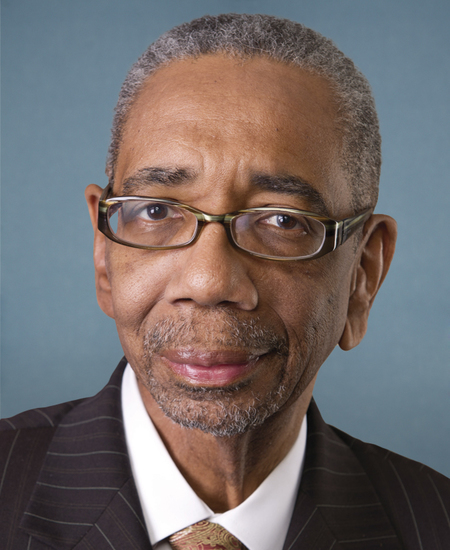
Photo of Bobby L. Rush
D United States House · District 1 · Illinois

Rep. Bobby L. Rush

Compare
Total votes
958
all sessions
Attendance
100%
4 missed
Higher than 77% of chamber peers
With party
99%
of cast votes
Higher than 86% of chamber peers
Bipartisan score
0%
crosses aisle rarely
Lower than 87% of chamber peers
Sponsored
644
bills & resolutions
Higher than 85% of chamber peers
Committees
0
assignments
644 bills and resolutions

Sponsored bills

Total
644
Primary
53
Co-sponsor
591
This page
644
matching current filters
Co-sponsor HRES 890
In committee · United States House · Co-sponsor
Recognizing the cultural and historical significance of Lunar New Year in 2022.

This resolution recognizes the cultural and historical significance of the Lunar New Year. The resolution expresses, in observance of this Lunar New Year, the Year of the Tiger, the deepest respect of the House of Representatives for Asian Americans and all individuals throughout the world who celebrate this significant occasion. The resolution wishes Asian Americans and all individuals who observe this holiday a happy and prosperous new year.

In committee Jan 28, 2022 1 co-sponsor
Co-sponsor HR 6525
In committee · United States House · Co-sponsor
Lunar New Year Day Act

Maddy summaryHR 6525, the Lunar New Year Day Act, would designate the Lunar New Year as an official federal holiday. The bill amends Section 6103(a) of Title 5 of the U.S. Code to add "Lunar New Year Day" to the list of holidays observed by federal employees. This holiday would be observed on the actual date of the Lunar New Year, which varies annually based on the lunar calendar. As a result, federal employees would receive a paid day off, and federal agencies would adjust operations to accommodate the new holiday.

In committee Jan 28, 2022 1 co-sponsor
Co-sponsor HR 6390
In committee Jan 24, 2022 1 co-sponsor
Co-sponsor HR 1848
In committee · United States House · Co-sponsor
LIFT America Act

Leading Infrastructure For Tomorrow’s America Act or the LIFT America Act This bill establishes several programs and incentives to modernize the nation's communications, drinking water, energy, transportation, health care, and other related infrastructure. For example, the bill provides incentives to make broadband internet more accessible and affordable. It also establishes grants to implement next generation 9-1-1 services. In addition, it supports drinking water programs, including the drinking water state revolving fund program. Further, it provides grants to treat perfluoroalkyl or polyfluoroalkyl substances (commonly referred to as PFAS) in drinking water and to replace lead service lines. The bill establishes a variety of programs to support clean energy infrastructure and address climate change, including efforts to (1) modernize the electric grid and make it more resilient, efficient, and secure; (2) increase energy efficiency in buildings; and (3) support renewable energy infrastructure. Further, it provides incentives for vehicle infrastructure, such as incentives to develop infrastructure for electric vehicles and grants to reduce air pollution at ports by electrifying port infrastructure. Additionally, the bill establishes grants and programs for health care infrastructure, including by providing support for the Centers for Disease Control and Prevention, laboratories, and state, local, tribal, and territorial health departments. Finally, the bill reauthorizes grant programs to remediate brownfield sites (i.e., sites contaminated with hazardous substances) through FY2026.

In committee Jan 20, 2022 1 co-sponsor
Co-sponsor HR 6416
In committee · United States House · Co-sponsor
Banning Surveillance Advertising Act of 2022

Banning Surveillance Advertising Act of 2022 This bill restricts online advertising that targets an individual, internet-connected device, or group of individuals or devices based on personal information. Personal information includes information that is reasonably linkable to an individual or connected device such as internet browsing history or the content of communications. The bill generally prohibits (1) online advertisers from using personal information, including personal information that identifies an individual as a member of a specified protected class, to target advertising; and (2) advertising facilitators (i.e., entities that receive compensation for disseminating online advertisements) from using personal information to disseminate targeted advertising or knowingly enabling online advertisers to do so. The bill allows certain exceptions, including for advertisements disseminated based on (1) content with which an individual is engaging, such as search results, if the advertisement is displayed in close proximity to the individual's engagement with the content; or (2) a state, market area, or other geographic location associated with an individual. Furthermore, an advertising facilitator may use information provided by an advertiser or third party if that advertiser or third party also attests in writing that the information complies with the bill's requirements. The bill provides for enforcement of these provisions by the Federal Trade Commission, states, and individuals.

In committee Jan 19, 2022 1 co-sponsor
Co-sponsor HR 6396
In committee · United States House · Co-sponsor
Climate RESILIENCE Act

Climate Risk and Emergency Support In Livable Inclusive and Equitable Neighborhoods and Communities Everywhere Act or the Climate RESILIENCE Act This bill makes changes to the Robert T. Stafford Disaster Relief and Emergency Assistance Act to take into account climate change. The bill includes extreme temperature events, such as heat waves or freezes, within the scope of the act and defines resilience for purposes of disaster assistance and mitigation efforts. Federal and state preparedness and mitigation assistance may be used for reducing the impacts of extreme temperatures and improving air quality and mitigating against wildfire smoke.. The bill authorizes implementing predisaster hazard mitigation measures that will be cost-effective and equitable long-term and provide enhanced protection to the community. The Federal Emergency Management Agency (FEMA) must (1) provide technical assistance to underserved and disadvantaged communities for such measures; and (2) provide guidance to implement the latest published editions of relevant consensus-based codes, specifications, and standards that incorporate the latest hazard-resistant designs. The bill includes within the hazard mitigation program requirements the abatement of lead, mold, mildew, radon, asthma, and allergen triggers, or other pollutants and hazardous materials directly caused by a major disaster or emergency. FEMA must report to Congress regarding challenges posed by FEMA requirements for determining the cost-effectiveness of mitigation activities and how such requirements may disproportionately burden underserved or disadvantaged communities.

In committee Jan 14, 2022 1 co-sponsor
Co-sponsor HJRES 68
In committee · United States House · Co-sponsor
Amending title 36, United States Code, to direct the President to issue an annual proclamation establishing Democracy Day.

Maddy summaryThis bill (H.J.Res. 68) is a symbolic, procedural measure that would require the President to issue an annual proclamation designating a day as "Democracy Day." It directs the President to call on state/local governments and citizens to observe the day through programs and activities, with January 6 referenced as a potential date. The bill does not create new government programs or change existing laws - it only establishes a recurring presidential proclamation. It directly affects federal, state, and local governments by encouraging them to participate in annual observances. The bill has no budgetary impact and remains focused on promoting civic engagement through a designated day.

In committee Jan 11, 2022 1 co-sponsor
Co-sponsor HR 6117
In committee · United States House · Co-sponsor
PrEP Access and Coverage Act

PrEP Access and Coverage Act This bill requires private health insurance plans to cover prescription drugs that prevent HIV, including related screenings, diagnostic procedures, administrative fees, and clinical follow-ups, without any cost-sharing obligation for the plan holder. Further, insurance plans must not impose any preauthorization requirement for this coverage. These coverage requirements also apply to public health insurance programs, including Medicare, Medicaid, and the Children's Health Insurance Program. Additionally, the bill prohibits denying, limiting, or qualifying coverage or increasing premiums for disability insurance, long-term care insurance, or life insurance policies based on an individual taking medication for HIV prevention. The bill further requires the Department of Health and Human Services to award grants to states, or directly to eligible local organizations, to provide uninsured individuals and underinsured individuals access to prescription drugs and related services that prevent HIV. The Centers for Disease Control and Prevention also must develop a public awareness campaign that focuses efforts in communities with a high need for HIV prevention treatment.

In committee Jan 6, 2022 1 co-sponsor
Primary HR 6338
In committee · United States House · Lead sponsor
SNAP PLUS Act of 2021

SNAP Provisions to Lower Undue Struggle Act of 2021 or the SNAP PLUS Act of 2021 This bill expands the Supplemental Nutrition Assistance Program (SNAP) to permit the use of SNAP benefits to purchase prepared foods fit for immediate consumption and hot foods.

In committee Jan 4, 2022 0 co-sponsors
Co-sponsor HR 6272
In committee · United States House · Co-sponsor
College Student Hunger Act of 2021

College Student Hunger Act of 20 21 This bill modifies the eligibility requirements for the Supplemental Nutrition Assistance Program (SNAP) to make additional students at institutions of higher education eligible for benefits.

In committee Jan 4, 2022 1 co-sponsor
Showing 201 to 210 of 644 bills
Previous 1 … 20 21 22 … 65 Next