

Big Cat Public Safety Act This act revises requirements governing the trade of big cats (i.e., species of lion, tiger, leopard, cheetah, jaguar, or cougar or any hybrid of such species) under the Lacey Act to limit the possession, breeding, and exhibition of big cats. The Lacey Act prohibits any person from importing, exporting, buying, selling, transporting, receiving, or acquiring big cats across state lines or the U.S. border. However, some exemptions are provided for certain entities, such as universities and wildlife sanctuaries. (Sec. 3) The act expands the Lacey Act prohibitions to include a prohibition on possessing or breeding big cats. Breeding means facilitating propagation or reproduction (whether intentionally or negligently), or failing to prevent propagation or reproduction. Owners of big cats that were born before this act's enactment may keep their big cats, but the owners must register them with the U.S. Fish and Wildlife Service. The act modifies the list of entities that are exempt from prohibitions to export, buy, sell, transport, receive, acquire, possess, or breed big cats. The modified list includes exemptions for entities or facilities exhibiting animals to the public if they (1) hold a Class C license in good standing under the Animal Welfare Act, and (2) do not allow individuals to come into direct physical contact with big cats. However, direct contact is allowed if the individual is a trained professional, a veterinarian, or directly supporting conservation programs that do not involve commercial activities and meet other specified restrictions. (Sec. 4) A person who knowingly violates the act must be fined not more than $20,000, or imprisoned for no more than five years, or both. The act considers each violation to be a separate offense. The offense must be deemed to have been committed not only in the district where the violation first occurred, but also in any district in which the defendant may have taken or been in possession of the prohibited wildlife species. (Sec. 5) The act extends forfeiture provisions to fish, wildlife, or plants that are bred or possessed; thus, big cats bred or possessed in violation of the act are subject to forfeiture. (Sec. 6) The Department of the Interior must issue regulations to implement this act.
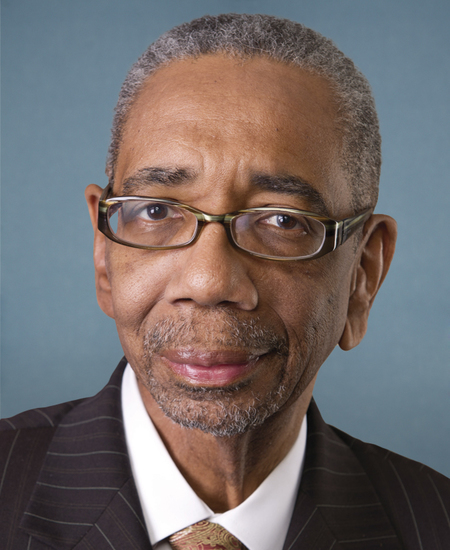
Rep. Bobby L. Rush
Sponsored bills
This act designates the facility of the United States Postal Service located at 303 East Mississippi Avenue in Elwood, Illinois, as the Lawrence M. "Larry" Walsh Sr. Post Office.
Further Continuing Appropriations and Extensions Act, 2023 This act provides continuing FY2023 appropriations for federal agencies through December 23, 2022, and extends several expiring programs and authorities. (Unless otherwise specified, the extensions referred to in this summary are also effective through December 23, 2022.) The act also requires the National Oceanic and Atmospheric Administration (NOAA) to develop guidance and take other actions to update precipitation estimates. (Sec. 3) This section provides that references to this Act included in any division of this act refer only to the provisions of the division unless the act expressly provides otherwise. (Sec. 4) This section provides appropriations for a payment to Colette Wallace McEachin, the beneficiary of the late Representative Aston Donald McEachin. (A gratuity equal to one year's salary has long been given to the heirs or beneficiaries of Members of Congress who die in office.) DIVISION A--FURTHER CONTINUING APPROPRIATIONS ACT, 2023 Further Continuing Appropriations Act, 2023 This division provides continuing FY2023 appropriations to federal agencies through the earlier of December 23, 2022, or the enactment of the applicable appropriations act. It is known as a continuing resolution (CR) and prevents a government shutdown that would otherwise occur if the FY2023 appropriations bills have not been enacted when the existing CR expires on December 16, 2022. The CR funds most programs and activities at the FY2022 levels. It also extends several exceptions that provide funding flexibility or additional appropriations for various programs. The division also extends the Department of Homeland Security's federal intrusion detection and prevention system and a related reporting requirement. DIVISION B--OTHER MATTERS TITLE I--EXTENSIONS (Sec. 101) This section extends the authority of the Federal Communications Commission to conduct auctions for electromagnetic spectrum licenses. (Sec. 102) This section extends a special assessment on nonindigent persons or entities convicted of certain offenses involving sexual abuse or human trafficking. The assessment funds programs for human-trafficking survivors. United States Parole Commission Further Extension Act of 2022 (Sec. 103) This section extends the U.S. Parole Commission. (Sec. 104) This section extends the Commodity Futures Trading Commission Customer Protection Fund expenses account. TITLE II--BUDGETARY EFFECTS This title exempts the budgetary effects of this division and each succeeding division from (1) the Statutory Pay-As-You-Go Act of 2010 (PAYGO), (2) the Senate PAYGO rule, and (3) certain budget scorekeeping rules. DIVISION C--HEALTH AND HUMAN SERVICES TITLE I--MEDICARE AND MEDICAID (Sec. 101) This section extends certain increased payment adjustments for low-volume hospitals under Medicare's inpatient prospective payment system. (Sec. 102) This section extends the Medicare-Dependent Hospital Program, which provides additional payments to certain small rural hospitals that have a high proportion of Medicare patients. (Sec. 103) This section extends the increased Medicaid federal matching rate (also known as the Federal Medical Assistance Percentage) for U.S. territories. (Sec. 104) This section decreases funding for the Medicare Improvement Fund. TITLE II--HUMAN SERVICES (Sec. 201) This section extends and provides additional funding for the Maternal, Infant, and Early Childhood Home Visiting Program, which supports pregnant individuals and parents of young children in certain communities through home visits and partnerships with health, social service, and child development professionals. (Sec. 202) This section extends and provides additional funding for the Stephanie Tubbs Jones Child Welfare Services Program and the MaryLee Allen Promoting Safe and Stable Families Program (i.e., Title IV-B child and family services programs). TITLE III--EXTENSION OF FDA AUTHORIZATIONS (Sec. 301) This section reauthorizes the Critical Path Public-Private Partnerships, through which the Food and Drug Administration (FDA) may enter into collaborative agreements with eligible entities to develop projects designed to achieve certain goals, such as fostering medical product innovation and accelerating medical product development. (Sec. 302) This section reauthorizes a National Institutes of Health program to (1) develop and publish a priority list of needs in pediatric therapeutics, and (2) award funds to entities with expertise in conducting research regarding such needs. (Sec. 303) This section reauthorizes through December 24, 2022, the humanitarian device exemption program, which authorizes the FDA to, for the purposes of an application for approval to market a medical device, waive certain effectiveness requirements for an eligible device designed to treat or diagnose a disease or condition that affects no more than 8,000 individuals in the United States. Specifically, a request for such an exemption must be submitted on or before December 24, 2022. (Sec. 304) This section reauthorizes a program that provides grants or contracts to nonprofit consortia for demonstration projects to promote pediatric device development. (Sec. 305) This section reauthorizes until December 24, 2022, a provision that allows an applicant for market approval for an eligible single-enantiomer drug to make an election that may qualify the drug for a five-year market exclusivity period. (Sec. 306) This section extends through December 24, 2022, a provision requiring the FDA to accredit persons to inspect facilities that manufacture certain classes of medical devices. (Sec. 307) This section reauthorizes an FDA program that provides grants to defray the costs of developing drugs, medical devices, and medical foods for rare diseases or conditions. (Sec. 308) This section reauthorizes a provision requiring the FDA to post on its website quarterly reports with information on received generic drug applications and priority review applications. (Sec. 309) This section reauthorizes through December 24, 2022, a program that allows accredited persons to review reports and make recommendations to the FDA pertaining to the initial classification of medical devices. TITLE IV--INDIAN HEALTH This title extends until December 24, 2022, provisions that prohibit the Indian Health Service from disbursing funds to Alaska Native villages or corporations that are located in areas served by Alaska Native regional health entities. DIVISION D--PRECIP ACT Providing Research and Estimates of Changes In Precipitation Act or the PRECIP Act This division directs the National Oceanic and Atmospheric Administration (NOAA) to take actions regarding precipitation estimation. NOAA must seek to enter an agreement with the National Academies of Science, Engineering, and Medicine to conduct a study on the state of practice and research needs for precipitation estimation, including probable maximum precipitation estimation. NOAA, in consideration of the study's recommendations, shall consult with relevant partners on the development of a plan to update probable maximum precipitation estimates. NOAA shall develop guidance regarding probable maximum precipitation estimates that (1) provides best practices for federal and state regulatory agencies, private meteorological consultants, and other users that perform probable maximum precipitation studies; (2) considers the recommendations provided in the National Academies study; (3) facilitates review of probable maximum precipitation studies by regulatory agencies; and (4) provides confidence in regional and site-specific probable maximum precipitation estimates.
Rebuild America's Schools Act of 2022 This bill provides support for long-term improvements to public elementary and secondary school facilities. First, the bill sets forth allocations to states and establishes a need-based grant program for local educational agencies (LEAs) to improve school facilities. Further, the bill specifies allowable uses of grant funds, including carrying out major repairs, improving indoor air quality, and making facilities accessible to disabled individuals. Additionally, the bill requires LEAs that receive funds for new construction, modernization, or renovation projects to comply with hazard-resistance building codes and performance criteria under the WaterSense program of the Environmental Protection Agency. Further, the bill requires such LEAs to adopt certain green practices (environmental standards) and requires the use of iron, steel, and manufactured products that are made in the United States (Buy America). The bill restores school infrastructure tax credit bonds. The bill also sets forth reporting requirements, including annual reports on grant program projects and a report by the Government Accountability Office that requires a study of the geographic distribution of projects, the impact of selected projects on student and staff health and safety, and the accessibility of projects to high-poverty schools. The bill also establishes the Office of School Infrastructure and Sustainability within the Department of Education. Next, the bill extends through FY2027 the Impact Aid Construction program. Finally, the bill establishes a grant program to assist LEAs with repairing or replacing concrete foundations affected by pyrrhotite (an iron sulfide material linked to crumbling foundations).
Puerto Rico Status Act This bill provides for a plebiscite to be held on November 5, 2023, to resolve Puerto Rico's political status. Specifically, such plebiscite shall offer eligible voters a choice of independence, sovereignty in free association with the United States, or statehood. The Puerto Rico State Elections Commission shall carry out a nonpartisan voter education campaign through traditional paid media and make available at all voting locations voter education materials related to the plebiscites, and invite national and international election observers to ensure transparency and confidence in the electoral process. All voter educational materials and ballots used to carry out this bill shall be made available in English and Spanish. The bill sets forth transition and implementation provisions for each choice offered in the plebiscite.
VA Employee Fairness Act of 2021 This bill repeals provisions excluding any matter or question concerning professional conduct or competence; peer review; or the establishment, determination, or adjustment of employee compensation from the applicability of collective bargaining rights for Veterans Health Administration employees.
Equal Access to Green cards for Legal Employment Act of 2022 or the EAGLE Act of 2022 This bill modifies requirements related to employment-based visas and addresses related issues. The bill increases the per-country cap on family-based immigrant visas from 7% of the total number of such visas available that year to 15% and eliminates the per-country cap for employment-based immigrant visas. The bill establishes transition rules for employment-based visas such as (1) reserving a percentage of EB-2 (workers with advanced degrees or exceptional ability) and EB-3 (skilled and other workers) visas for individuals not from the two countries with the largest number of recipients of such visas, and (2) allotting a number of visas for professional nurses and physical therapists. The bill imposes additional requirements on an employer seeking an H-1B visa, such as prohibiting (1) an employer from advertising that a position is only open to H-1B applicants or that H-1B applicants are preferred, and (2) certain employers from having more than half of their employees as nonimmigrant visa workers. The Department of Labor shall create a publicly available website where an employer seeking an H-1B visa must post certain information about the open position. The bill also expands Labor's authority to review and investigate H-1B applications for fraud or misrepresentations. The bill also allows certain aliens to obtain lawful permanent resident status if the alien (1) is in the United States as a nonimmigrant, (2) has an approved immigrant visa petition, and (3) has waited at least two years for a visa.
Boundary Waters Wilderness Protection and Pollution Prevention Act This bill withdraws certain federal lands and waters in Minnesota from mining and related activities. Specifically, the bill withdraws approximately 234,328 acres of federal land and waters in a specified area in the Rainy River Watershed of Superior National Forest from entry, appropriation, and disposal under the public land laws; location, entry, and patent under the mining laws; and operation of the mineral leasing, mineral materials, and geothermal leasing laws. The area is adjacent to the Boundary Waters Canoe Area Wilderness and the Boundary Waters Canoe Area Wilderness Mining Protection Area. Land or interest in land within such area that is acquired by the United States shall be immediately withdrawn in accordance with this bill. The Forest Service is authorized to permit the removal of sand, granite, iron ore, and taconite from national forest system lands within such area if the removal is not detrimental to the water quality, air quality, and health of forest habitat within the Rainy River Watershed.
International Violence Against Women Act of 2022 This bill requires a U.S. global strategy to prevent and respond to violence against women and girls. The bill establishes in the Department of State an Office of Global Women's Issues, which shall be headed by an Ambassador-at-Large for Global Women's Issues. The Ambassador-at-Large shall (1) coordinate U.S. government efforts regarding gender equality and the advancement of women and girls in foreign policy, and (2) develop or update periodically a U.S. global strategy to prevent and respond to gender-based violence. The bill establishes in the U.S. Agency for International Development the position of Senior Coordinator for Gender Equality and Women's Empowerment who shall coordinate policies, programs, and funding regarding gender equality and women's empowerment.
Veteran Service Recognition Act of 2022 This bill addresses immigration-related issues pertaining to noncitizen (or non-U.S. national) military veterans, including by authorizing the Department of Homeland Security (DHS) to provide lawful permanent resident status to a veteran subject to removal. If a noncitizen veteran appears to be eligible for lawful permanent resident status under this bill, that veteran must receive a reasonable opportunity to apply for such status and may not be removed until there is a final administrative decision on the veteran's eligibility. For the purposes of providing such status under this bill, DHS may waive any applicable grounds of inadmissibility, except for certain crime- or security-related grounds. The bill also extends certain deadlines relating to obtaining citizenship after serving in the Armed Forces. DHS must create a system for identifying noncitizens who are or may be veterans. Before initiating removal proceedings against a noncitizen, DHS must attempt to determine whether the noncitizen is a veteran. DHS must ensure that veteran status is considered in immigration proceedings. The bill also requires U.S. Citizenship and Immigration Services (USCIS) and the Department of Defense to take certain actions to facilitate opportunities for military recruits and veterans to obtain U.S. citizenship, such as by training Judge Advocate General Corps members to act as liaisons between the Armed Forces and USCIS on servicemember citizenship applications. The bill also establishes the Military Family Immigration Advisory Committee to provide recommendations on cases involving the removal of a servicemember, veteran, or certain family members of a servicemember or veteran. Such an individual may not be removed until the committee has provided a recommendation to DHS about the individual's case, unless the individual is inadmissible due to a conviction for an aggravated felony. The bill also waives certain grounds of inadmissibility (e.g., being unlawfully present in the United States) for certain noncitizens applying for lawful permanent resident status as an immediate relative of a U.S. citizen who has served at least two years in the Armed Forces.