

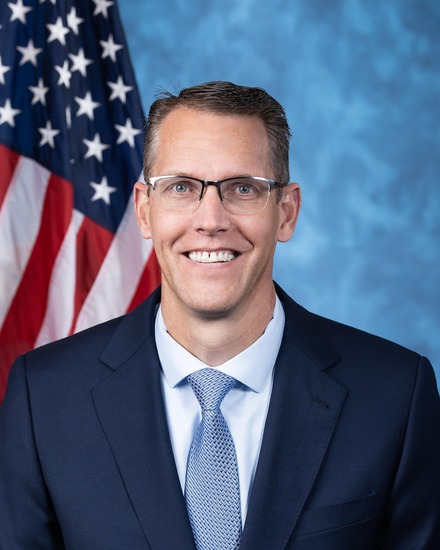
Photo of Randy Feenstra
R United States House · District 4 · Iowa

Rep. Randy Feenstra

Compare
Total votes
2,837
all sessions
Attendance
99%
18 missed
Near the chamber average
With party
97%
of cast votes
Near the chamber average
Bipartisan score
2%
crosses aisle rarely
Near the chamber average
Sponsored
926
bills & resolutions
Near the chamber average
Committees
7
assignments
926 bills and resolutions

Sponsored bills

Total
926
Primary
101
Co-sponsor
825
This page
926
matching current filters
Co-sponsor HRES 363
Passed · United States House · Co-sponsor
Resolution memorializing law enforcement officers killed in the line of duty

Maddy summaryHRES 363 is a resolution expressing support for recognizing National Police Week, an annual observance established by law to honor law enforcement officers who have died in the line of duty. The resolution acknowledges 556 officers killed in the line of duty during 2022 and calls for ensuring law enforcement officers have necessary equipment, training, and resources to protect both themselves and the public. It encourages the American public to observe National Police Week by honoring law enforcement personnel and recognizing their essential mission in serving communities across the United States. This resolution does not create new law but formally expresses congressional support for an existing observance.

Passed May 15, 2023 1 co-sponsor
Co-sponsor HR 3270
In committee · United States House · Co-sponsor
Permanent Tax Cuts for American Families Act of 2023

Permanent Tax Cuts for American Families Act of 2023 This bill permanently increases the standard tax deduction for nonitemizing taxpayers. It also requires an inflation adjustment to the increased deduction amounts.

In committee May 11, 2023 1 co-sponsor
Co-sponsor HR 3238
In committee · United States House · Co-sponsor
Affordable Housing Credit Improvement Act of 2023

Maddy summaryHR 3238, the Affordable Housing Credit Improvement Act of 2023, updates the Low-Income Housing Tax Credit (LIHTC) program to increase the availability of affordable housing across the United States. The bill makes several key changes including increasing state funding formulas, modifying tenant eligibility rules to better serve vulnerable populations (such as domestic violence victims and students), and expanding credit eligibility for projects in rural and Native American communities. Specific provisions raise the credit for properties serving extremely low-income households, clarify rules around tenant income increases, and require housing providers to protect victims of domestic violence. The bill also updates terminology from "low-income" to "affordable" throughout the tax code and enhances program transparency through data sharing requirements. These changes aim to make the LIHTC program more effective at creating and preserving affordable housing units for low-income households nationwide.

In committee May 11, 2023 1 co-sponsor
Co-sponsor HR 1480
In committee · United States House · Co-sponsor
Beagle Brigade Act of 2023

Maddy summaryThe Beagle Brigade Act of 2023 establishes a National Detector Dog Training Center to train dogs and handlers for detecting foreign pests and diseases threatening U.S. agriculture and natural resources. The Center will collaborate with agencies like U.S. Customs and Border Protection and state agriculture departments to safeguard farms and ecosystems. It requires annual funding for operations and mandates a congressional report within one year detailing pest threats, Center effectiveness, and recommendations for improving detection capabilities. The law directly affects agricultural protection efforts by enhancing canine-based prevention of invasive species.

In committee May 11, 2023 1 co-sponsor
Co-sponsor HR 1163
Passed · United States House · Co-sponsor
Protecting Taxpayers and Victims of Unemployment Fraud Act

Maddy summaryThe Protecting Taxpayers and Victims of Unemployment Fraud Act allows states to retain 25% of funds recovered from fraudulent unemployment claims (for pandemic-related benefits) to improve fraud prevention systems. States can use these retained funds to modernize unemployment systems, hire fraud investigators, reimburse administrative costs, or conduct other fraud prevention activities. The bill requires states to use specific data matching systems like the National Directory of New Hires to detect fraud more effectively. It modifies federal rules to ensure states can use recovered funds without violating deposit requirements. This legislation aims to reduce unemployment fraud while protecting taxpayers and victims of fraud.

Passed May 11, 2023 1 co-sponsor
Co-sponsor HR 3175
In committee · United States House · Co-sponsor
Regulation Reduction Act of 2023

Maddy summaryHR 3175, the Regulation Reduction Act of 2023, requires federal agencies to repeal two existing regulations before issuing a new rule, and three for "major rules" (those with significant economic impact). For major rules, the new rule's cost must not exceed the cost of the repealed rules, and the Office of Management and Budget must certify this. Agencies must also submit a 90-day review to Congress identifying costly, ineffective, duplicative, or outdated regulations. This bill directly affects federal agencies and the businesses, states, and local governments subject to federal regulations.

In committee May 10, 2023 1 co-sponsor
Primary HR 3139
In committee · United States House · Lead sponsor
ACRE Act of 2023

Maddy summaryThe ACRE Act of 2023 amends the tax code to exclude interest income from certain rural and agricultural loans from taxable income for eligible lenders. It directly affects banks, savings associations, and their wholly-owned entities that provide qualified loans secured by rural or agricultural real estate, including single-family homes in designated rural areas (with a $750,000 loan balance cap) or aquaculture facilities. The key provision allows these lenders to exclude interest earned on qualifying loans from their gross income, effectively reducing their tax liability on such lending activity. The bill applies to loans made after its enactment date and aligns with existing definitions of rural property from the Agricultural Credit Act of 1987.

In committee May 9, 2023 0 co-sponsors
Co-sponsor HRES 339
In committee · United States House · Co-sponsor
Expressing the sense of the House of Representatives that an "all-of-the-above" energy strategy is the most viable approach to energy policy.

Maddy summaryHRES 339 is a non-binding House resolution expressing that an "all-of-the-above" energy strategy - including oil, gas, nuclear, coal, hydropower, and renewables - is the most viable approach to U.S. energy policy. It states this strategy would strengthen national security, lower consumer energy prices, and reduce reliance on foreign energy sources. The resolution highlights that domestic energy production supports infrastructure funding, job creation, and energy independence, while noting U.S. energy sources like Gulf of Mexico oil and nuclear power provide clean, reliable electricity. As a statement of congressional opinion, it does not create new laws or policy changes.

In committee May 5, 2023 1 co-sponsor
Co-sponsor HR 3124
In committee · United States House · Co-sponsor
To amend the Internal Revenue Code of 1986 to remove private or commercial golf courses and country clubs from the list of uses for which certain proceeds cannot be used.

Maddy summaryHR 3124 removes a prohibition in the tax code that previously prevented certain tax-exempt bond proceeds from being used for private or commercial golf courses and country clubs. The bill amends Section 144 of the Internal Revenue Code by deleting the specific language barring these facilities from using such funds. This change directly affects private golf courses and country clubs by allowing them to access tax-exempt bond financing they were previously excluded from. The key mechanism is the straightforward deletion of the restriction from the tax code, with effective dates applying to new bond issuances and specific tax credit provisions after enactment.

In committee May 5, 2023 1 co-sponsor
Co-sponsor HR 3039
In committee · United States House · Co-sponsor
DRIVE Act

Maddy summaryHR 3039, the DRIVE Act, prohibits the Federal Motor Carrier Safety Administration (FMCSA) from requiring speed limiting devices on trucks weighing over 26,000 pounds operating in interstate commerce. This directly affects commercial trucking companies and drivers transporting goods across state lines. The bill's key provision explicitly bans the FMCSA from issuing any rule mandating such devices, which are typically set to limit vehicle speed. The law applies specifically to interstate trucking operations and does not affect state-level regulations.

In committee May 3, 2023 1 co-sponsor
Showing 511 to 520 of 926 bills
Previous 1 … 51 52 53 … 93 Next