

Maddy summaryHR 4690, the Gray Zone Defense Assessment Act, requires the U.S. government to assess and improve its capacity to counter "gray zone" state-led actions - such as disinformation, cyberattacks, or economic coercion - below the threshold of military conflict. The bill mandates two key reports: a presidential review within 180 days evaluating U.S. interagency capabilities to identify and respond to such campaigns, and a State Department report detailing its capacity to coordinate responses to adversaries like China, Russia, and Iran. These reports must include recommendations for better coordination, resources, and thresholds for action, with classified and unclassified summaries for Congress. The law aims to strengthen the U.S. government’s whole-of-government approach to countering gray zone tactics that challenge national interests without triggering direct military conflict.
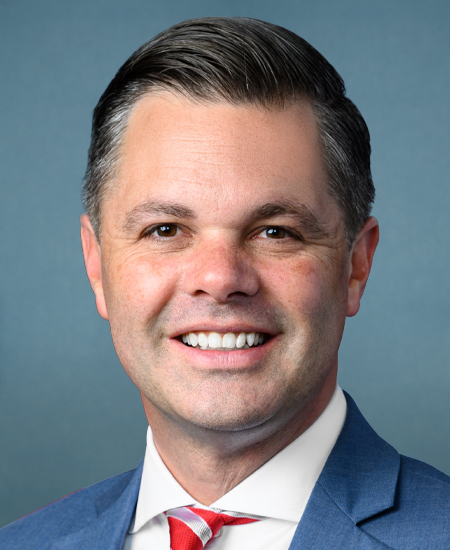
Rep. Zachary Nunn
Sponsored bills
Closing Loopholes for the Overseas Use and Development of Artificial Intelligence Act or the CLOUD AI Act This bill prohibits certain transactions between a U.S. person (i.e., natural person or entity) and an entity located in China or Macau when the transactions support remote access to certain integrated circuits. Specifically, the bill prohibits a U.S. person (and any foreign branch of a U.S. person) from providing support to an entity in China or Macau for the remote or cloud use of integrated circuits covered by export control classification numbers 3A090 or 4A090. (The classification numbers cover certain high-performance integrated circuits, computers, electronic assemblies, and related components.) The bill directs the Department of Commerce to establish the ban no later than 180 days after the bill is enacted and to issue the regulations necessary to implement the bill.
Maddy summaryThis bill prohibits entities controlled by Iran, North Korea, China, or Russia from purchasing or leasing agricultural land in the United States, including both public land managed by federal agencies and private land. It also bars such entities from participating in most U.S. Department of Agriculture programs (with exceptions for food safety, health, and labor safety initiatives). The bill expands reporting requirements to include leases and security interests in foreign land ownership, mandates public online disclosure of foreign ownership data with specific details, and imposes penalties like liens on land for violations. Additionally, it requires annual reports to Congress on risks of foreign ownership, enforcement effectiveness, and foreign investment motives.
Maddy summaryHRES 580 is a symbolic resolution expressing the House's support for designating "Journeyman Lineworkers Recognition Day." It honors lineworkers who work in hazardous conditions (such as at heights near live wires) and respond to disasters like hurricanes and wildfires, while recognizing their contributions and the legacy of Henry Miller, an early electrical worker who died on the job. The resolution has no legal effect - it solely encourages public recognition and reflection on these workers' service.
Maddy summaryHR 4656, the "Protecting American’s Savings Act," regulates how institutional investors (like pension funds) vote on corporate matters. It prohibits "robovoting" (automatically using proxy advisory firm recommendations without independent review) and bans institutional investors from outsourcing their voting decisions. The bill also states no one must vote on proxy matters and requires proxy advisory firms to calculate votes based on the state where the company is incorporated. This directly affects large investment firms and proxy advisors, aiming to ensure voting decisions are made independently rather than automatically following firm recommendations.
Maddy summaryThe PLAYS in Youth Sports Act establishes federal grant programs to improve youth sports access, safety, and health for underserved children. It provides up to $2.5 million in grants to national nonprofits and $250,000 to local organizations, requiring them to fund subgrants for regional sports groups. These subgrants - ranging from $1,000 to $10,000 - must support coaching training (emphasizing child development over winning), reducing participation barriers for low-income or disabled youth, and implementing safety measures like background checks and concussion protocols. The bill allocates $75 million total, with a focus on evidence-based practices to increase healthy sports participation and safety across communities.
Maddy summaryThe Water Infrastructure Enhancement Act of 2023 establishes a federal grant program to fund critical upgrades for public water systems. It directly affects water suppliers in rural areas (population ≤20,000) and communities designated as "areas of persistent poverty" (e.g., counties with 20%+ poverty for 30 years or census tracts with ≥20% poverty). The program allocates $800 million annually from 2024-2029, requiring at least 50% of funds to support rural areas and 15% to historically disadvantaged communities or persistent poverty zones. Grants cover up to 90% of costs for eligible activities like replacing pipes, upgrading treatment facilities, or modernizing monitoring systems, with the Administrator determining additional eligible projects.
This resolution expresses the sense of the House of Representatives that research and promotion boards support efforts to develop new markets and strengthen existing markets via research, education, and promotion.
Maddy summaryThe FRIDGE Act of 2023 authorizes $1 million annually (2024-2028) to provide technical assistance for improving cold chain infrastructure in developing countries. It directly affects U.S. agricultural exporters by addressing infrastructure gaps that cause food loss and export damage, and it targets developing nations needing upgrades to cold storage, transport, and port systems. The bill requires the Secretary of Agriculture to fund needs assessments, training, and infrastructure support through agreements with eligible trade organizations. This concrete funding mechanism aims to reduce food waste and expand U.S. agricultural exports by strengthening supply chains in key markets.
Maddy summaryThe Afghan Adjustment Act creates a pathway for certain Afghans who directly supported U.S. missions in Afghanistan during the 20-year U.S. military presence to adjust to lawful permanent resident status (green card holders). It specifically targets Afghans who worked with U.S. forces or agencies, including military personnel, security personnel, and their families, who received "Chief of Mission approval" for special immigrant status. Key provisions include new vetting requirements (in-person interviews and biometric screening), exemption from immigration numerical limits, $20 million annually for implementation, and a task force to develop resettlement strategies. The bill also establishes a new category of special immigrant visas for at-risk Afghan allies and sets a two-year application deadline after guidance is published.