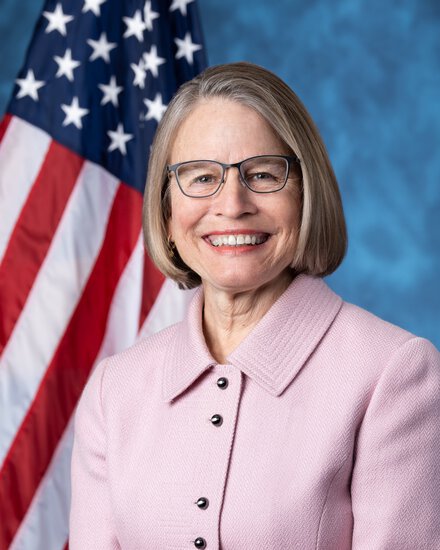
Photo of Mariannette Miller-Meeks
R United States House · District 1 · Iowa On the 2026 ballot

Rep. Mariannette Miller-Meeks

Compare
Total votes
2,837
all sessions
Attendance
97%
72 missed
Near the chamber average
With party
93%
of cast votes
Near the chamber average
Bipartisan score
4%
crosses aisle rarely
Near the chamber average
Sponsored
1,362
bills & resolutions
Near the chamber average
Committees
6
assignments
1,362 bills and resolutions

Sponsored bills

Total
1,362
Primary
132
Co-sponsor
1,230
This page
1,362
matching current filters
Primary HR 7979
In committee · United States House · Lead sponsor
Securing Our Schools Act of 2022

Securing Our Schools Act of 2022 This bill allows states, territories, tribal governments, metropolitan cities, and local governments to use unobligated Coronavirus State and Local Fiscal Recovery Funds to carry out school security measures (e.g., trainings and security assessments).

In committee Jun 8, 2022 0 co-sponsors
Co-sponsor HR 7987
In committee · United States House · Co-sponsor
DEFEND Act of 2022

Deterring Enemy Forces and Enabling National Defenses Act of 2022 or the DEFEND Act of 2022 This bill requires the Department of Defense to seek to cooperate with Middle East allies and partners (i.e., countries of the Gulf Cooperation Council, Iraq, Israel, Jordan, Egypt, and other countries in the region as appropriate) to identify and develop an approach for such allies and partners to implement an integrated air and missile defense capability to protect against attacks from Iran and groups linked to Iran.

In committee Jun 8, 2022 1 co-sponsor
Co-sponsor HR 2518
In committee · United States House · Co-sponsor
PRECISE Act

Producing Responsible Energy and Conservation Incentives and Solutions for the Environment Act or the PRECISE Act This bill incorporates support for precision agriculture into various programs of the Department of Agriculture (USDA). Precision agriculture refers to an information- and technology-based management system used to identify, analyze, and manage variability in agricultural production for optimum profitability, sustainability, and environmental protection. Specifically, the bill makes changes to eligibility criteria, administrative procedures, and other aspects of the Conservation Loan Program, the Environmental Quality Incentives Program, and the Conservation Stewardship Program. These changes include allowing the programs to support the adoption of precision agriculture practices and acquisition of precision agriculture technologies. In addition, the bill expands a program through which USDA makes and insures loans to for-profit and nonprofit organizations that invest in rural areas by allowing the loans to be used for precision agriculture practices. The bill also requires USDA to emphasize the use of third-party providers with respect to technical assistance on matters related to soil health for participants in certain USDA conservation programs.

In committee Jun 3, 2022 1 co-sponsor
Co-sponsor HRES 1148
In committee May 31, 2022 1 co-sponsor
Co-sponsor HR 7892
In committee · United States House · Co-sponsor
Prohibition of Agricultural Land for the People’s Republic of China Act

Prohibition of Agricultural Land for the People's Republic of China Act This bill requires the President to prohibit nonresident aliens, foreign businesses, and agents associated with China's government from (1) purchasing agricultural (including ranching) real estate located in the United States, or (2) participating in Department of Agriculture programs that are unrelated to food and safety regulatory requirements.

In committee May 27, 2022 1 co-sponsor
Co-sponsor HR 6826
In committee · United States House · Co-sponsor
CTPAT Pilot Program Act of 2022

Customs Trade Partnership Against Terrorism Pilot Program Act of 2022 or the CTPAT Pilot Program Act of 2022 This bill requires the Department of Homeland Security to carry out a pilot program that assesses whether allowing certain entities to participate in the Customs Trade Partnership Against Terrorism (CTPAT) would enhance port security, combat terrorism, prevent supply chain security breaches, or otherwise satisfy the goals of CTPAT. Such entities are (1) non-asset-based third-party logistics providers that arrange international freight transportation and are licensed or bonded by specified federal agencies; or (2) asset-based third-party logistics providers that facilitate cross-border activity, are licensed or bonded by specified federal agencies, and execute logistics services using their own warehousing assets and resources. The bill requires the Government Accountability Office to report on the effectiveness of CTPAT.

In committee May 24, 2022 1 co-sponsor
Co-sponsor HCONRES 92
In committee · United States House · Co-sponsor
Declaring a state of emergency due to the Russian invasion of Ukraine, in order to establish a waiver of the minimum tonnage requirements of section 55305 of title 46, United States Code.

This concurrent resolution declares that a state of emergency exists due to the Russian invasion of Ukraine. It also states that such emergency justifies a waiver of the minimum tonnage requirements for the transport of equipment, materials, or commodities related to humanitarian operations resulting from the invasion. Such requirements apply to cargoes that are transported on ocean vessels and that are procured, furnished, or financed by the United States.

In committee May 20, 2022 1 co-sponsor
Co-sponsor HR 7851
In committee · United States House · Co-sponsor
To amend the Higher Education Act of 1965 to require institutions of higher education to disclose certain ties to China-affiliated organizations, and for other purposes.

This bill requires institutions of higher education (IHEs) to disclose information regarding gifts from and contracts with China-affiliated organizations. China-affiliated organization refers to any entity that receives support directly or indirectly from the Chinese government, including certain educational institutes or programs, think tanks, and business entities. Under current law, an IHE must disclose to the Department of Education (ED) a gift or contract from a foreign source that is valued at $250,000 or more, considered alone or in combination with all other gifts from or contracts with that foreign source in a calendar year. This bill establishes a special disclosure rule relating to China-affiliated organizations. Specifically, the bill requires an IHE to disclose a gift from or contract with a China-affiliated organization that is valued at $5,000 or more, considered alone or in combination with all other gifts from or contracts with that organization in a calendar year. Additionally, the bill requires an IHE that receives federal grants to annually file a report with ED that identifies any activities conducted pursuant to a contract or other agreement between the IHE and a China-affiliated organization, including any joint research or academic exchanges. Such a contract or other agreement must be made available on a publicly accessible website of the IHE.

In committee May 19, 2022 1 co-sponsor
Co-sponsor HR 7639
In committee · United States House · Co-sponsor
Cattle Price Discovery and Transparency Act of 2022

Cattle Price Discovery and Transparency Act of 2022 This bill requires the Department of Agriculture (USDA) to take various actions to address transparency in contract terms and pricing in the cattle industry. Among these requirements, USDA must maintain a publicly available library or catalog of contracts entered into between meat packers and livestock producers for the purchase of cattle, including any schedules of premiums or discounts associated with the contracts and other specific details. USDA must make this information available to producers and other interested parties in a monthly report. The bill further requires USDA to establish five to seven regions encompassing the entire continental United States that reasonably reflect similar fed cattle purchase practices for processing plants and establish mandatory minimums for each region (i.e., the minimum percentage of cattle purchases that are required to be made through approved pricing mechanisms from producers that are not packers). Under the bill, approved pricing mechanisms are generally purchases of fed cattle made through a negotiated purchase, through a negotiated grid purchase, at a stockyard, or through trading systems or platforms where multiple buyers and sellers can regularly make and accept bids and offers. The bill also establishes a maximum penalty for mandatory minimum violations by covered packers. Under the bill, a covered packer is a packer that has slaughtered an average of 5% or more of the number of fed cattle slaughtered nationally during the immediately preceding five calendar years.


In committee May 19, 2022 1 co-sponsor
Co-sponsor HR 7830
In committee · United States House · Co-sponsor
Babies Need More Formula Now Act of 2022

Babies Need More Formula Now Act of 2022 This bill addresses the regulation of infant formula, including by authorizing the Food and Drug Administration (FDA) to waive certain requirements related to importation. The FDA may waive labeling requirements related to the importation (or distribution or sale) of infant formula from a country with requirements that provide a similar assurance of safety as U.S. requirements. The FDA must, when appropriate, enter into arrangements to harmonize U.S. regulatory requirements pertaining to infant formula with the requirements of other nations. The bill imposes time lines for the FDA to respond to submissions for market approval for new infant formula. The FDA must also issue guidance as to what types of changes in the ingredients of infant formula, if any, may not require a new growth study to meet FDA requirements. The bill also authorizes a person to import, without prior notice to the FDA, up to a three-month supply of infant formula for personal use from a country with formula safety standards similar to U.S. standards, such as Canada. Before recommending or requiring a recall of infant formula due exclusively to a labeling deficiency, the FDA must ensure that the recall will not negatively affect the supply of formula in the United States. The bill also requires the FDA to (1) notify Congress no later than 24 hours after initiating a formula recall, and (2) provide certain information to formula manufacturers about restarting production after an inspection of a manufacturing facility impacted by a recall.

In committee May 18, 2022 1 co-sponsor
Showing 941 to 950 of 1,362 bills
Previous 1 … 94 95 96 … 137 Next