

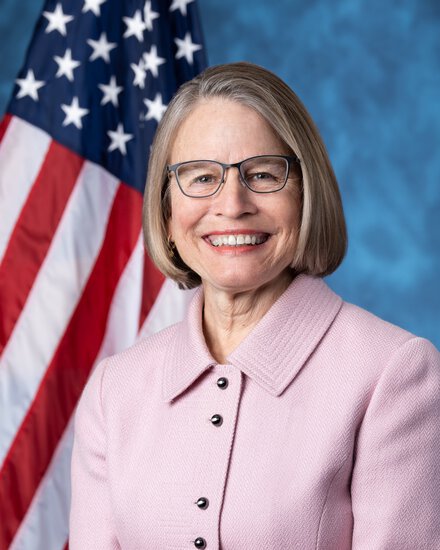
Photo of Mariannette Miller-Meeks
R United States House · District 1 · Iowa On the 2026 ballot

Rep. Mariannette Miller-Meeks

Compare
Total votes
2,837
all sessions
Attendance
97%
72 missed
Near the chamber average
With party
93%
of cast votes
Near the chamber average
Bipartisan score
4%
crosses aisle rarely
Near the chamber average
Sponsored
1,360
bills & resolutions
Near the chamber average
Committees
6
assignments
1,360 bills and resolutions

Sponsored bills

Total
1,360
Primary
131
Co-sponsor
1,229
This page
1,360
matching current filters
Co-sponsor HR 2172
In committee · United States House · Co-sponsor
Preserving Patient Access to Home Infusion Act

Preserving Patient Access to Home Infusion Act  This bill specifically includes pharmacy services and home infusion drugs that are administered without a pump as part of covered home infusion therapy under Medicare. The bill also allows nurses and physician assistants to establish and review the plan of care for home infusion therapy, and it specifies that payment may be made regardless of whether a practitioner is physically present in the home at the time the drug is administered.

In committee Mar 18, 2025 1 co-sponsor
Co-sponsor HR 2213
In committee · United States House · Co-sponsor
Medical Supply Chain Resiliency Act

Maddy summaryThe Medical Supply Chain Resiliency Act (HR 2213) establishes a framework for the U.S. to form agreements with foreign countries that commit to reliable medical supply chains during emergencies. It allows the President to negotiate "trusted trade partner agreements" that reduce trade barriers (like duties and quotas) for medical goods with countries meeting specific criteria, such as maintaining open trade during health crises and protecting intellectual property. These agreements require Congressional review and approval, with ongoing monitoring to ensure partners uphold commitments. The bill directly affects U.S. trade policy, foreign governments seeking partnerships, and the medical supply industry by aiming to diversify sources and secure critical products like pharmaceuticals and medical devices.

In committee Mar 18, 2025 1 co-sponsor
Co-sponsor HJRES 35
Signed into law · United States House · Co-sponsor
Providing for congressional disapproval under chapter 8 of title 5, United States Code, of the rule submitted by the Environmental Protection Agency relating to "Waste Emissions Charge for Petroleum and Natural Gas Systems: Procedures for Facilitating Compliance, Including Netting and Exemptions".

Maddy summaryHJRES 35 is a congressional resolution disapproving an Environmental Protection Agency (EPA) rule that established procedures for emissions charges on petroleum and natural gas systems. Specifically, it targets the EPA’s November 2024 rule titled "Waste Emissions Charge for Petroleum and Natural Gas Systems: Procedures for Facilitating Compliance, Including Netting and Exemptions," which would have required companies to pay fees based on emissions. The resolution, passed by both chambers in February 2025, nullifies the rule, preventing it from taking effect. This directly affects oil and gas companies subject to the EPA’s emissions regulations, removing a specific compliance mechanism they would have faced.

Signed into law Mar 14, 2025 1 co-sponsor
Co-sponsor HR 2107
In committee · United States House · Co-sponsor
Children’s Hospital GME Support Reauthorization Act of 2025

Maddy summaryThis bill reauthorizes federal funding for children's hospitals operating graduate medical education (GME) programs through 2030, extending current support until fiscal year 2030. It prohibits payments to any hospital that provided "specified procedures and drugs" to minors under 18 during the prior fiscal year, including surgeries like hysterectomies or puberty-blocking medications. Exceptions apply for medically necessary treatments, such as puberty suppression for precocious puberty or genetic disorders, and care for life-threatening conditions. The bill specifies annual funding levels: $124 million for hospital GME support and $261 million for other program payments from 2026-2030. It directly affects children's hospitals receiving federal GME funding, requiring them to comply with the new restrictions on certain medical services for minors.

In committee Mar 14, 2025 1 co-sponsor
Primary HR 2144
In committee · United States House · Lead sponsor
No Fuel Credits for Batteries Act of 2025

Maddy summaryThis bill prohibits the Environmental Protection Agency (EPA) from authorizing renewable fuel credits for electricity generated from renewable sources to meet transportation fuel requirements under the Clean Air Act. It also bans the use or transfer of any such credits generated before the law takes effect. The policy directly affects renewable energy companies and entities that previously sought to use electricity-based credits toward transportation fuel compliance. The key mechanism is a clear EPA directive preventing both the creation and utilization of these specific credits for transportation fuel mandates.

In committee Mar 14, 2025 0 co-sponsors
Co-sponsor HR 2048
In committee · United States House · Co-sponsor
Metastatic Breast Cancer Access to Care Act

Metastatic Breast Cancer Access to Care Act This bill expedites payment of Social Security Disability Insurance (SSDI) benefits and eligibility for Medicare coverage for those with metastatic breast cancer (i.e., breast cancer that has spread to other sites in the body). Specifically, the bill eliminates the 5-month waiting period for SSDI benefits and the subsequent 24-month waiting period for Medicare coverage for individuals with metastatic breast cancer. Under current law, individuals generally must wait 5 months after the onset of disability to begin receiving SSDI benefits and an additional 24 months to become eligible for Medicare.

In committee Mar 11, 2025 1 co-sponsor
Co-sponsor HR 2028
In committee · United States House · Co-sponsor
REDI Act

Resident Education Deferred Interest Act or the REDI Act This bill allows borrowers in medical or dental internships or residency programs to defer student loan payments until the completion of their programs.

In committee Mar 11, 2025 1 co-sponsor
Co-sponsor HR 2089
In committee · United States House · Co-sponsor
Generating Retirement Ownership through Long-Term Holding

Maddy summaryThis bill changes how individual investors in mutual funds (regulated investment companies) are taxed on certain dividends. It allows investors to defer paying tax on capital gain dividends that are automatically reinvested in additional fund shares through a dividend reinvestment plan. The deferred tax is recognized later when the investor sells shares or upon their death. It also establishes that shares acquired through this reinvestment are treated as held for over one year from the start, potentially qualifying for long-term capital gains rates. The rule applies only to individual investors (not estates, trusts, or dependents claimed by others).

In committee Mar 11, 2025 1 co-sponsor
Co-sponsor HR 1980
In committee · United States House · Co-sponsor
State Strategic Stockpile Act of 2025

Maddy summaryThe State Strategic Stockpile Act of 2025 reauthorizes a federal program that provides funding to states for maintaining emergency medical supply stockpiles. It extends the funding period through fiscal year 2030 and adds requirements for states to coordinate with health officials and share best practices through state consortia. The bill mandates that states receiving funds must collaborate with healthcare and emergency management entities within their jurisdiction. This directly affects state health departments and emergency management agencies that administer medical stockpiles under the program.

In committee Mar 10, 2025 1 co-sponsor
Co-sponsor HR 2003
In committee · United States House · Co-sponsor
Affordable Loans for Students Act

Maddy summaryThis bill automatically reduces the interest rate on eligible federal student loans to 2.0% for all borrowers, starting July 1 after enactment. It applies to all federal loans held by the U.S. Department of Education (like Direct Loans) and refinances other federal loans (like older FFELP loans) into new Direct Consolidation Loans at 2.0% interest without requiring borrower action (though borrowers may opt out of refinancing). Key provisions include eliminating origination fees, preserving original repayment terms, and requiring the Department to report annually on participation and delinquency rates. The policy directly affects millions of student loan borrowers with federal loans, lowering their interest costs without altering repayment duration or forgiveness eligibility.

In committee Mar 10, 2025 1 co-sponsor
Showing 251 to 260 of 1,360 bills
Previous 1 … 25 26 27 … 136 Next