

Harriet Tubman Bicentennial Commemorative Coin Act This bill directs the Department of the Treasury to mint and issue 50,000 $5 gold coins, 400,000 $1 silver coins, and 750,000 half-dollar clad coins emblematic of the legacy of Harriet Tubman as an abolitionist. The Secretary may issue coins under this bill only during the period of January 1, 2024, through December 31, 2024. All surcharges received by Treasury from the sale of such coins must be paid equally to the National Underground Railroad Freedom Center in Cincinnati, Ohio, and The Harriet Tubman Home, Inc. in Auburn, New York, for the purpose of accomplishing and advancing their missions.
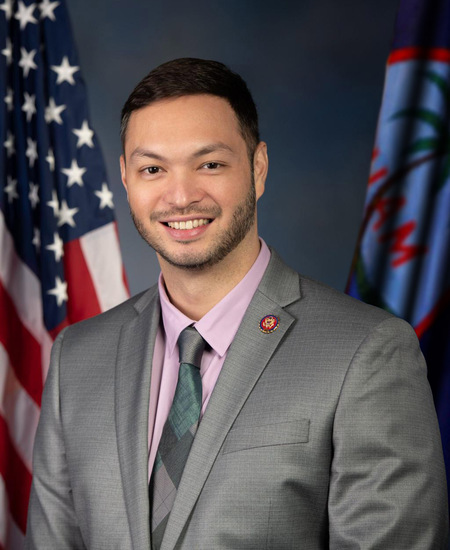
Rep. Michael F. Q. San Nicolas
Sponsored bills
Territories Statistics Collection Equity Act This bill requires implementation of a plan for federal agencies to collect and publish statistics regarding the U.S. territories in the same manner as statistics are collected and reported for the states. Specifically, the bill directs the Interagency Council on Statistical Policy to publish a list and assessment of existing federal statistical programs that collect and publish data for the U.S. territories comparable to the states. The council must submit to Congress a plan to collect and publish statistics regarding the territories in the same manner as statistics are collected and reported by federal agencies for the states. The council, in coordination with agencies, must implement the plan no later than four years after enactment of this bill.
VA Loan Informed Disclosure Act of 2022 or the VALID Act of 2022 The bill requires a Federal Housing Administration mortgage notice to a veteran to contain comparative rate and fee information about loans available under the Veterans Affairs home loan program.
Securing and Enabling Commerce Using Remote and Electronic Notarization Act of 2022 or the SECURE Notarization Act of 2022 This bill allows a notary public commissioned under state law to remotely notarize electronic records and perform notarizations for remotely located individuals. The bill provides technical requirements for such notarizations, including the creation and retention of video and audio recordings and the use of communication technologies (i.e., video chat). Additionally, the bill requires U.S. courts and states to recognize notarizations—including remote notarizations of electronic records and notarizations of remotely-located individuals—that occur in or affect interstate commerce and are performed by a notary public commissioned under the laws of other states. The bill also allows a notary public to remotely notarize electronic records involving an individual located outside of the United States, subject to certain requirements.
Overdraft Protection Act of 2021 This bill prohibits a financial institution from engaging in unfair or deceptive acts in connection with overdraft coverage. Each financial institution that offers overdraft coverage for accounts must disclose overdraft coverage fees. It must also disclose that the consumer's transaction may be declined if there are insufficient funds in the related account, and the consumer will not be charged a fee if such transaction is declined. A financial institution must provide certain other disclosures regarding its overdraft protection program, including prompt notification of the account's overdraft status. The bill limits the number of overdraft fees a consumer may be charged each month and year, and provides that such fees must be reasonable. The bill prohibits an overdraft coverage fee if the overdraft results solely from a debit hold amount that exceeds the actual dollar amount of the transaction. The bill also prohibits a financial institution from charging a non-sufficient fund fee for any automated teller machine or debit card transaction, or reporting negative information regarding consumer use of overdraft coverage to any consumer reporting agency when the overdraft amounts and coverage fees are paid under the terms of an overdraft coverage program.
Maddy summaryHRES 1235 is a non-binding resolution designating the third week of July as "Latino Conservation Week." It recognizes the Latino community's engagement with outdoor activities and conservation efforts, while highlighting statistics showing Latinos' strong support for protecting natural resources and public lands. The resolution does not create new policies or programs but formally supports this annual observance, which encourages community events like park cleanups and educational outings on public lands. It was introduced in the House on July 20, 2022, by Representatives Barragán, Espaillat, and others.
Southern Campaign of the Revolution National Heritage Corridor Act of 2021 This bill establishes the Southern Campaign of the Revolution National Heritage Corridor in North Carolina and South Carolina. The University of South Carolina, as the local coordinating entity for the corridor, shall submit a management plan for the corridor.
Elizabeth Dole Home and Community Based Services for Veterans and Caregivers Act of 2022 or the Elizabeth Dole Home Care Act This bill addresses home care and caregiver programs for veterans.
Return Home to Housing Act This bill increases the maximum rate of per diem payments provided by the Department of Veterans Affairs to entities (i.e., grant recipients or authorized entities) that furnish services and transitional housing to homeless veterans.
Access for Veterans to Records Act of 2022 This bill directs the Office of the Archivist of the United States to submit to Congress a comprehensive plan for reducing the backlog of requests for records from, and improving the efficiency and responsiveness of operations at, the National Personnel Records Center. Such plan must include an estimate of the number of backlogged record requests for veterans; target time frames to reduce the backlog; a detailed plan for using existing funds to improve technology infrastructure, including secure access to appropriate agency federal records, to prevent future backlogs; actions to improve customer service for requesters; measurable goals with respect to the comprehensive plan and metrics for tracking progress toward such goals; and strategies to prevent future record request backlogs, including backlogs caused by an event that prevents employees of the center from reporting to work in person. The office must submit updates of such plan at specified intervals.