

American Family Act of 2021 This bill modifies the child tax credit to (1) make the credit fully refundable, (2) increase the amount of the credit and allow an additional credit for children who are under six years of age, (3) require the amount of the credit to be adjusted annually for inflation, and (4) require the Department of the Treasury to establish a program for making advance payments of the credit on a monthly basis.
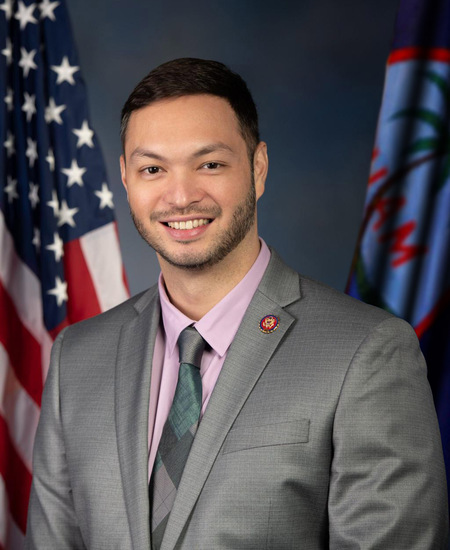
Rep. Michael F. Q. San Nicolas
Sponsored bills
Essential Worker Pandemic Compensation Act of 2021 This bill compensates specified essential workers who die or are hospitalized as a result of COVID-19 (i.e., coronavirus disease 2019) or related complications. Specifically, the bill provides death benefits to survivors of essential workers equal to the amount available under the public safety officer benefits program. Essential workers include those identified in the Cybersecurity and Infrastructure Security Agency guidance or by a Special Master appointed by the Department of Health and Human Services. Such death benefits include additional payments to a surviving spouse or child enrolled in qualified postsecondary education. Further, essential workers who are hospitalized as a result of COVID-19 receive one half of the base death benefit amount.
National Broadband Plan for the Future Act of 2021 This bill requires the Federal Communications Commission (FCC) to update the national broadband plan, which establishes benchmarks to meet the goal of ensuring that all people of the United States have access to broadband capability. This update must include (1) an assessment of the progress in achieving the goals of the original national broadband plan; (2) an examination of the effects of the COVID-19 (i.e., coronavirus disease 2019) pandemic on how people learn, work, receive medical information and treatment, and participate in civic communications; and (3) an analysis of the change in reliance people will have on services enabled by broadband internet access service as a result of COVID-19. The FCC must report annually on its progress toward achieving the goals of the updated national broadband plan.
This resolution expresses the sense of the House of Representatives that the U.S. Postal Service should continue door delivery for all customers.
Gym Mitigation and Survival Act of 2021 or the GYMS Act of 2021 This bill establishes a grant program to provide economic support to eligible fitness facilities in response to the COVID-19 (i.e., coronavirus disease 2019) pandemic. Specifically, the bill authorizes the Small Business Administration to make initial and supplemental grants to privately owned fitness facilities that primarily provide health or fitness services and that do not offer golf, hunting, sailing, or riding facilities. The total amount of grant funds for a recipient may not exceed $25 million, and the recipient must use these funds for payroll costs, rent or mortgage obligations, and other ordinary and necessary business expenses.
Real Economic Support That Acknowledges Unique Restaurant Assistance Needed To Survive Act of 2021 or the RESTAURANTS Act of 2021 This bill temporarily establishes and provides funding for the Restaurant Revitalization Fund, from which the Department of the Treasury shall make grants to eligible food and beverage purveyors to cover specified costs such as payroll, operational expenses, and paid sick leave. For the grant program's initial period, Treasury must (1) prioritize awarding grants to marginalized and underrepresented communities, and (2) only award grants to eligible food and beverage purveyors with annual revenues of less than $1.5 million in 2019. For tax purposes, grant amounts are excluded from the recipient's gross income. An entity that received a loan under the Paycheck Protection Program established to support small businesses in response to COVID-19 (i.e., coronavirus disease 2019) may not apply for or use a restaurant revitalization grant for the same expenses for which the entity received the paycheck protection loan. Further, a grant applicant may request an additional amount to cover the cost of providing 10 days of paid sick leave to its employees. Treasury must report a list of grant recipients with the amount each recipient received, as well as demographics and other specified information.
Scientific Integrity Act This bill revises provisions regarding the release of scientific research results by federal agencies. Each agency that funds, conducts, or oversees scientific research must (1) adopt and enforce a scientific integrity policy that includes requirements such as that scientific conclusions are not based on political considerations, and (2) submit such policy to the Office of Science and Technology Policy (OSTP) for approval. Each agency must make such policy available to the public and submit such policy to Congress. Agencies and the OSTP must periodically review the policies. The Government Accountability Office shall review implementation of the policies. Each agency shall (1) appoint a Scientific Integrity Officer, (2) establish a process for dispute resolution consistent with the scientific integrity policy, and (3) establish a specified training program for current and new employees.
Restoring Communities Left Behind Act This bill directs the Department of Housing and Urban Development to establish a grant program for local partnerships to carry out neighborhood revitalization support activities in economically distressed areas. Eligible activities include weatherization and energy efficiency improvements; housing accessibility improvements for seniors and persons with disabilities; purchasing delinquent mortgages; purchasing and developing vacant or distressed properties to create affordable rental housing and for other purposes; and improving parks, sidewalks, and street lighting.
Secure Data and Privacy for Contact Tracing Act of 2021 This bill establishes grants for state, tribal, and territorial health departments to incorporate digital contact tracing technology in COVID-19 (i.e., coronavirus disease 2019) contact tracing programs. The Centers for Disease Control and Prevention must award the grants. Any technology developed or procured with these grants must meet privacy, security, and other conditions. Grantees that acquire technology that does not meet these conditions lose eligibility for this, and future, funding for COVID-19 contact tracing technology. In addition, federal privacy standards for personal health information expressly apply to information transmitted or maintained by grant-funded programs. Current law restricts the use and disclosure of personal health information by health care providers, health plans, health clearinghouses, and their business associates. However, there is an exception to these standards for information used by, or disclosed to, a public health authority. The bill also prohibits the use of data derived from the contact tracing technology in legal proceedings or for immigration enforcement. The Government Accountability Office must evaluate this program.
Rural Maternal and Obstetric Modernization of Services Act or the Rural MOMS Act This bill expands initiatives to address maternal health in rural areas. The bill provides funding through FY2026 for the Health Resources and Services Administration (HRSA) to establish rural obstetric networks. These networks must foster collaboration to improve birth outcomes and reduce maternal morbidity in rural areas. HRSA also must award demonstration grants to medical schools and other health professional training programs to support education and training on maternal health in rural areas. In addition, the bill incorporates maternal health services in certain telehealth grant programs. It also revises various research and other activities of the Department of Health and Human Services that pertain to maternal health. Furthermore, the Government Accountability Office must report on maternal health topics, including health inequities and data issues.