

Assuring You Uniform Dietary Assistance (AYUDA) Act of 2021 This bill makes the Commonwealth of the Northern Mariana Islands eligible to participate in the Supplemental Nutrition Assistance Program (SNAP, formerly known as the food stamp program).
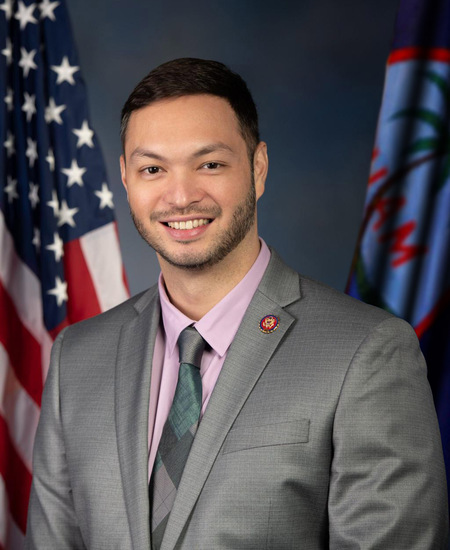
Rep. Michael F. Q. San Nicolas
Sponsored bills
ABLE Age Adjustment Act This bill increases from 26 to 46 the age threshold for tax-favored ABLE (Achieving a Better Life Experience) accounts. (ABLE accounts are designed to enable individuals with disabilities to save for and pay for disability-related expenses. To establish an account, an individual must have a qualifying impairment that began before the individual attained the age threshold.)
Next Generation Entrepreneurship Corps Act This bill establishes the Next Generation Entrepreneurship Corps Program to promote entrepreneurship in the most distressed regions of the United States, including those regions affected by COVID-19 (i.e., coronavirus disease 2019), by awarding participating fellows a two-year stipend to start and grow a new small business. Fellows will receive (1) a $120,000, two-year stipend for living and basic startup expenses; (2) health care; and (3) interest-free federal student loan deferral for two years. Further, fellows shall receive mentorship from the Service Corps of Retired Executives and be matched with a full range of lenders, investors, and insurers. The bill also establishes a fund in the Department of the Treasury from which the SBA may provide loans for qualified investors to support a small business owned and operated under the program by a fellow.
Expanding Access to Emergency Meals Act This bill makes an exception to the prohibition on duplication of assistance during a major disaster or emergency for any person who is or may be entitled to receive nutrition assistance through a program administered by the Department of Agriculture (USDA). Thus, individuals participating in the Supplemental Nutrition Assistance Program and other USDA nutrition programs may also participate in feeding programs funded using Federal Emergency Management Agency (FEMA) public assistance funds.
Teacher Diversity and Retention Act This bill revises certain grant programs related to teacher recruitment and training. First, the bill reauthorizes through FY2027 and otherwise revises the Augustus F. Hawkins Centers of Excellence program, which provides grants to establish teacher preparation programs at minority-serving institutions. It allows grants to be used for school leader preparation programs. In addition, the bill consolidates certain grant programs for teacher preparation into a single grant program. In particular, the Department of Education must award grants to eligible partnerships (e.g., high-need local educational agencies and certain programs at institutions of higher education) to expand teacher preparation programs that embed dual certification in special education and training on social and emotional learning competencies and behavior management practices.
Vaccine Administration Centralization to Coordinate and Improve National Execution Act or the VACCINE Act This bill establishes a grant program for states, tribal nations, and territories to set up or expand COVID-19 (i.e., coronavirus disease 2019) vaccine registration systems. The system must be the jurisdiction's sole means of registering an individual for a vaccine. The Department of Health and Human Services (HHS) must set up a website and a call center to share information with the public about each registration system. HHS must also develop standards to allow for electronic information exchange among the systems. To carry out the program, HHS may use funds from the Public Health Emergency Fund. The authority for this program terminates at the end of the COVID-19 emergency period.
Helping Experts Accelerate Rare Treatments Act of 2021 This bill addresses rare diseases, including by requiring the Food and Drug Administration to ensure the inclusion of rare disease experts and staff members in various parts of the drug review process. The bill also requires certain reports to address issues related to rare diseases and drugs for treating such diseases (sometimes referred to as orphan drugs if the rarity of the disease makes it difficult for the drug to be profitable).
Commission on Domestic Terrorism Act of 2021 This bill establishes in the legislative branch the National Commission on Domestic Terrorism. The commission shall investigate relevant facts and circumstances relating to the federal government's failure to respond to and prevent acts of domestic terrorism in the past 20 years, including relating to the attack on the Capitol on January 6, 2021; identify, review, and evaluate the lessons learned from such acts regarding the structure, coordination, and management arrangements of the federal government, and, if appropriate, state and local governments and nongovernmental entities, relative to detecting, preventing, and responding to domestic terrorist attacks; and report to the President and Congress.
This resolution expresses support for the goals and ideals of International Mother Language Day.
This resolution expresses the sense of the House of Representatives that the federal government has a duty to develop a holistic agenda to respond to racial injustice, unemployment, the COVID-19 (i.e., coronavirus disease 2019) pandemic, and climate change. The resolution further outlines the goals of this agenda to build a society with greater racial, economic, and gender justice; dignified work; healthy communities; and a stable climate. Additionally, the resolution identifies efforts to support these goals.