Preference for Local Veteran Contractors Act This bill requires the Department of Veterans Affairs (VA) to give preference to local contractors for purposes of awarding contracts for the construction or maintenance of a VA facility or for services provided to a particular VA facility or campus. Local contractors are those who submit a bid or proposal and have principal offices or locations within a 60-mile radius of the VA facility covered by the contract. Per the bill, the VA must publish a public notice explaining why a local contractor was not awarded a contract if another contractor is selected. The bill also updates the order of priority for awarding contracts to small business concerns to include priority for local contractors.
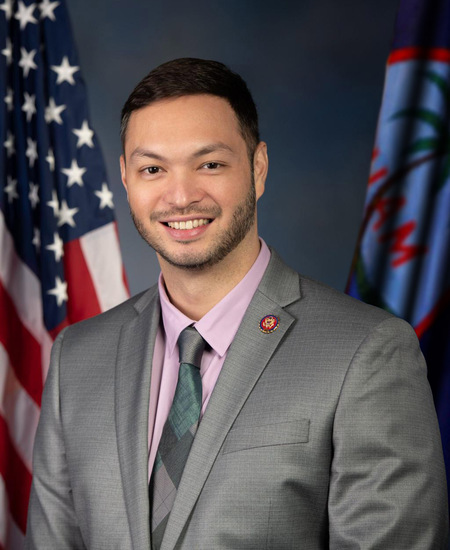
Rep. Michael F. Q. San Nicolas
Sponsored bills
Expanded Coverage for Former Foster Youth Act This bill modifies certain changes that are scheduled to take effect under the Substance Use-Disorder Prevention that Promotes Opioid Recovery and Treatment (SUPPORT) for Patients and Communities Act relating to the coverage of former foster youth under Medicaid. Under current law, a state Medicaid program must cover former foster youth until the age of 26 if the youth were in the state's foster care system at the age of 18 and were enrolled in the state's Medicaid program while in foster care; a state may choose to also cover former foster youth from other states. The SUPPORT for Patients and Communities Act altered these provisions to require a state Medicaid program to cover former foster youth from other states until the age of 26; such changes apply to former foster youth who reach the age of 18 on or after January 1, 2023. The bill requires state Medicaid programs to also cover former foster youth who were placed in a legal guardianship with a kinship caregiver or were emancipated from foster care before the age of 18. The bill also repeals the provision that requires former foster youth to have been enrolled in a state Medicaid program while in foster care in order to qualify for Medicaid coverage until the age of 26. States must also establish Medicaid outreach and enrollment programs for former foster youth.
RTP Full Funding Act of 202 1 This bill revises provisions regarding the recreational trails program of the Department of Transportation (DOT). Specifically, the bill requires DOT to estimate the total amount of nonhighway recreational fuel taxes received by the Department of the Treasury and transferred to the Highway Trust Fund; the Federal Highway Administration to establish financial management information system codes for certain motorized and non-motorized use projects, including single and diverse use projects; DOT to reserve amounts of the state-apportioned funds for administrative, research, technical assistance, and training expenses to carry out the recreational trails program; and states to obligate a specific amount of reserved funds each fiscal year for the recreational trails program.
Territories Medicare Prescription Drug Assistance Equality Act of 2021 This bill makes certain income-based subsidies under the Medicare prescription drug benefit available to individuals who reside in Puerto Rico or another U.S. territory and are otherwise eligible. Current law makes such individuals ineligible for premium and cost-sharing subsidies, but establishes a process for U.S. territories to apply for financial assistance with respect to the provision of Medicare prescription drugs. The bill retains a process for U.S. territories to apply for such assistance, but alters the formula by which the amount of assistance is calculated. Specifically, the bill phases in modifications to the formula that more closely align how assistance is calculated for U.S. territories with how it is calculated for the 50 states and the District of Columbia.
Foster Youth Dental Act of 2021 This bill expands Medicaid coverage of current and former foster youth, particularly with respect to dental services. Specifically, the bill requires state Medicaid programs to cover early and periodic screening, diagnostic, and treatment services, including dental services, for current and former foster youth under the age of 26. States must set a special payment rate, based on rates in the private sector, for dental services provided to such individuals; the bill provides an enhanced Federal Medical Assistance Percentage (i.e., federal matching rate) for excess expenses that result from such payments. The bill's requirements take effect 80 days after the date of enactment of the bill. The bill also accelerates the application of certain provisions that require a state Medicaid program to cover former foster youth from other states until the age of 26; such provisions currently apply to former foster youth who reach the age of 18 on or after January 1, 2023. The bill instead applies these provisions to former foster youth who reach the age of 18 on or after the date of enactment of the bill.
This resolution supports the goals and ideals of National Middle Level Education Month.
Success in the Middle Act of 2021 This bill directs the Department of Education (ED) to establish a grant program and take other specified actions to improve student learning and academic achievement for students in the middle grades (i.e., grades 5-8). Specifically, the bill directs ED to make formula grants to states, based on their proportion of children aged 5 to 17 living below the poverty line, to implement state middle grades need analyses and, on the basis of such analyses, create statewide improvement plans to improve student academic achievement in the middle grades; and award competitive subgrants to local educational agencies (LEAs) or designated LEA partnerships to implement a comprehensive middle school improvement plan for each eligible school (based on graduation rates and specified risk factors). Among other activities, ED must also (1) study and identify promising practices for the improvement of middle grades education, (2) create a national clearinghouse and national middle grades database, (3) establish an educational research and development center, and (4) provide grants to turn around low-performing schools that serve middle grade students.
COVID Community Care Act This bill provides FY2021 supplemental appropriations for the Department of Health and Human Services (HHS) to prevent, prepare for, and respond to COVID-19 (i.e., coronavirus disease 2019). Specifically, the bill provides appropriations to the HHS Public Health and Social Services Emergency Fund and the Indian Health Service for implementing programs to prevent, prepare for, and respond to COVID-19 in medically underserved communities and among tribal populations, respectively. The bill designates the funding as emergency spending, which is exempt from discretionary spending limits.
Protecting the Right to Organize Act of 20 21 This bill expands various labor protections related to employees' rights to organize and collectively bargain in the workplace. Among other things, it (1) revises the definitions of employee , supervisor , and employer to broaden the scope of individuals covered by the fair labor standards; (2) permits labor organizations to encourage participation of union members in strikes initiated by employees represented by a different labor organization (i.e., secondary strikes); and (3) prohibits employers from bringing claims against unions that conduct such secondary strikes. The bill also allows collective bargaining agreements to require all employees represented by the bargaining unit to contribute fees to the labor organization for the cost of such representation, notwithstanding a state law to the contrary; and expands unfair labor practices to include prohibitions against replacement of, or discrimination against, workers who participate in strikes. The bill makes it an unfair labor practice to require or coerce employees to attend employer meetings designed to discourage union membership and prohibits employers from entering into agreements with employees under which employees waive the right to pursue or a join collective or class-action litigation. The bill further prohibits employers from taking adverse actions against an employee, including employees with management responsibilities, in response to that employee participating in protected activities related to the enforcement of the prohibitions against unfair labor practices (i.e., whistleblower protections). Such protected activities include providing information about a potential violation to an enforcement agency, participating in an enforcement proceeding, initiating a proceeding concerning an alleged violation or assisting in such a proceeding, or refusing to participate in an activity the employee reasonably believes is a violation of labor laws. Finally, the bill addresses the procedures for union representation elections, provides employees with the ability to vote in such elections remotely by telephone or the internet, modifies the protections against unfair labor practices that result in serious economic harm, and establishes penalties and permits injunctive relief against entities that fail to comply with National Labor Relations Board orders.

Biliteracy Education Seal and Teaching Act or the BEST Act This bill directs the Department of Education to award renewable two-year grants to states to establish or improve, and carry out, Seal of Biliteracy programs to recognize student proficiency in speaking, reading, and writing in both English and a second language. Further, these programs must allow speakers of any official Native American language to use equivalent proficiency in speaking, reading, and writing in such language in lieu of proficiency in English.