Protecting Seniors from Emergency Scams Act This bill requires the Federal Trade Commission to report on, and increase awareness regarding, scams targeting older adults. Specifically, the commission must report on the number and type of scams that target older adults and provide policy recommendations to prevent such scams; revise the commission's web portal with current information about such scams, including contact information for law enforcement and adult protective services agencies; and coordinate with media outlets and law enforcement to disseminate such information.
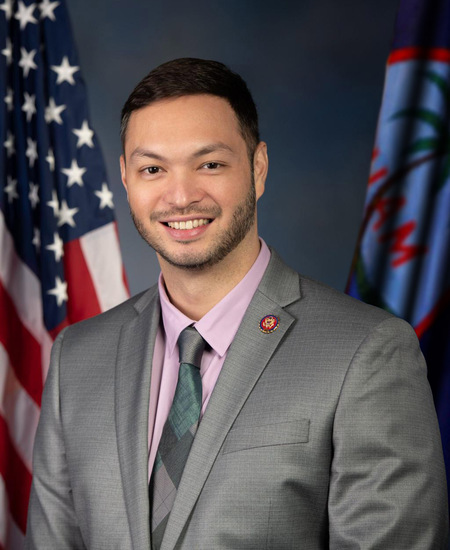
Rep. Michael F. Q. San Nicolas
Sponsored bills
Women Veterans Transitional Residence Utilizing Support and Treatment Act or the Women Veterans TRUST Act This bill requires the Department of Veterans Affairs (VA) to conduct a nationwide analysis of the need for women-specific VA programs that treat and rehabilitate women veterans with drug and alcohol dependency. Based on the findings of the analysis, the VA must implement a women-specific pilot program to treat and rehabilitate women veterans with drug and alcohol dependency.
Commission to Study and Develop Reparation Proposals for African Americans Act This bill establishes the Commission to Study and Develop Reparation Proposals for African Americans. The commission shall examine slavery and discrimination in the colonies and the United States from 1619 to the present and recommend appropriate remedies. The commission shall identify (1) the role of the federal and state governments in supporting the institution of slavery, (2) forms of discrimination in the public and private sectors against freed slaves and their descendants, and (3) lingering negative effects of slavery on living African Americans and society.
Healthy Families Act This bill provides for paid and unpaid sick leave for employees to meet their own medical needs and those of their families. It requires employers with 15 or more employees to provide their employees with at least one hour of earned paid sick leave for every 30 hours worked, up to a maximum of 56 hours of paid sick leave in a year. An employer with fewer than 15 employees may also provide the same amount of paid sick leave, but may opt out of such requirement, in which case such employer must provide its employees at least 56 hours of unpaid leave in a year. An employee may use sick leave for absences (1) resulting from a physical or mental illness, injury or medical condition; (2) resulting from obtaining professional medical diagnosis or care, or preventive medical care; (3) to care for a child, parent, spouse, a domestic partner, or other blood or close relative; and (4) resulting from domestic violence, sexual assault, or stalking. The bill makes it unlawful for any employer to interfere with, restrain, or deny the exercise of an employee's right to accrue sick leave as provided by this bill. An employee may take legal action to enforce the right to sick leave granted by this bill and the Department of Labor must investigate complaints of violations of the requirements of this bill. Labor is authorized to conduct a public awareness campaign to educate and inform the public of the requirements for paid sick leave provided by this bill.

This bill waives through September 30, 2021, the requirement that any recipient of assistance under the Women's Business Center program obtain matching funds from nonfederal sources. Currently, this waiver expires on June 30, 2021. The Women's Business Center program authorizes the Small Business Administration to provide assistance to private, nonprofit organizations to carry out projects for the benefit of small businesses that are owned and controlled by women.
Community Navigator Reporting Act of 2021 This bill requires the Small Business Administration to report annually on the performance and effectiveness of the Community Navigator pilot program, which was established to improve access to assistance programs and resources for small businesses in response to COVID-19 (i.e., coronavirus disease 2019).
Teaching Asian Pacific American History Act This bill requires entities (e.g., institutions of higher education, libraries, and museums), in order to be eligible for certain grants administered by the Department of Education (ED), to include Asian Pacific American history in their teaching of American history. It also requires Asian Pacific American history to be included in tests administered by the National Assessment of Educational Progress (NAEP). Specifically, the bill mandates the inclusion of Asian Pacific American history as a required component of American history for such entities to be eligible for American History and Civics Academies' competitive grants. These grants support the establishment of (1) Presidential Academies for Teachers of American History and Civics, which offer workshops to teachers of American history and civics to strengthen their knowledge and prepare them to teach in these subjects; and (2) Congressional Academies for Students of American History and Civics, which support high school students in developing an understanding of these subjects. (Currently, Asian Pacific American history is not a required component of American history for either academy.) In addition, ED must give priority to grant applicants that align their activities with programs and resources of the Smithsonian Institution's Asian Pacific American Center. The bill also requires the inclusion of Asian Pacific American history in tests administered by the NAEP, which measures student academic achievement in various subjects.
This resolution supports the vision, mission, and goals of the Global Partnership for Education, and it affirms the role of the United States in improving access to quality public education and improved learning outcomes for children and adolescents (particularly for girls) in the poorest countries.
This resolution expresses support for meeting key goals of the 2030 Agenda for Sustainable Development, including achieving gender equality, ending extreme poverty, and improving public health. The resolution also states that the agenda's Sustainable Development Goals form a critical blueprint to end poverty, protect the planet, and ensure that all people can live in peace and prosperity by 2030.
Public Servants Protection and Fairness Act of 2021 This bill establishes an alternative formula to calculate Social Security retirement benefits for those who receive pensions for certain non-covered employment. (The existing formula is known as the windfall elimination provision.) The alternative formula adjusts an individual's total lifetime earnings based on the proportion of covered earnings (i.e., earnings subject to Social Security payroll taxes). It applies to individuals who (1) first become eligible for benefits after 2022, (2) have earnings from non-covered service performed after 1977, and (3) have less than 30 years of coverage (i.e., years in which a beneficiary is considered to have contributed a substantial amount into the Social Security trust funds). Beneficiaries receive the higher benefit amount as calculated under the alternative method or the existing formula. In addition, the bill provides rebates for certain beneficiaries currently impacted by the existing formula. The Social Security Administration must include non-covered earnings in Social Security account statements, and the Government Accountability Office must study the availability of certain information related to retirement plans maintained by state and local governments.